

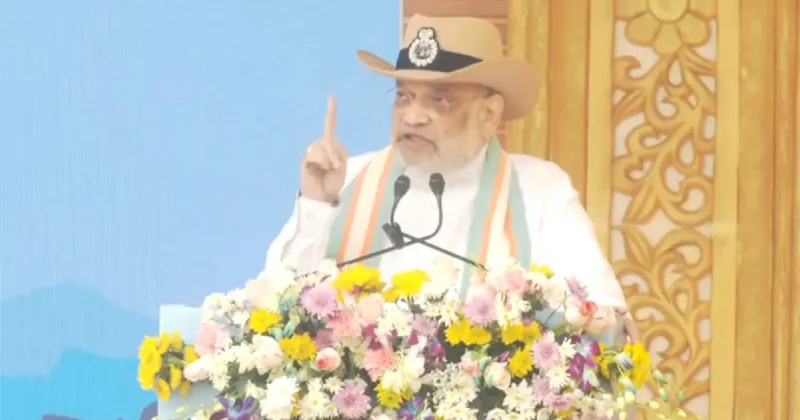
GUWAHATI, Feb 21: Union Home Minister Amit Shah on Saturday asserted that the Naxal problem will be wiped out from the country by March 31, 2026, crediting the Central Reserve Police Force (CRPF) for breaking the backbone of Maoist violence and restoring peace in several troubled regions.
Speaking at the 87th CRPF Day Parade in Guwahati — the first time the event has been held in the Northeast — Shah said he could “rely on the CRPF” and confidently state that Naxalism would be eliminated within the deadline set by the government. He praised the force’s role in Jammu and Kashmir, where he said stone-pelting has come down to zero, in handling ethnic violence in Manipur, and in anti-Maoist operations.
Highlighting the 21-day ‘Operation Black Forest’ in the Karreguta Hills along the Chhattisgarh–Telangana border, Shah recalled how CRPF personnel operated in extreme heat, walking over scorching rocks and losing nearly 15 litres of water a day in sweat, yet managed to clear the area and kill 31 Naxals in April–May 2025. He said such operations had “demolished” Naxal strongholds.
Shah noted that just a decade ago the country faced three “festering wounds” — terrorism in Jammu and Kashmir, Naxalism, and insurgency in the Northeast — but these regions are now emerging as engines of growth and development. He underlined that this transformation would not have been possible without the sacrifices of CRPF personnel, pointing out that 700 jawans laid down their lives in the Northeast, 780 in Naxal-affected areas and 540 in Jammu and Kashmir. In Assam alone, he said, 79 CRPF personnel have been martyred.
Calling it a matter of pride that the CRPF’s foundation day parade was being held in “our Assam” for the first time in its 86-year history, the home minister lauded the force as a “strong pillar” of national security, recalling that 2,270 personnel have made the supreme sacrifice since its inception. He also said that after the abrogation of Article 370, peace was maintained in Jammu and Kashmir without the need to fire a single bullet, with the CRPF playing a key role on the ground.
On the occasion, Shah conferred Gallantry medals on 15 CRPF personnel and President’s Police Medals for Distinguished Service on six others, while trophies were presented to the best-performing battalions.
Earlier, CRPF Director General G P Singh said Operation Black Forest had “broken the back” of Naxalism and echoed the home minister’s confidence that the menace would be eradicated by March 31, 2026.
The ceremonial parade at Guwahati’s Sarusajai Stadium featured eight contingents drawn from across the country, including women personnel, units from various sectors, the Rapid Action Force and the elite CoBRA commandos. The march past, led by Commandant Deepak Dhoundiyal of the 225th Battalion, was followed by precision drills, a simulated hostage-rescue operation and a jungle-warfare demo showcasing anti-Naxal tactics.
The CRPF traces its origins to 1939, when it was raised as the Crown Representative’s Police under British rule. It was renamed the Central Reserve Police Force in 1949 by India’s first Home Minister, Sardar Vallabhbhai Patel.
