

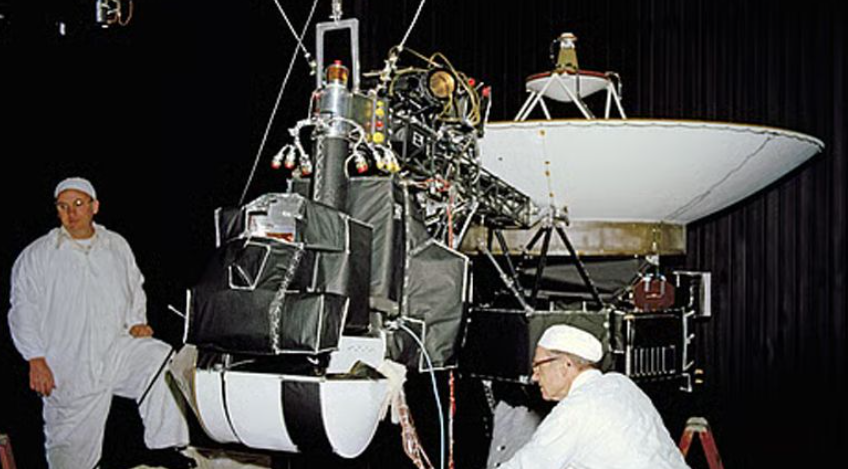
CAPE CANAVERAL, NOVEMBER 15 : NASA’s Voyager 1 spacecraft is approaching a historic milestone as it prepares to become the first human-made object to travel one light-day away from Earth, venturing deeper into interstellar space.
Launched nearly 49 years ago, Voyager 1 is now more than 26 billion kilometres from Earth. Once it reaches the milestone on Wednesday, radio signals travelling at the speed of light will take approximately 24 hours to cover the distance between the spacecraft and Earth.
NASA estimates that Voyager 1 would need another 18,000 years to travel a full light-year and more than twice that time to approach another star.
Voyager project manager Suzanne Dodd described the spacecraft as Earth’s ambassador travelling between the stars while continuing to expand humanity’s understanding of space.
“It’s a national treasure. Really extraordinary,” she told The Associated Press.
To mark the achievement, NASA has encouraged people worldwide to participate in a symbolic tribute by using mobile phone lights or flashlights to create a wave of golden light after sunset on Tuesday. Participants have been asked to use Morse code to spell out “V-G-R”, Voyager’s call sign.
Despite technical challenges associated with their age, both Voyager 1 and its twin Voyager 2 continue to transmit scientific and engineering data while travelling through interstellar space at approximately 61,000 kilometres per hour.
Voyager 1 was launched in 1977, two weeks before Voyager 2. However, its twin is expected to reach the one light-day distance milestone only in 2035.
During its historic journey, Voyager 1 flew past Jupiter in 1979 and Saturn in 1980, capturing valuable scientific observations before leaving the region defined by NASA as the solar system. It entered interstellar space in 2012.
Voyager 2 also explored Jupiter and Saturn, along with Uranus and Neptune, sending back remarkable images and scientific data. It entered interstellar space in 2018.
Both spacecraft continue to provide information about their unexplored surroundings, including magnetic field strength and direction, pressure, dust and galactic cosmic rays.
Dodd, who has worked on the Voyager programme since 1984, compared the spacecraft to weather satellites that continuously collect information about their environment.
A small flight-control team at NASA’s Jet Propulsion Laboratory in Pasadena, California, sends commands to the spacecraft approximately once a week. The team increases its efforts whenever technical problems arise, sometimes receiving assistance from retired engineers who previously worked on the mission.
In September, controllers completed another power-conservation exercise to extend the operational life of the plutonium-powered spacecraft. Communication with Voyager 1 was briefly disrupted in October, and engineers are still investigating the cause.
Voyager 1 has also earned a place in the Guinness World Records as the farthest-travelling human-made object. In 1990, it captured the iconic image of Earth known as the “Pale Blue Dot” from beyond Neptune.
The photograph inspired astronomer Carl Sagan, who was part of the mission’s imaging team, to reflect on Earth’s place in the vast universe, describing the planet as a tiny stage in a much larger cosmic arena.
The Voyager missions also carry a unique message from humanity. Each spacecraft contains a 30-centimetre gold-plated phonographic record, commonly known as the Golden Record, featuring greetings in 55 languages, photographs, diagrams and sounds representing life on Earth.
The record includes the voice of Carl Sagan’s six-year-old son, Nick, saying, “Hello from the children on Planet Earth.” It also carries a stylus and instructions explaining how the record can be played.
Dodd described the Golden Record as a time capsule of life on Earth from 1977, expressing hope that someone might discover it thousands of years in the future.
The Voyager missions continue to stand as one of humanity’s most ambitious space exploration achievements, carrying a message from Earth into the vastness of interstellar space.
