

PROFESSOR JIGAR MOHAMMED
According to Jahangir, “Sultan Zainul Abidin …ruled Kashmir with absolute sway. They (Kashmiris) speak of him as the great Badshah. They tell many strange customs of his. There are many remains and traces of building of his in Kashmir. One of these is in the midst of a lake called Wulur, and of which the length and breadth are more than three or four kos. It is called Zainlanka, and in making it they have exerted greatly. The spring of this lake is very deep. The first time they brought a large quantity of stone in boats and poured it on the place where now the building stands it had no result. At last they sank some thousands of boats with 100 gaz out of the water, and made a terrace, and on one side thereof the sultan erected a temple for the worship of his supreme God. Than this there is no finer place. He (the Sultan) often came to the spot by boat and engaged in worship of the King of Wisdom. They say he spent many ‘forty days’ in that place.” Jahangir also mentions some oral traditions of Kashmir regarding the folk’s perception Zainul Abidin’s methods of making a person dutiful and God-fearing through peaceful means. He quotes an incident narrated by some people of Kashmir. According to him, “One day a wicked son of his (Zainul Abidin) came to that place to kill him, and finding him alone, drew a sword and went in. When his eyes fell on the Sultan, however, on account of his venerable dignity and the might of his virtues, he became confused and bewildered and turned away.
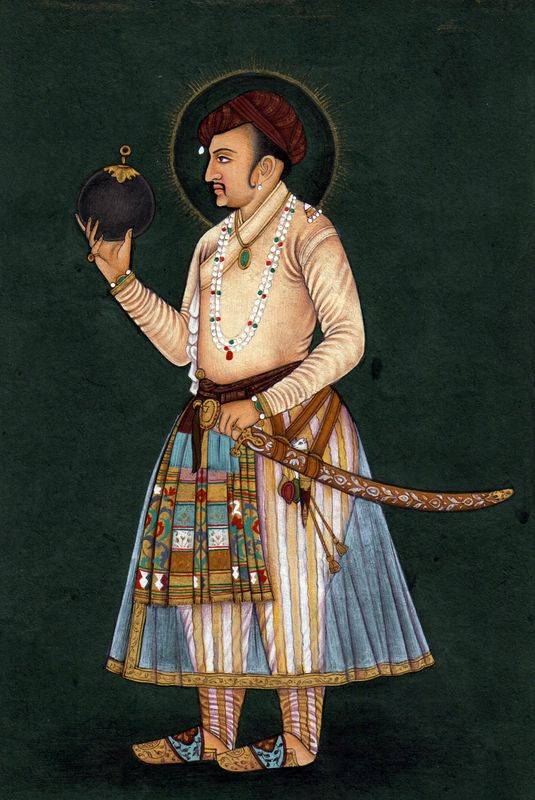
The Mughal emperor Nuruddin Muhammed Jahangir (1605-27) not only maintained political stability in Kashmir during his reign, but, more significantly, appreciated and articulated cultural features of Kashmir which made it a land of attraction and established it distinct from the rest of the world. In his Memoirs, Tuzuk-i-Jahangiri, he gives huge space to the life and works of the people of Kashmir. His narration of the various features of the socio-economic activities of Kashmir provides huge publicity to people of Kashmir in terms of their contribution to the cultural developments in the region. For him, Kashmir was one of the ancient historical region of the world. He presents the historical events of Kashmir in accordance with both the Kashmiri and his own perceptions. In his Memoirs he mentions Rajtarangini as the source of the history of Kashmir. This establishes that Jahangir was interested to know the people’s history of Kashmir through its own sources. Moreover, he records the oral traditions of Kashmir and use them as sources of his narrations.
Jahangir traces the history of Kashmir from ancient period onwards. Giving the glimpses of the political life of Kashmir, he writes, “In old times the country (Kashmir) was in the possession of Rajas. Their dynasty lasted for 4000 years. An account of them, and a list of their names, are given in the Raj-tarang, which, by my father’s order, was translated from the Sanskrit (Hindi in text) into Persian. In the Hijri year 712 (1312-13) Kashmir was illumined by the religion of Islam. Thirty two Muhammadan princes reigned over it for 282 years, until, in 994 (1586), my father conquered it. From that date till now, being a period of thirty five years, the country has been in the possession of the Crown (Mughal).”
His mention shows that the Mughal emperor found the Kashmiris a politically conscious people and the ruling class of Kashmir gave a it a definite political identity. It is also evident from Jahangir’s mention that before the establishment of Mughal rule in Kashmir, its rulers carried various types of the constructive programme. He was highly impressed with the people perception and build heritage of the Sultan Zainul Abidin (1420-70). For Jahangir, Zainul Abidin’s building works, magnanimity and endurance brought huge social fame and support to him and he became an important theme of the oral traditions of Kashmir.
According to Jahangir, “Sultan Zainul Abidin …ruled Kashmir with absolute sway. They (Kashmiris) speak of him as the great Badshah. They tell many strange customs of his. There are many remains and traces of building of his in Kashmir. One of these is in the midst of a lake called Wulur, and of which the length and breadth are more than three or four kos. It is called Zainlanka, and in making it they have exerted greatly. The spring of this lake is very deep. The first time they brought a large quantity of stone in boats and poured it on the place where now the building stands it had no result. At last they sank some thousands of boats with 100 gaz out of the water, and made a terrace, and on one side thereof the sultan erected a temple for the worship of his supreme God. Than this there is no finer place. He (the Sultan) often came to the spot by boat and engaged in worship of the King of Wisdom. They say he spent many ‘forty days’ in that place.”
Jahangir also mentions some oral traditions of Kashmir regarding the folk’s perception Zainul Abidin’s methods of making a person dutiful and God-fearing through peaceful means.
He quotes an incident narrated by some people of Kashmir. According to him, “One day a wicked son of his (Zainul Abidin) came to that place to kill him, and finding him alone, drew a sword and went in. When his eyes fell on the Sultan, however, on account of his venerable dignity and the might of his virtues, he became confused and bewildered and turned away.
The Sultan shortly after came out and seated himself in the boat with this same son, and started for the city. On the way he said to his son, ” I have forgotten my rosary; get into a canoe and fetch it for me.” The son having gone into the temple sees his father in the same place, and the graceless man with complete shame of face falls at his father’s feet and asks pardon for his fault. They have told many tales of such miracles as this of him, and they say also he had well practised the science of khala (ilm-i-khala-i-badan i.e. withdrawl of soul from the body).
When, from the ways and methods of his sons, he perceived in them signs of haste in seeking for rule and government, he would say to them, “To me it is very easy to abandon rule, and even to pass away from life, but when I am gone you will do nothing and the time of your prosperity will not endure long, but in a short time you will obtain the recompense of your evil deeds and your own dispositions.” Having spoken thus, he gave up eating and drinking , and passed forty days in this manner… On fortieth day he gave up the deposit of his existence, and entered into the mercy of God.”
Jahangir mentions that Zainul Abidin’s sons brought the end of their family through mutual rivalries and conflicts and the persons of Chak tribe replaced the family of Zainul Abidin in terms of political power. For him, the Chaks were the people of common soldiers of Kashmir before their acquisition of the sovereignty of Kashmir.
He also mentions Yaqub Chak’s resistance against the Mughals army in Kashmir, led by Raja Bhagwan Das. His narration shows that establishment of the Mughal rule in Kashmir was resisted by the Chaks for long time. For him, the sultans of Kashmir were the great builders in terms of construction of the bridges, mosques, palace and monasteries. He mentions existence of a beautiful and lofty mosque in Srinagar, built by Sultan Sikandar in 1393 and rebuilt by Sultan Husain in the early sixteenth century.
Jahangir makes sufis, Rishis, artificers, merchants, Brahmans, Sunnis and Shias etc. as important themes of his Memoirs. He mentions that Mir Sayyid Ali (a famous sufi of Kubraviya order) of Hamdan visited Kashmir. His monastery was also established in Srinagar. For Jahangir, majority of the merchants and artificers of Kashmir belonged to Sunni sect and majority of the soldiers belonged to Imamiyya Shia sect.
He also mentions the presence of the Nurbakhshi sect in Kashmir. Jahangir found the Rishis as the most contented persons and actively engaged in the public welfare activities in Kashmir. Describing the characteristics of the Rishi of Kashmir he writes: “There is also a body of Faqirs whom they call Rishis. Though they have not religious knowledge or learning of any sort, yet they possess simplicity, and are without pretence. They abuse no one, they restrain the tongue of desire, and the foot of seeking; they eat no flesh, they have no wives, always plant fruit-bearing tree in the fields, so that men may benefit by them, themselves deriving no advantage. There are about 2000 of these people.”
It is important to mention that the Rishis believed in the mysticism and spread the concept of the Unity of Being. Nuruddin or Nand Rishi was popular among both the Hindus and Muslims of Kashmir being propagator of the welfare of all. Jahangir’s mention shows that the Rishis works received huge social support in Kashmir. Jahangir was very much impressed from the Brahmans of Kashmir in terms their knowledge and sincerity to their religious practice. He also found some very attractive temples in Kashmir. He records the cultural identity of the Kashmiri Brahmans and their temples in these words: “There is also a body of Brahmans living from of old in this country, who still remain there and talk in the Kashmiri tongue.
Outwardly on cannot distinguish them from Musalmans. They have, however, books in the Sanskrit language, and read them. They carry into practice whatever relates to the worship of idols. Sanskrit is a language in which the learned of India have composed books, and esteem them greatly. The lofty temples which were built before the manifestation of Islam are still in existence, and are all built of stones, which from foundation to roof are large, and weigh 30 or 40 maunds, placed one on the other. Near the city there is a small hill which they call Kuh-i-Maran as well as Hari Parbat. On the east side of the hill there is the Dal lake, which measures round a little more than 6.50 koss. My father (may the lights of Allah be his testimony!) gave an order that they should build in this place a very strong fort of stone and lime; this has been nearly completed during the reign of this supplicant, so that the little hill has been brought into the midst of the fortifications, and the wall of the fort built round it. The lake is close to the fort, and the palace overlooks the water…At this period it appeared to me to be very much out of order and ruinous. As it was the place where that veritable qibla (place turned towards in prayer) and visible Deity used to sit, and it is really a place of prostration for this suppliant, therefore its neglected state did not appear right to me. I (Jahangir) ordered Mutamid K. who is a servant who knows my temperament to make every effort to put little garden in order and repair the buildings.” Jahangir observed the food habits, dress and crops of Kashmir very minutely. He not only records them in his Memoirs in accordance with local perception but also makes his own comments on them. For him, the Kashmiris produced multiple crops. But he found rice as the major staple crop of Kashmir. His narration of the rice shows that Jahangir collected huge information regarding its use in Kashmir.
According to him, “Rice is the principal crop. Probably there are three parts (of Kashmir) under rice and one under all other grains. The chief food of the people of Kashmir is rice, but it is inferior. They boil it fresh and allow it to get cold, and then eat it, and call it batha. It is not usual to take their food warm, but people of small means keep a portion of the batha for a night, and eat it next day.” Jahangir also witnessed the use of both vegetables and meat in Kashmir. But both the vegetable and meat were prepared in a way which did not suit to his own taste. Commenting on the use of rice with vegetable in Kashmir Jahangir writes, “It is not custom (in Kashmir) to put salt into the batha. They boil vegetable in water, and throw in a little salt in order to alter the flavour, and then eat them along with the batha. Those who want something tasty put a little walnut-oil into the vegetables. Walnut oil soon becomes bitter and evil flavoured. They also use cow-oil (raughan-i.e. ghi), but this taken fresh, and fresh from newly made butter (maska).
They threw it into the food, and call it “sada-pak” in the Kashmiri language. As the atmosphere is cold and damp, it becomes altered by being kept for three or four days.” Jahangir also found various types of pickles made in Kashmir. For him, garlic pickle was the best. But the peas and wheat of Kashmir were of inferior quality.
Regarding the quality of wheat and its use Jahangir writes, “The wheat is small and of little substance (kam maghz). It is not the custom to eat bread (nan).” He mentions the use of the flesh of sheep (handu) and some birds such as fowls, geese and ducks. Jahangir mentions the availability of various kinds of fishes with both the scales and without scales. Jahangir witnessed a method of fishing which was peculiar to Kashmir. He gives a long description of the fishing in Kashmir.
He records the fishing of Kashmir in a very interesting manner. According to him, “…I saw an unusual kind of fishing on the part of the fishermen of Kashmir. In a place where the water was up to a man’s chest, they propelled two boats that were side by side, and so that at one end they were in contact, and at the other end they were 14 or 15 yards apart.
Two boatmen held long poles in their hands, and sat on the outside edge of each boat so as to regulate the space between each boat, and they should proceed equally. Then ten or twelve boatmen got down into the water, and laying hold of the ends of the two boats that were joined together with their hands, trampled the bottom with their feet, and moved on. The fish which were between the boats wanted to get out of the narrow space, and came against the feet of the boatmen. Immediately one of the boatmen dived , and another one pressed upon his back and with his two hands kept him coming to the surface.
The latter caught a fish and produced it. Some who are expert in the art catch two fish with their hands, and bring them to the surface. Among them was an old boatman, who generally at each dive brought up two fish. This kind of fishing occurs at Panj Brara, and is peculiar to Jhelam. It is not used in ponds or other streams. It also only takes place in the spring when the water is not cold or impetuons (gazanda).”
Jahangir mentions woollen tunic (Kurta) as the most popular dress of the Kashmiris and shawls most precious dress item. He also mentions the climatic factors behind the use of these woollen dresses. According to him, ” Men and women wear a woollen tunic (kurta), and call it pattu. If they do not put on a time, they (Kashmiris) believe that the air affects them, and even it is impossible to digest their food without it.” Kashmir’s pashmina shawls are very much appreciated by Jahangir. Though he does not mention the term pashmina, his description of shawls from two types wools, one from Tibet and another from local Kashmiri wool (pattu), shows that Pashmina shawls were most precious. Describing the different kinds of shawls, woven in Kashmir, Jahangir writes, “The shawls of Kashmir to which my father (Akbar) gave the name of parm-narm, are very famous; there is no need to praise them. Another kind is tahrma (naharma); it is thicker than a shawl and soft. Another is called darma. It is like a jul-i-khirsak, and is put over carpets. With the exception of shawls they make woollen materials better in Tibet. Though they bring the wool for the shawls from Tibet, they do not make them there. The wool for shawls comes from a goat which is peculiar to Tibet. In Kashmir they weave the pattu shawl from wool, and sewing two shaws together they smooth them into kind of saqarlat (broad-cloth), which is not bad for a rain-coat.” Jahangir also mentions that generally the men of Kashmir shaved their head and wore a round turban. Jahangir records the music as a dominant means of recreation in Kashmir. He mentions several musical instruments such as lutes, dulcimers, harps, drums flutes and Kashmir were very experts in play with them. For Jahangir, the Kashmiris used to sing in Kashmiri language compositions and musicians and singers were able to combine two or three modes together, even many of them were skill in chorus.
Jahangir preserves some of the local customs of Kashmir in his Memoirs. One of these customs was the lighting of lamps on the bank of Jhelam river. He describes this custom in these words; “…the Kashmiris had lined with lamps both sides of the Bihat.
It is an ancient custom that every year on this day everyone, whether rich or poor, whoever has a house on the bank of the river, should light as on the Shab-i-barat. I (Jahangir) asked the Brahmans the reason of this, and they said that on this day the fountain-head of the Jhelam was disclosed, and the custom had come down from old days that on this date must take place the feast of Veth tarwah. Veth means the Jhelam and they call thirteen tarwah; as this day is the 13th of Shawwal, they light lamps. In this way they call it Veth tarwah. Undoubtedly the lamp-lighting was good. I (Jahangir) sat in a boat and went round to see it.”
Jahangir’s narration of the historical events of Kashmir pertaining to its people shows the Mughal emperor’s policy of integration of the region with the Mughal empire. He tried to establish that he was concerned with the local issues and sentiments of the people of Kashmir.
His Tuzuk-i-Jahangiri helps to understand the nature of Kashmiri society in the 17th century. The description of the distinct social groups and their beliefs also show that Kashmiri culture was one of the well-established cultural identities of the Mughal empire and their preservation and propagation were instrumental in associating the Kashmiris with the different socio-political and economic aspects of Mughal India.
