

“The present bureaucratic setup, while efficient in moving files, struggles to understand daily Ladakh life. This has led to planning that feels distant, uniform, and sometimes misplaced.”
Shivang Satya Gupta
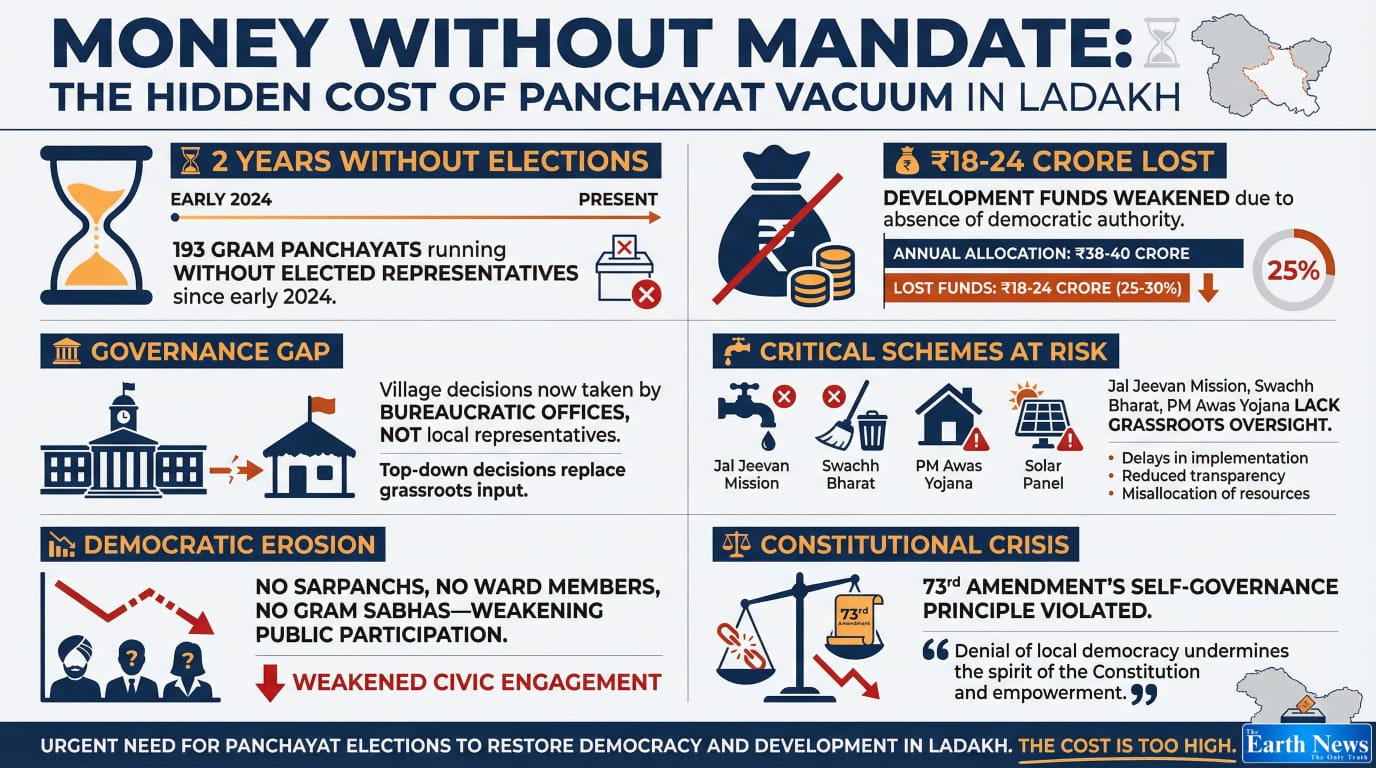
For nearly two years, the Union Territory of Ladakh has been running without elected village panchayats. Pertinently, the terms of the panchayat bodies elected in 2018 ended in early 2024, but fresh elections have not yet taken place. In a UT where grassroots democracy was meant to be the backbone of governance, this long delay has created a quiet but serious gap both democratic and financial.
On paper, the Panchayati Raj in Ladakh system still exists. All 193 gram panchayats—95 in Leh and 98 in Kargil—are listed as active units. Panchayat codes remain valid, online dashboards function, and files continue to move. Yet the heart of the system is missing. There are no elected sarpanchs, no ward members, and no Gram Sabhas led by village representatives. What remains is governance by procedure, not by people.
This gap has slowly changed how decisions are made.
In the absence of elected panchayats, authority has moved upward into the hands of the bureaucracy. Decisions that once came from village discussions—what work is urgent, which hamlet needs support, how limited funds should be spent—are now taken mostly at block or district offices. Officers may act with sincerity, but administration cannot replace local wisdom.
Ladakh’s terrain makes this problem sharper. Needs vary greatly between Changthang, Zanskar, Nubra, Suru and Sham. A centrally planned solution may look neat on paper, but it often fails to reflect ground realities. The present bureaucratic setup, while efficient in moving files, struggles to understand daily Ladakh life. This has led to planning that feels distant, uniform, and sometimes misplaced.
The most serious impact of this panchayat vacuum is financial and it often goes unnoticed because it is hidden inside budget figures.
Under the Fifteenth Finance Commission, every gram panchayat receives annual grants for basic services like drinking water, sanitation, waste management, village roads and lighting. For Ladakh’s 193 panchayats, this amounts to roughly ₹38–40 crore every year.
Without elected bodies, these funds face several problems. Money meant for panchayat accounts is often delayed, held at higher levels, or spent through departments without village approval. Since gram sabha resolutions are missing, fund use becomes weak and mechanical. In many cases, money is not fully used, which risks future cuts or reallocation.
A cautious estimate shows that nearly 25-30 per cent of these funds—₹9-12 crore every year—are effectively lost or weakened. Over two years, this adds up to ₹18-24 crore of development that never truly reaches villages. This is not corruption in the usual sense, but a loss caused by the absence of democratic authority.
This situation exists at a time when Ladakh is being promoted as a “saturation” Union Territory for major Central schemes such as Jal Jeevan Mission (JJM), Swachh Bharat Mission (Gramin), PM Awas Yojana, Ayushman Bharat, PM Surya Ghar and PM Vishwakarma.
These schemes depend heavily on village involvement. But without elected panchayats, village planning becomes a formality. Gram Panchayat Development Plans are prepared by officials, not debated by villagers. Assets like water tanks, drains and village paths are created without strong local ownership. As a result, maintenance suffers and assets fail earlier than expected.
In JJM alone, weak village oversight risks crores worth of infrastructure underperforming. The loss does not appear as unused money, but as broken taps, leaking pipes and delayed repairs. The bureaucratic system, designed for control and compliance, is not built for daily follow-up at the village level.
Beyond schemes and budgets, the everyday cost of this setup is felt by common Ladakhis. Earlier, the sarpanch was the first door for grievances. Today, Ladakhis must approach block offices or departments—places that are administrative, not accountable. Remote hamlets suffer the most, as visibility often decides priority in bureaucratic systems.
More worrying is the slow erosion of democratic habits. Gram sabhas were meant to teach participation, debate and collective decision-making. Two years without them has weakened public engagement, especially among young voters who are learning to see governance as something distant and imposed.
The 73rd Constitutional Amendment clearly defined panchayats as institutions of self-government, not extensions of the bureaucracy. When Ladakh became a UT in 2019, Ladakhis expected stronger local democracy backed by better Central support. That expectation remains unfulfilled.
The present bureaucratic setup in Ladakh may be well-structured, rule-bound and efficient on paper, but it lacks a human anchor. Administration without elected representatives creates development without ownership. Files may move faster, but trust moves slower and trust is vital in a sensitive border region like Ladakh.
Panchayat elections are not a procedural formality. They are a constitutional need. Restoring elected village bodies would improve fund use, strengthen scheme results, bring accountability closer to Ladakhis, and revive democratic participation at the grassroots.
Until then, Ladakh risks becoming a region governed well on paper but weak on the ground—a democracy with budgets, but without villages.
For a land that stands at both India’s strategic and democratic frontiers, this is a cost the system can no longer afford to ignore.
