

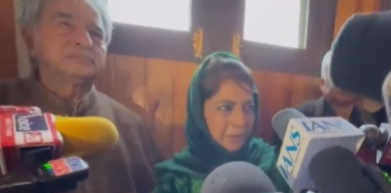
Khanbal, J&K, Feb 26: PDP chief Mehbooba Mufti launched a sharp attack on Prime Minister Narendra Modi’s ongoing visit to Israel today, accusing him of embracing a global pariah amid heightened international criticism of Israeli leadership.
In remarks captured on video from Khanbal in south Kashmir, Mufti didn’t hold back: “PM went and hugged a criminal. He (Benjamin Netanyahu) has been shunned by the world, banned from entering many countries.” Her comments underscore deepening domestic political divides over India’s foreign policy, particularly its steadfast support for Israel despite global backlash over Gaza operations.
Mufti’s outburst comes as Modi tours Israeli tech exhibitions and courts investments, reinforcing bilateral ties forged stronger post-October 2023 Hamas attacks. Netanyahu recently praised Modi as “more than a friend” for India’s unwavering backing, including defense deals and UN votes shielding Israel. Yet, for opposition voices like Mufti—whose PDP has historically championed softer lines on regional issues—this embrace signals misplaced priorities.
The timing amplifies tensions: Just days ago, India rebuked Pakistan’s “la-la land” propaganda at the UNHRC on J&K, while VP Radhakrishnan hailed the Valley’s “new era of peace.” Mufti’s critique taps into a narrative questioning if New Delhi’s Israel outreach neglects Palestinian concerns or J&K’s own sensitivities.
As CM Omar Abdullah and LG Manoj Sinha share stages at Kashmir University’s convocation with VP Radhakrishnan, Mufti’s solo broadside highlights PDP’s opposition role in the newly elected assembly. Her party, once in coalition with BJP, now positions itself as a vocal critic, blending local grievances with global flashpoints.
Critics like Mufti argue Netanyahu faces ICC warrants and travel bans in parts of Europe and the Global South, framing Modi’s hug as diplomatic tone-deafness. Supporters counter that India’s Israel ties—spanning drones, cybersecurity, and agri-tech—bolster security amid Pakistan threats, as echoed by Western Command’s Lt Gen Katiyar warning of “harsher” responses to aggression.
This isn’t isolated: Mufti’s past critiques of Article 370 abrogation and security ops now extend outward, potentially rallying PDP’s base ahead of local polls. Yet, with J&K logging record tourism, investments, and normalcy, her words risk clashing against ground realities of peace dividends.
As Modi’s Israel engagements continue—inviting firms to invest in India—the episode spotlights the tightrope: balancing strategic alliances with domestic optics in a polarized landscape. For Mufti, it’s personal: “Hugging a criminal” won’t erase what she sees as eroded trust.
