

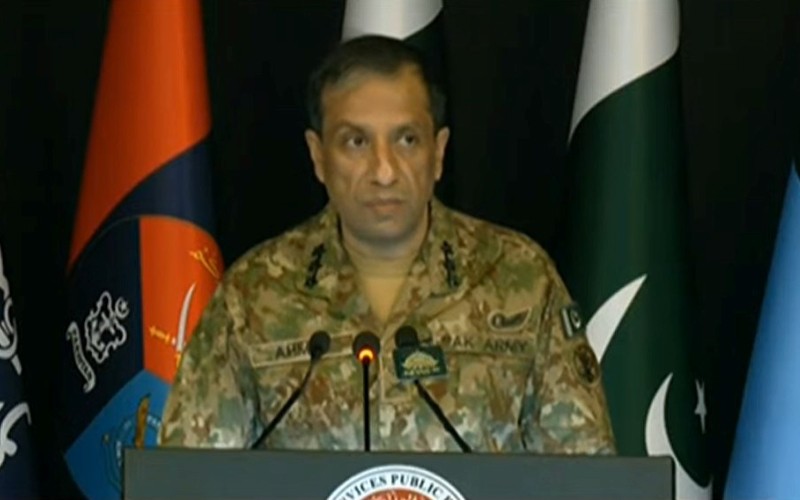
PAKISTAN JAN 08 : Pakistan Army spokesperson Lieutenant General Ahmed Sharif Chaudhry has triggered widespread controversy after issuing threats to India in a colloquial and mocking tone during a recent press conference, abandoning standard military and diplomatic language for what observers described as taunting rhetoric.
The Director General of Pakistan’s Inter-Services Public Relations (ISPR) used the phrase “Mazaa na karaya toh paise vaapis” (If you don’t enjoy it, money back) while warning India, a statement that quickly went viral on social media and drew sharp criticism for its unprofessional nature. The remarks represent a visible departure from conventional military briefings and have raised questions about Pakistan’s strategic messaging amid heightened regional tensions.
During the January 6, 2026 briefing in Rawalpindi, Chaudhry claimed that India would “never accept Pakistan’s existence” and asserted that how the year 2026 unfolds would depend on Pakistan’s response. He insisted that the country’s political and military leadership had “complete clarity” on the issue, reiterating a familiar narrative by describing Pakistan as a “gift of God”.
“How the year 2026 will be will depend on how we stand, how we react. The will of our opponent is clear. India will not accept your existence. It is saying that the enemy of my enemy is my friend,” Chaudhry claimed, alleging an India-Afghanistan nexus working against Islamabad.
The ISPR chief made several controversial statements during the briefing, including an apparent acknowledgment of Pakistani casualties in military operations. “India carried out attacks and killed Pakistanis, and we also killed our own citizens. We didn’t carry out attacks in Afghanistan to kill Afghans; we killed Pakistanis,” he stated, in comments that appeared to reference regional security dynamics.
Chaudhry further claimed that Pakistan would need to become a “hard state” in 2026 and asserted that whether adversaries approach “from above or below, from the right or left, alone or together,” they would be dealt with. He stated that Pakistan is prepared to confront threats from both India and Afghanistan, underscoring rising tensions in the region.
The briefing included details and images of Pakistani soldiers allegedly killed during the India-Pakistan escalation that followed the Pahalgam terror attack in Jammu and Kashmir, which claimed the lives of 26 Indian civilians in April 2025 and led to India’s launch of Operation Sindoor. India attributed the Pahalgam attack to Pakistan, which denied any involvement, leading to a series of missile and drone strikes between both nations over four days before a ceasefire was brokered.
A US defense report from May 2025 noted that Pakistan regards India as an “existential threat” and is continuing to pursue military modernization efforts, including the development of battlefield nuclear weapons. The Council on Foreign Relations has warned that Pakistan’s disputes with India and Afghanistan could escalate into armed conflict in 2026, placing South Asia among the world’s most dangerous flashpoints.
India has repeatedly refuted Pakistan’s charge that the Afghan Taliban is “fighting a proxy war” on behalf of New Delhi, stating that it is an old practice of Pakistan to blame its neighbors for its internal failures. Indian officials have not issued formal responses to Chaudhry’s latest provocative remarks.
This is not the first time Chaudhry has drawn attention for unprofessional behavior during media interactions. Last month, the ISPR chief was criticized for winking at a female journalist during a press conference when she pressed him on allegations against jailed former Prime Minister Imran Khan.
The latest remarks have sparked widespread ridicule and criticism on social media, with observers noting that the language and tone are inappropriate for a senior military official representing a nuclear-armed nation.
