Close Menu
  • Home
  • Latest Stories
  • Inking The Truth
  • Jammu & Kashmir
  • Ladakh
  • Entertainment
  • National
  • International
What's Hot

PM Modi departs from Philippines after concluding two-day visit

Yasha Mudgal reviews PACS computerisation, CAPEX expenditure; stresses timely execution

JK Migrant Deputation, Several other delegations call on Sagar

Facebook X (Twitter) Instagram
Wednesday, November 18
  • About
  • Contact us
  • Advertise With Us
  • Privacy Policy
Facebook X (Twitter) Instagram YouTube
The Earth News
E-Paper Edition
  • Home
  • Latest Stories

    PM Modi departs from Philippines after concluding two-day visit

    November 17, 2026

    Yasha Mudgal reviews PACS computerisation, CAPEX expenditure; stresses timely execution

    November 17, 2026

    JK Migrant Deputation, Several other delegations call on Sagar

    November 17, 2026

    CM Suvendu warns against conspiracies against India, says govt will not tolerate violence, lawlessness

    November 17, 2026

    MLA Mankotia calls upon Union Home Minister Amit Shah in New Delhi

    November 17, 2026
  • Inking The Truth

    Ladakh’s Polls 2026: Let facts guide the calendar

    November 11, 2026

    Karan Singh and historical ‘stakes’ of the Gor meeting

    November 9, 2026

    More Schemes, Where Are Results?

    October 17, 2026

    J&K before 2019 to be made JLK

    October 14, 2026

    Democracy on Banner, Politics on the Agenda

    October 12, 2026
  • Jammu & Kashmir

    Yasha Mudgal reviews PACS computerisation, CAPEX expenditure; stresses timely execution

    November 17, 2026

    JK Migrant Deputation, Several other delegations call on Sagar

    November 17, 2026

    MLA Mankotia calls upon Union Home Minister Amit Shah in New Delhi

    November 17, 2026

    JMC Comm Inspects Wards 20, 21, 22; Reviews Devp Works, Interacts with Public

    November 17, 2026

    BJP holds meeting of All Cells, focusses grassroots strengthening, reviews organizational programmes

    November 17, 2026
  • Ladakh

    Ladakh’s Black-Necked Crane Population Rises 25%, Reaches 108 in 2026

    November 17, 2026

    Centre Likely to Hold Talks with Ladakh Leaders After Hill Council Polls, Says LAB Chairman

    November 15, 2026

    Ladakh Gets Major Water Security Boost as LG Approves 97 More Ponds Under Project Amrit Sarovar

    November 15, 2026

    Ladakh Gets Major Water Security Boost as LG Approves 97 New Ponds Under Project Amrit Sarovar

    November 15, 2026

    LG Saxena Inaugurates Ladakh Pavilion at India International Trade Fair 2026

    November 14, 2026
  • Entertainment

    ‘Ramayana’ Enters Rs 1,000 Crore Club, Becomes 11th Indian Film To Achieve Milestone

    November 13, 2026

    ‘Ramayana’ records 91.5 per cent jump on day 5, worldwide gross reaches Rs 673.90 crore

    November 10, 2026

    Havan-Yagna Marks Conclusion of Two-Day Shri Bala Devi Balhama Yatra

    October 18, 2026

    Rajinikanth’s ‘Jailer 2’ Collects ₹210.65 Crore Worldwide in Two Days

    October 17, 2026

    Pranav Abrol wins ‘Mr. Jammu’ and ‘Mr. Perfect’ titles at Mr India Super Model 2026 – Season 14

    October 6, 2026
  • Features Stories

    When Artificial Intelligence Becomes a Double-Edged Sword: Cyberattacks, Software Failures and the Growing Fragility of the Digital World

    November 17, 2026

    500 SPOs of J&K Police martyred, 34000 in service

    November 16, 2026

    When AI Writes the Code, Who Takes Responsibility When the World Goes Offline?

    November 13, 2026

    Manoj Sinha May Return to Modi Cabinet; Who Could Be the Next Lieutenant Governor of Jammu & Kashmir?

    November 12, 2026

    Beijing’s Slum Swap: China Turns Dhaka into Delhi in Baffling Propaganda Farce

    November 12, 2026
  • More
    • National
    • International
The Earth News
  • Home
  • Latest Stories
  • Inking The Truth
  • Jammu & Kashmir
  • Ladakh
  • Entertainment
  • National
  • International
Features Stories

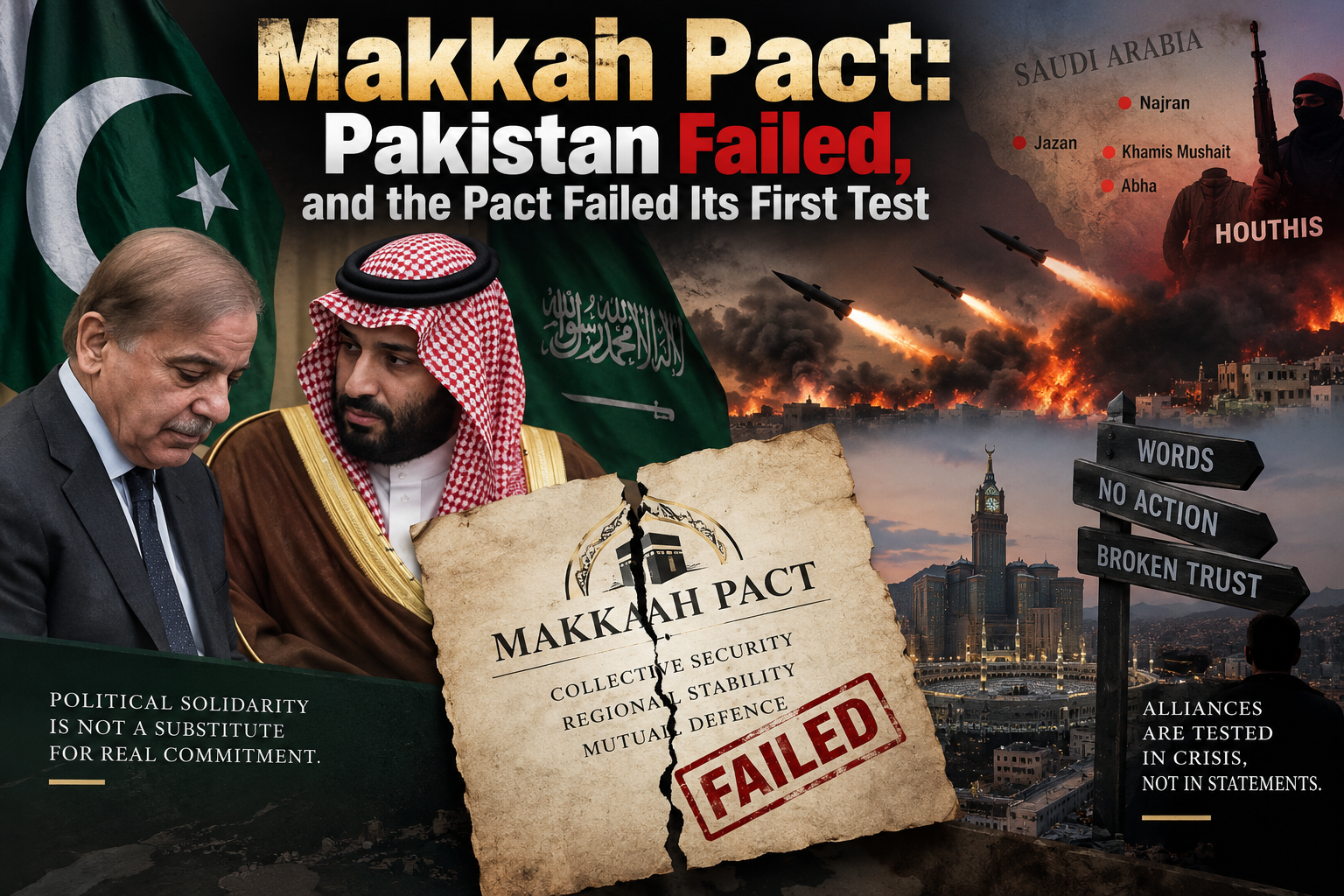
Makkah Pact: Pakistan Failed, and the Pact Failed Its First Test

Earth News NetworkBy Earth News NetworkSeptember 13, 2026No Comments5 Mins Read
Share Facebook Twitter Pinterest Copy Link Telegram LinkedIn Tumblr Email
Share
Facebook Twitter LinkedIn Pinterest Email

By Ravish Handoo

Pakistan’s response to Houthi attacks on Saudi Arabia has exposed a fundamental question over the practical value of the Makkah Pact: how far is Islamabad prepared to go when the security of a partner is directly threatened?
For an agreement presented around the principle that an attack on one member should concern all members, Pakistan’s conduct has so far been notably cautious. Islamabad has condemned the attacks, warned the Houthis that aggression against Saudi Arabia could invoke the pact, and reaffirmed its support for Riyadh. But it has also made clear that no military response is currently under discussion.
That distinction is important. From an Indian geopolitical perspective, the episode highlights the difference between political solidarity and operational collective defence. The former is relatively easy to demonstrate through statements and diplomatic support. The latter requires governments to accept military, financial and political risks.
Saudi Arabia has faced Houthi missile and drone attacks affecting areas including Abha, Khamis Mushait, Jazan and Najran. Pakistan has described some of the attacks as targeting Saudi civilian and economic sites and has publicly condemned them.
On September 8, Islamabad warned the Houthis that an attack on Saudi Arabia could trigger the pact’s collective-defence principle. The statement appeared to give substance to the idea that the security of one member could become a concern for the others.
But Pakistan subsequently clarified that military action was not being discussed.
That qualification has exposed the central ambiguity surrounding the arrangement. If the pact is primarily a political commitment, Islamabad’s response is consistent with a conventional diplomatic posture. If it is intended to function as a genuine collective-defence mechanism, however, the absence of any announced military contribution raises questions about how the commitment would work during a serious conflict.
The issue matters beyond the immediate Houthi crisis because Pakistan has sought to use its relationships with Saudi Arabia and Türkiye to enhance its strategic position. A broader security framework could, in theory, give Islamabad greater diplomatic weight and strengthen its role in the Muslim world.
But alliances do not eliminate national interests. Saudi Arabia, Türkiye and Pakistan each have their own security priorities, economic considerations and regional relationships. None can be assumed to accept unlimited military obligations simply because of political alignment.
Pakistan’s position becomes even more complicated in the event of a wider Saudi-Iran confrontation.
Islamabad shares a border with Iran and has strong reasons to avoid direct military confrontation with Tehran. A decision to fight Iran in defence of Saudi Arabia would carry consequences for Pakistan’s own border security, economy and regional diplomacy.
This is where the Makkah Pact faces its more difficult credibility test. The question is not whether Pakistan supports Saudi Arabia politically. It clearly does. The question is whether Islamabad would accept the costs of military intervention if Saudi Arabia faced a sufficiently serious threat.
So far, the answer remains unclear.
For India, that ambiguity is strategically relevant. Pakistan has traditionally sought political and diplomatic support from friendly Muslim-majority states, particularly when dealing with disputes involving India. But the logic of collective security also imposes obligations on the country seeking such support.
If Pakistan expects partners to stand behind it during a confrontation, those partners can reasonably be expected to examine Islamabad’s own willingness to assume risks on their behalf. A security arrangement based largely on political declarations is unlikely to provide the same deterrent effect as one backed by clearly understood military commitments.
This does not mean that the Makkah Pact has no strategic significance. Defence cooperation, military relationships and political coordination can have value even without automatic troop deployments. But its practical limits become visible when an actual security crisis arrives.
The Houthi attacks have therefore exposed an uncomfortable asymmetry. Pakistan has invoked the collective-defence principle while simultaneously avoiding any commitment to military action. That may reflect a deliberate effort by Islamabad to preserve its relationship with Saudi Arabia without becoming directly involved in another regional conflict.
From a Pakistani perspective, that may be a rational calculation of national interest. From the standpoint of alliance credibility, however, it creates a problem.
The more expansive the language of collective defence, the greater the expectation that members will demonstrate both the capability and willingness to act when another member is threatened. Diplomatic condemnation alone cannot establish that credibility.
The immediate crisis may pass without requiring Pakistan to make that choice. But the question raised by it will remain: when collective security becomes a real military obligation rather than a political declaration, where exactly does Pakistan draw the line?
Until that question has a clearer answer, the Makkah Pact remains stronger as a framework for political and defence alignment than as a demonstrated collective-security guarantee.
Ravish Handoo is a geopolitical analyst, television commentator, and regular participant in television debates on national and international affairs.

ABHA alliance credibility Collective Defence Collective Security Defence Cooperation geopolitical analysis geopolitical news Gulf security Houthi attacks Houthi attacks Saudi Arabia Houthi drones Houthi missiles Houthis India geopolitical perspective India Pakistan relations International affairs international news Jazan Khamis Mushait Makkah Pact Makkah Pact collective defence Middle East Crisis Middle East Geopolitics Muslim world Najran Pakistan Pakistan Foreign Policy Pakistan Iran Relations Pakistan latest news Pakistan Military Response Pakistan response to Houthi attacks Pakistan Saudi Arabia relations Pakistan Saudi Defence Pact Pakistan Turkey relations Ravish Handoo Regional Security Saudi Arabia Saudi Arabia Iran tensions Saudi Arabia news Saudi Arabia security Saudi Pakistan strategic ties South Asia Geopolitics Türkiye Pakistan relations World News Yemen conflict
Follow on Google News Follow on Flipboard
Share. Facebook Twitter Pinterest LinkedIn Tumblr Email Copy Link
Previous ArticleNHM Employees Enter Day 5 of Agitation as Demands Remain Unresolved
Next Article Director FCS&CA directs crackdown on unfair trade practices
Earth News Network
  • Website

Related Posts

India, Japan to Hold 2+2 Ministerial Dialogue in Tokyo

November 17, 2026

When Artificial Intelligence Becomes a Double-Edged Sword: Cyberattacks, Software Failures and the Growing Fragility of the Digital World

November 17, 2026

India Votes Against UN-OIC Resolution, Accuses Turkiye of Deliberately Excluding New Delhi From Consultations

November 17, 2026

Comments are closed.

Latest Posts

PM Modi departs from Philippines after concluding two-day visit

Yasha Mudgal reviews PACS computerisation, CAPEX expenditure; stresses timely execution

JK Migrant Deputation, Several other delegations call on Sagar

CM Suvendu warns against conspiracies against India, says govt will not tolerate violence, lawlessness

MLA Mankotia calls upon Union Home Minister Amit Shah in New Delhi

JMC Comm Inspects Wards 20, 21, 22; Reviews Devp Works, Interacts with Public

The Earth News
Facebook X (Twitter) Instagram YouTube
  • About
  • Contact us
  • Advertise With Us
  • Privacy Policy
© 2026 Earth news. All Rights Reserved. | Powered by Ideogram Technology Solutions [P] Ltd..

Type above and press Enter to search. Press Esc to cancel.