

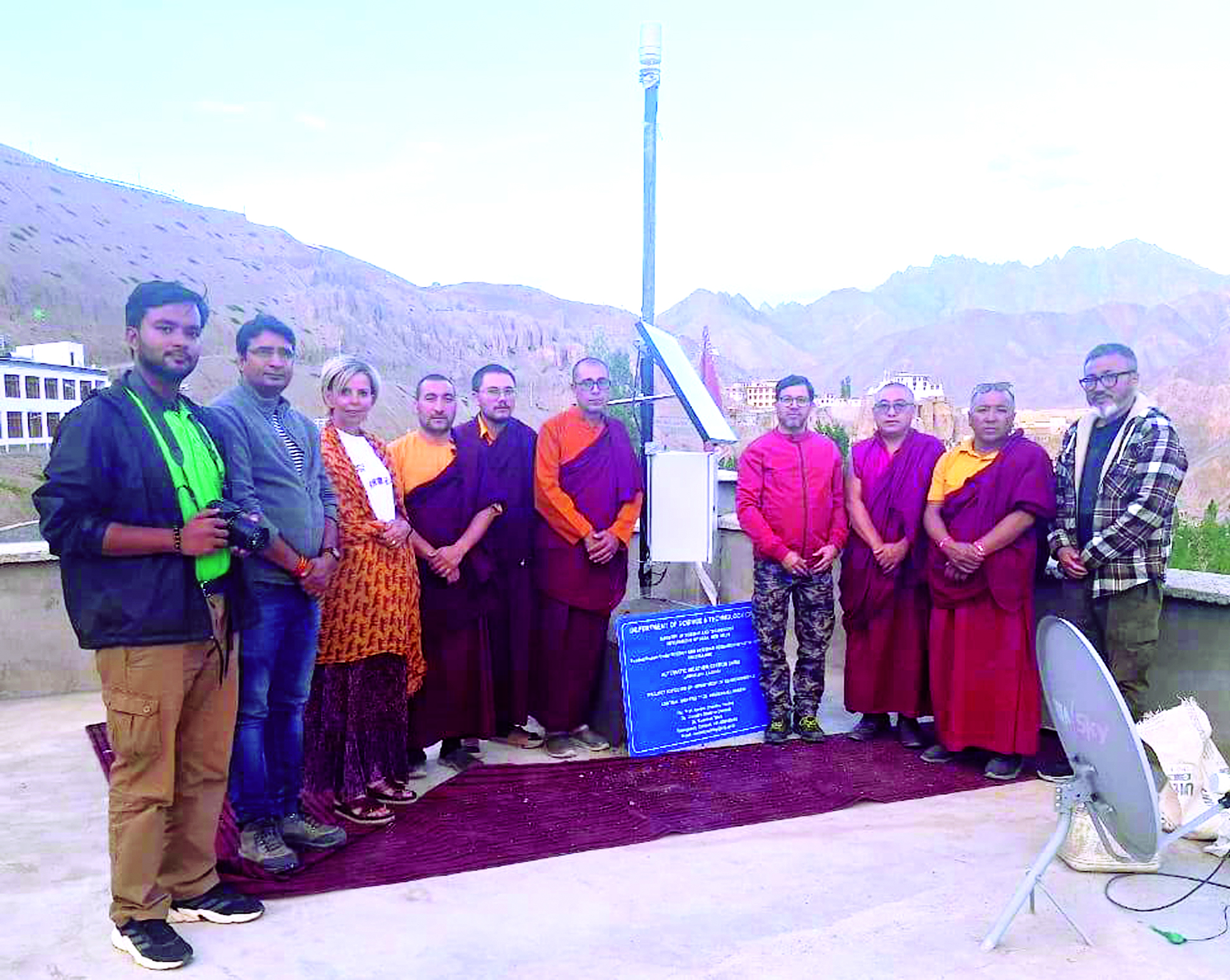
Lamayuru and Zanskar Monasteries get Scientific shield against natural hazards

Lamayuru, Jul 30: A new scientific initiative aimed at preserving Buddhist monasteries in the cold desert region of Ladakh has been launched under the Department of Science and Technology (DST), Government of India. The project, titled “Field based 3D Laser Scanner Structural (Exterior and Interior) Mapping and Monitoring of Buddhist Monasteries for Conservation Planning Incorporating Natural Hazards,” is being carried out under the Science and Heritage Research Initiative (SHRI). It is being implemented by the Department of Geoinformatics at the Central University of Jharkhand, Ranchi.
This project is designed to support sustainable conservation planning for heritage sites in Ladakh. It focuses on creating detailed structural maps—both exterior and interior—of ancient Buddhist monasteries using advanced LIDAR-based 3D laser scanning technology. This will help researchers understand natural hazards and the effects of climate change on these culturally rich structures.
To enhance the study, two Automatic Weather Stations (AWS) have been installed in the region. These are located at Lamayuru Monastery and Karsha Monastery in Zanskar, both situated in the Union Territory of Ladakh. These stations will collect climate data essential for analyzing environmental risks.
On July 29, 2025, the Principal Investigator of the project, Prof. Arvind Chandra Pandey, along with Co-Principal Investigators Dr. Chandra Shekhar Dwivedi and Dr. Konchok Tashi, visited Lamayuru Monastery as part of the fieldwork. The team received a warm welcome from the resident monks, who honored them with a traditional scarf known as “Khatak,” a gesture of respect and hospitality. The visit helped strengthen the collaboration between the research team and the monastery community.
The first weather station has been successfully installed near Lamayuru Monastery, placed on the rooftop of Hotel Grand Moonland. This location was chosen for its safety and open field of view, allowing efficient data collection.
The expected outcomes of the project include better conservation planning and improved preservation of the monasteries. It also aims to promote sustainable development in the region by addressing potential natural hazards. By doing so, the initiative supports the protection of Ladakh’s rich cultural heritage and its surrounding environment.
