

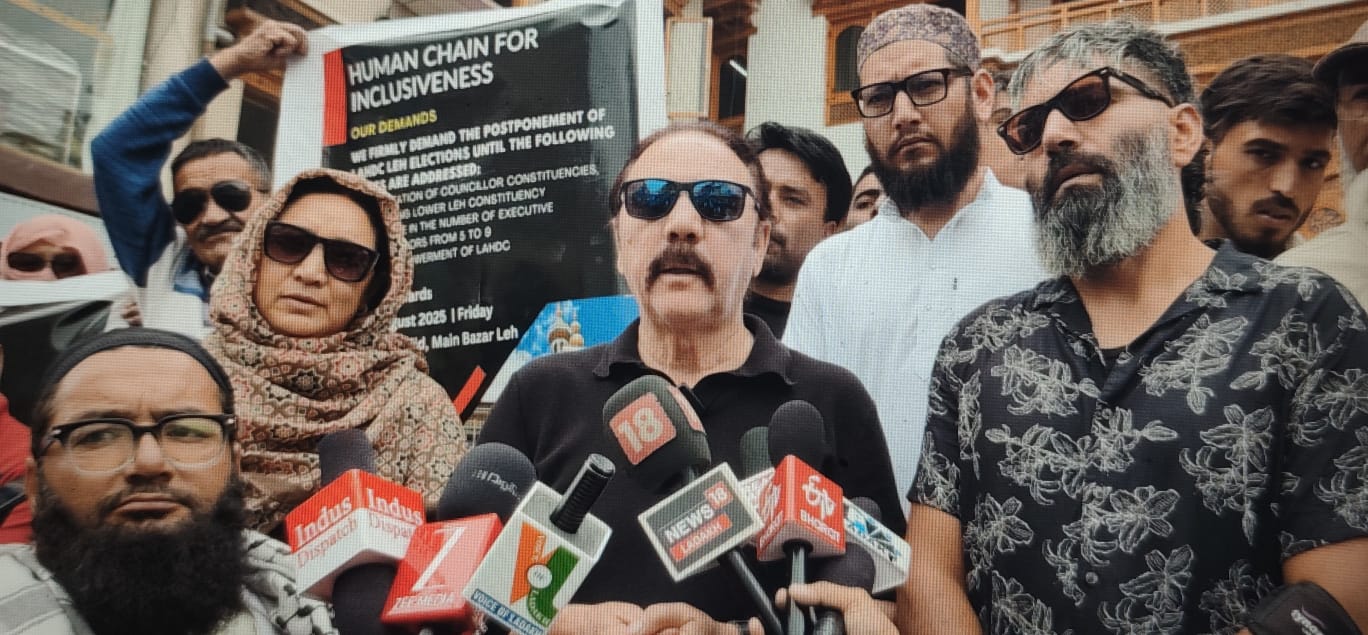
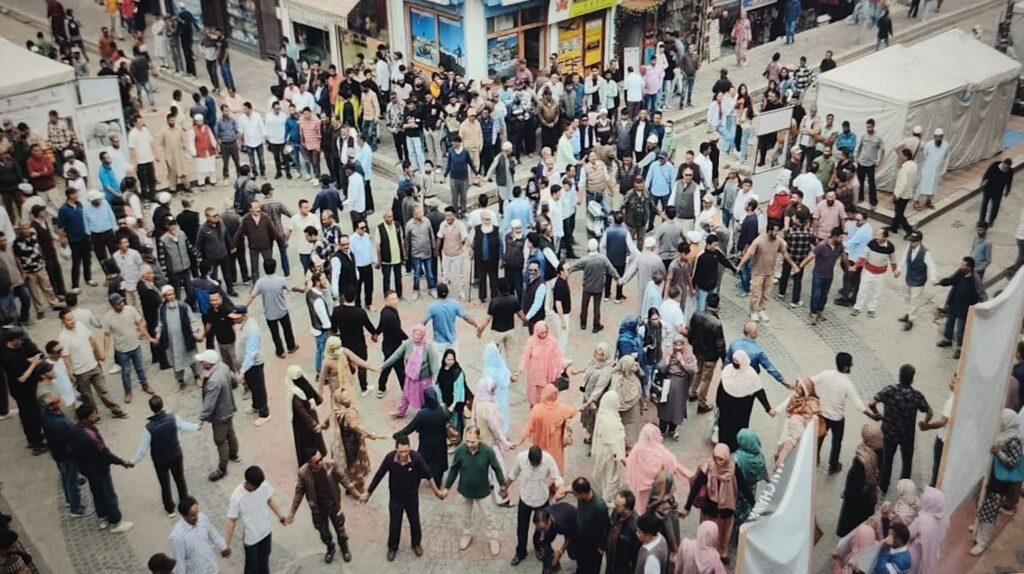
Leh, Aug 01: Dozens of Sunni residents gathered in the heart of Leh’s Main Bazar near Jama Masjid on Friday, forming a human chain to demand fairer political representation in the upcoming Ladakh Autonomous Hill Development Council (LAHDC), Leh elections. The peaceful demonstration, conducted under the banner ‘Human Chain for Inclusiveness,’ aimed to draw attention to what the organisers described as long-standing electoral imbalances and administrative gaps in the region.
The protestors urged authorities to delay the LAHDC Leh elections until pressing concerns—such as the redrawing of constituencies and expansion of council seats—are addressed. A central demand is the creation of new constituencies, particularly for Lower Leh and Central Leh, where representation does not reflect the large number of voters. The community also called for increasing the number of Executive Councillors from five to nine, citing examples from other autonomous councils in India.
Dr. Abdul Qayum, President of Anjuman Moin-ul-Islam, who led the event, explained that the protest was not aligned with any political party but was rooted in democratic ideals. “This human chain is a reflection of shared concern. People from all walks of life came together—young, old, men and women—because everyone deserves a voice,” he said.
Dr. Qayum argued that Ladakh’s administrative model must adapt to reflect its status as a Union Territory. “With five new districts and evolving governance structures, the Hill Council also needs reforms to ensure it is responsive to today’s realities,” he added.
The protestors pointed to what they see as a misalignment between voter strength and representation. Lower Leh, with more than 12,000 voters, is currently represented by just one councillor. Combined with Phyang, which faces a similar issue, nearly 30,000 voters have only three councillors between them. Community members stressed that this disparity affects the equitable distribution of development funds and decision-making authority.
A memorandum listing their demands has been sent to top officials, including the Union Home Minister, Home Secretary, Chief Executive Councillor of Leh, and the Lieutenant Governor of Ladakh. The group is now seeking a meeting with the Lieutenant Governor to further discuss their proposals.
One proposal includes raising the number of total councillors from 26 to 40, following examples like the Bodoland Territorial Council, which accommodates broader regional diversity. The community emphasized that the push for reforms is aimed at inclusion, not community advantage.
“This isn’t about sectarian interests,” Dr. Qayum noted. “It’s about ensuring that no section of the population remains unheard or excluded from local governance.”
He expressed hope in the present Lieutenant Governor’s ability to understand and act on these demands, given his administrative experience in the former Jammu and Kashmir state.
The community has reiterated the demand to hold on the election notification until a transparent and inclusive delimitation exercise is conducted. They insist this would lay the foundation for a more democratic and equitable council in Ladakh. Dr. Qayum remarked, “UT status was a moment of progress after decades. Now, ensuring fair representation must be the next step.”
The organisers plan to continue such peaceful demonstrations—without slogans or confrontations—as a way to keep the conversation alive while maintaining harmony and unity.
