

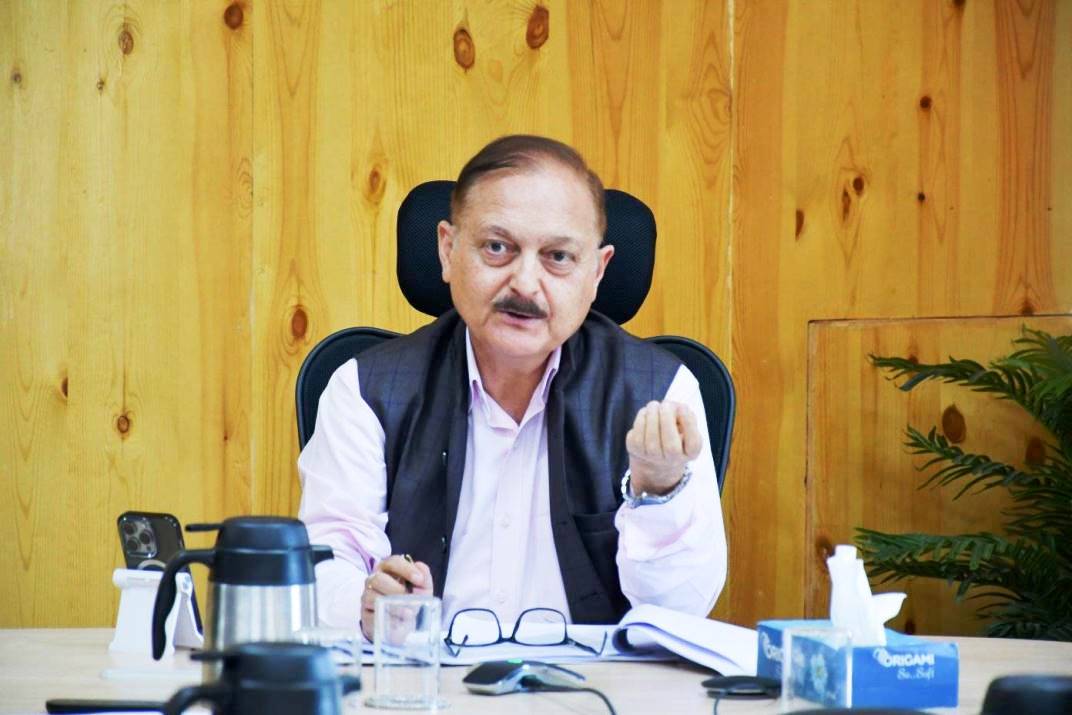
Dr Pawan Kotwal
Chief Secy Ladakh UT
Yash Khajuria
Leh, Jun 28: In what could be termed a major relief for the educated unemployed youth in the Union Territory of Ladakh, the District Staff Selection Recruitment Boards (DSSRBs) of Leh and Kargil have officially been granted clearance to carry out recruitment for district cadre posts. The decision comes after the UT Administration finalized fresh guidelines and aligned the recruitment process with recently amended legal provisions, ensuring strict compliance with domicile and reservation laws.
The clearance paves the way for long-awaited appointments to vacant district-level government posts, bringing hope to thousands of local job seekers. The move follows months of policy reviews and legal revisions aimed at safeguarding Ladakhi identity, equitable representation, and administrative fairness.
Speaking to The Earth News, Chief Secretary of Ladakh UT, Dr. Pawan Kotwal, said that the administration has issued clear directions to the Deputy Commissioners of both Leh and Kargil districts to initiate the recruitment process for district-level staff.
He stated that recruitment had been stalled due to a lack of clarity on key issues such as reservation criteria and cut-off, domicile status, and the Ladakh Resident Certificate. These matters were pending a final decision from the Government of India.
“Now that all these issues have been amicably resolved, the administration has directed officials to fast-track all pending recruitments in the Union Territory,” Dr. Kotwal said.
In the first phase, recruitment is being conducted for non-gazetted, district-level cadre posts. This will be followed by recruitment for state cadre posts by the Ladakh Recruitment Board, and then for gazetted-level posts, for which the administration has already started forwarding recommendations to the Union Public Service Commission (UPSC).
Dr. Kotwal emphasized the government’s commitment to filling all vacant positions in Ladakh UT.
“Since there are no more roadblocks in the recruitment process for both gazetted and non-gazetted jobs, our focus is on conducting the recruitment drive on a fast-track basis to fill all pending posts,” he added.
Meanwhile, as per the updated framework, all recruitments conducted by the DSSRBs must now strictly adhere to domicile requirements, ensuring only genuine residents of Ladakh are eligible for these posts; implement UT-specific reservation policies, particularly ensuring protected representation; use revised operational guidelines issued by the General Administration Department (GAD), based on amendments to the Ladakh Reservation Act and related provisions.
To operationalize this directive, the UT Administration amended several clauses under the Ladakh Reservation Rules and Ladakh Civil Services (Decentralization and Recruitment) Act, adapting provisions from the erstwhile Jammu and Kashmir system while ensuring they meet Ladakh’s unique socio-cultural and geographical needs.
Local civil society groups and student associations have welcomed the move but also called for timely notifications, fair exam schedules, and safeguards against delays.
The DSSRBs of both Leh and Kargil are expected to issue fresh recruitment calendars in the coming weeks. District magistrates, who head the respective boards, have been directed to ensure proper dissemination of guidelines and prompt redressal of grievances.
With this long-awaited green signal, Ladakh is poised to fill critical vacancies in education, health, public works, and revenue departments — a step that promises to strengthen public service delivery and reduce dependency on outsourced or temporary staffing.
Pertinently, the DSSRBs were temporarily restrained from conducting recruitments pending the notification of Ladakh-specific rules after the region was carved out as a Union Territory in 2019. Since then, the administration has been engaged in creating a new legal and governance framework distinct from that of the former Jammu and Kashmir state.
This decision is expected to directly benefit thousands of unemployed youth in Ladakh and is being seen as a vital milestone in the UT’s administrative evolution.
