

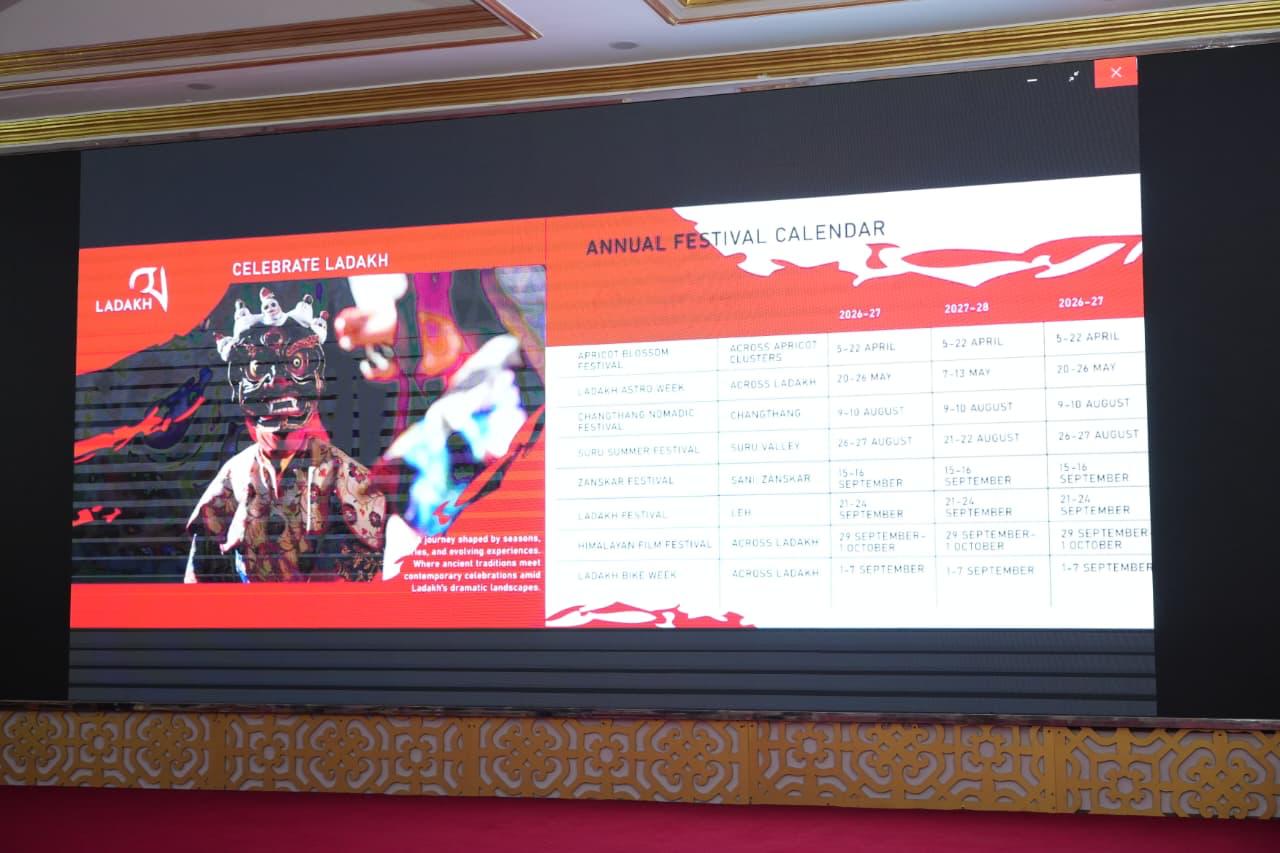
LEH: Marking a major step towards strengthening cultural branding and promoting year-round tourism in the Union Territory, Lieutenant Governor of Ladakh, Kavinder Gupta inaugurated the ‘Celebrate Ladakh’ Tourism Calendar, prepared by the Department of Tourism, UT Ladakh.
On the occasion, the UT Administration also announced the declaration of nine UT-Level Festivals, aimed at creating a strong, structured, and globally recognisable tourism identity for Ladakh.
Secretary, Tourism, Sanjit Rodrigues stated that Ladakh currently hosts more than seventy festivals across districts and seasons.
However, the absence of a clearly defined festival hierarchy has often resulted in fragmented branding, limited national visibility, and inconsistent promotion.
To address this gap, the Department of Tourism has identified nine high-impact festivals to be designated as UT-Level Festivals, with locations and dates fixed for the next three years, based on their cultural significance, tourism potential, geographic spread, and economic impact, and in alignment with national and international tourism calendars.
The nine UT-Level Festivals include the Apricot Blossom Festival, Ladakh Astro Week, Changthang Nomadic Festival, Suru Summer Festival, Zanskar Festival, Ladakh Festival, Himalayan Film Festival, Ladakh Bike Week, and Ethnic Food Festival.
Director, Tourism, TseringPaldan stated that this initiative will enable tour operators, travel platforms, media partners, and airlines to promote Ladakh more effectively as a year-round tourism destination through predictable and well-publicised events.
He further informed that two flagship festivals—the Ladakh Festival in Leh and the Suru Summer Festival in Kargil, have been proposed for national-level promotion under the Ministry of Tourism’s Two Festivals per State promotion scheme, with partial central support to maximise visibility and tourist inflow.
“While these nine festivals will receive priority branding, marketing support, and coordinated resource allocation, all other local and regional festivals—numbering approximately seventy—will continue to be celebrated in accordance with community traditions and district-level planning”, he added.
Festivals such as the Zanskar Festival, Changthang Nomadic Festival, and Himalayan Film Festival will be organised in close coordination with the Departments of Culture and Information, ensuring unified branding under the “Ladakh Tourism” identity while respecting departmental mandates.
The declaration of fixed festival dates for three years is expected to significantly enhance inter-departmental coordination, enable timely promotional campaigns, and eliminate challenges arising from ad-hoc or last-minute scheduling.
By prioritising these UT-Level Festivals, the UT Administration aims to strengthen Ladakh’s cultural appeal, attract domestic and international tourists, and generate sustained economic opportunities for local communities.
Through the launch of the ‘Celebrate Ladakh’ Calendar and the structured festival framework, Ladakh has taken a decisive step towards harmonising its rich cultural traditions with strategic tourism promotion, reinforcing its position as a premier destination for culture, adventure, gastronomy, and sustainable tourism.
Earlier in the day the LGunveiled the official ‘Destination Ladakh’ logo of the Department of Tourism & Culture at a ceremony held in Leh, marking a major step towards strengthening Ladakh’s tourism identity at national and global levels.
Delivering the welcome address, Sanjit Rodrigues, Administrative Secretary, Tourism & Culture, in a detailed presentation outlined the benefits of various Central Government schemes being implemented in UT Ladakh, with a vision for structured, sustainable, and responsible tourism development.
Speaking about the Destination Ladakh logo, he stated that it reflects the true spirit of Ladakh—its people, heritage, values, and way of life—and called for collective participation of all stakeholders while safeguarding Ladakh’s fragile ecology and cultural ethos.
Highlighting key initiatives, he informed that projects worth ₹22.1 crore have been approved under Swadesh Darshan 2.0, including the Sindhu Darshan Park as a signature project. Hunderman Village has been developed as a heritage tourism destination, while the Markha Valley is being further promoted. Under the PM-JUGA scheme, tribal villages are being empowered through sustainable homestays, with nearly 200 homestays registered under the Homestay Policy. He further added that petroglyph parks, museum development projects, common hiking centres, and visitor experience enhancement initiatives—such as sound-and-light shows and water screen installations at Leh Palace—are also underway.
The Lieutenant Governor unveiled the ‘Destination Ladakh’ logo, which draws inspiration from Ladakh’s cultural continuity and landscapes. Featuring the Bhoti letter “La”, the design symbolises the Land of High Passes, depicted through uneven brush strokes, while the deep red colour reflects Maryul, the historic “Red Land”, evoking Ladakh’s terrain, heritage, and resilience.
On the occasion, the LG also released the ‘Celebrate Ladakh’ Tourism Calendar, STP Incentive Scheme–2025, and Standard Operating Procedures for satellite phone procurement, aimed at promoting year-round tourism and ensuring safety and sustainability.
Meanwhile, Sewage Treatment Plant (STP) Incentive Scheme–2025, notified by the Department of Tourism, UT Ladakh, was launched in Ladakh aimed at promoting sustainable tourism and protecting Ladakh’s fragile ecological balance.
During a presentation, the Secretary, Tourism informed that the scheme encourages installation of decentralised Sewage Treatment Plants (STPs) in hotels and guesthouses to ensure scientific wastewater treatment, prevent pollution, and promote responsible tourism.
Recognising hotels and guesthouses as the backbone of Ladakh’s tourism economy, the scheme seeks to address environmental challenges arising from improper wastewater disposal through clean and sustainable waste management practices.
The scheme is applicable to new as well as existing hotels and guesthouses in UT Ladakh with a room capacity of 10 to 19 rooms. Eligible establishments must be provisionally or permanently registered with the Department of Tourism and possess valid permissions or No Objection Certificates from competent authorities.
Under the scheme, eligible units installing decentralised STPs will receive financial assistance of 75 percent of the cost of equipment, subject to a maximum ceiling of ₹5 lakh. An additional incentive of 10 percent shall be provided for hotels or guesthouses owned by women residents of UT Ladakh. Eligible expenses include equipment cost, installation, transportation, and consultancy, excluding GST and other non-admissible expenditures.
The scheme aligns with provisions of the Water (Prevention and Control of Pollution) Act, 1974 and the Air (Prevention and Control of Pollution) Act, 1981, as notified by the Ladakh Pollution Control Committee (LPCC).
While installation of STPs is not mandatory for Consent to Establish or Operate, eligible units are strongly encouraged to install STPs and avail benefits under the scheme, ensuring compliance with prescribed effluent quality standards.
To avail the incentive, applicants must install LPCC/CPCB-approved STP technology, obtain necessary consents from LPCC, and submit the prescribed application to the Department of Tourism. Upon verification and satisfactory commissioning, the incentive amount will be released through Direct Benefit Transfer (DBT) to the beneficiary’s Aadhaar-seeded bank account.
The scheme is voluntary and applicable only to hotels and guesthouses with 10 to 19 rooms. Responsibility for installation, operation, maintenance, and compliance of the STP shall rest with the beneficiary, while the Department of Tourism reserves the right to inspect, modify scheme provisions, and recover incentives in case of non-compliance.
