

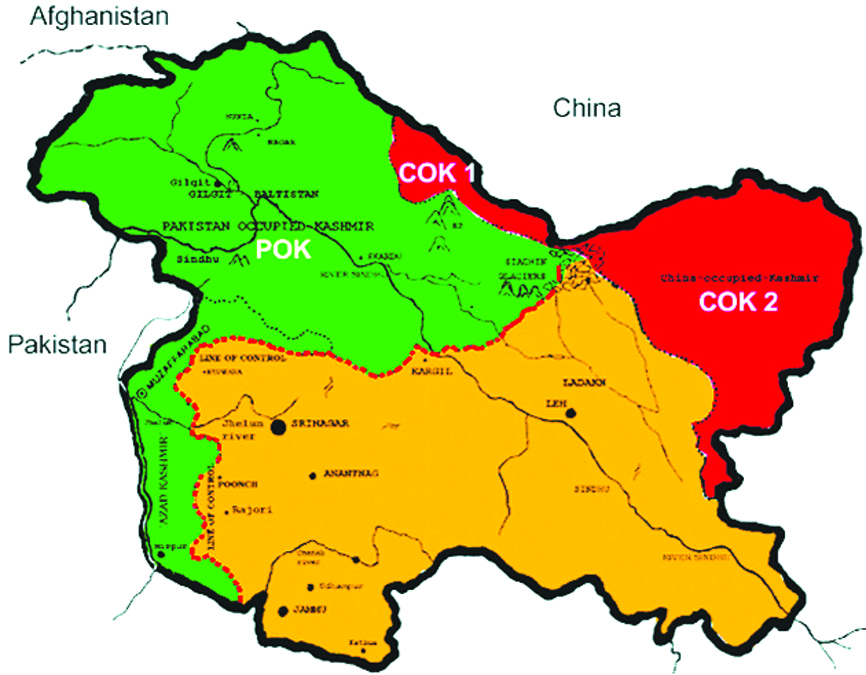
Jammu/Leh, Aug 01: Pakistan has been in “illegal occupation” of parts of Indian Union Territories of Jammu & Kashmir and Ladakh, and New Delhi has consistently called upon Islamabad to immediately vacate all areas under its illegal and forcible occupation, the government informed Parliament on Friday.
The Government also informed the Lok Sabha that following the April-May 2025 military clashes with Pakistan, relations between the two countries remain strained, while asserting that Operation Sindoor has not ended yet, and that until the threat of cross-border terror is completely eliminated, there will not be any talks with the enemy nation.
The Ministry of External Affairs (MEA) was asked in the Lok Sabha whether parts of “our Kashmir”, referred to as Pakistan-occupied-Jammu-and-Kashmir (PoJK), are still under Pakistan’s illegal occupation, and what efforts are being made to reclaim them.
“Pakistan has been in illegal occupation of parts of Indian Union Territories of Jammu & Kashmir and Ladakh. Government of India has consistently called upon Pakistan to immediately vacate all areas under its illegal and forcible occupation,” Minister of State for External Affairs Kirti Vardhan Singh said in a written response to the query.
“Government of India has lodged strong protests with the Government of Pakistan and rejects all attempts by it to bring material change in these occupied territories,” he added.
He emphasised that it has been India’s consistent and principled position that the “entire Union Territories of Jammu & Kashmir and Ladakh have been, are and will always remain integral parts of India”.
This was enunciated in the unanimously adopted 1994 Resolution of the Indian Parliament, the MoS said.
The ministry was also questioned about how PoJK is represented on maps.
“The official maps published by the government of India unambiguously represent entire Union Territories of Jammu & Kashmir and Ladakh, including the territories illegally occupied by Pakistan, as parts of the Union of India,” he said.
In response to another query, Singh noted, “India has also made clear its approach of strict action against the roots of terrorism, not tolerating any form of blackmail and taking decisive steps to protect its citizens against any threats.”
The MEA also responded to the query about the current status of relations between India and Pakistan after the military clashes that occurred in April-May 2025.
“India’s stand on the incompatibility of terror with any form of diplomatic interaction has also been communicated at the highest level. Operation Sindoor continues,” he said.
The response detailed a series of diplomatic and military measures taken by India following the attack that resulted in multiple civilian casualties in Jammu and Kashmir.
According to the ministry, India undertook decisive diplomatic initiatives following the incident and launched a targeted military operation named Operation Sindoor. The operation focused on dismantling terror launchpads and related infrastructure across the Line of Control.
On 10 May 2025, the Director General of Military Operations (DGMO) of Pakistan contacted his Indian counterpart requesting an end to firing and cross-border military action. The request was accepted the same day, resulting in a temporary cessation of direct military engagement along the border.
Despite the pause in active hostilities, India has maintained its policy position that terrorism and diplomacy cannot function simultaneously. The government reiterated that any future engagement with Pakistan depends on measurable and verifiable steps to curb terrorism.
Responding to a query on whether there has been a fundamental change in the relationship between the two countries post-conflict, the government stated that its long-term strategy is rooted in a firm approach against the sources of terrorism. “India has rejected any form of coercion or blackmail and has emphasized safeguarding national security.”
“As of now, Operation Sindoor continues. There has been no official confirmation of the possibility of resuming diplomatic dialogue with Pakistan in the near future. The government’s position remains that meaningful diplomatic engagement can only take place in an environment free from the threat of cross-border terrorism,” the reply reads.
The reply also clarified that all necessary steps would continue to be taken to protect Indian citizens and territory from external threats, with no compromise on the country’s security interests.
