

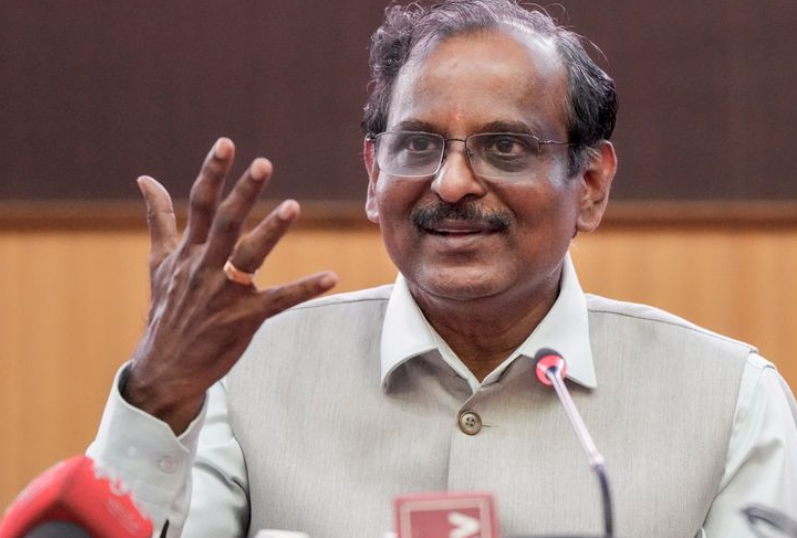
SRIHARIKOTA (ANDHRA PRADESH), October 31: ISRO Chairman V Narayanan on Saturday revealed that the space agency deliberately operated the NVS-03 navigation satellite with three pyro valves already open to overcome technical challenges and ensure mission reliability.
Addressing a post-launch press conference, Narayanan said the decision was taken after extensive technical assessments and was validated through rigorous vibration and shock tests conducted by a national-level committee headed by former ISRO chief Kiran Kumar.
The decision comes against the backdrop of the failure of NVS-02, the second satellite in India’s Navigation with Indian Constellation (NavIC) series, launched in 2025.
A high-level investigation panel had earlier concluded that the drive signal failed to reach the pyro valve in the oxidiser line of the engine required for raising the satellite’s orbit. In February 2026, ISRO identified the disengagement of at least one connector contact in both the main and redundant electrical paths as the most likely cause.
Narayanan said the latest launch had achieved remarkable orbital accuracy. The satellite reached a perigee of 170.31 km against the planned 170.36 km, while its apogee was recorded at 38,080 km against the targeted 37,247 km.
He described the orbital precision as one of the best achieved by any launch vehicle globally.
The 2,240-kg NVS-03 satellite was successfully placed into orbit early Saturday using the GSLV-F18 launch vehicle. The mission also marked ISRO’s fastest-ever turnaround for a heavy-lift rocket.
With NVS-03 successfully deployed, India’s NavIC navigation system has returned to its minimum operational configuration of four satellites, strengthening navigation and positioning services for civilian and strategic applications.
Narayanan further highlighted the growing use of NavIC-based tracking services. Currently, around 10,400 locomotives and 64,000 fishing vessels are being tracked in real time. Under the Pradhan Mantri Matsya Sampada Yojana, ISRO aims to extend the tracking facility to one lakh fishing vessels within the next six months.
Additionally, approximately 15 lakh tracking devices have been installed across vehicles. On the availability of NavIC services in civilian smartphones, the ISRO chief said the facility would become possible once the complete seven-satellite constellation is operational.
Outlining the agency’s upcoming plans, Narayanan said ISRO aims to conduct five more launches during the current financial year. These missions will include the first uncrewed Gaganyaan mission, G1, along with small satellite launches.
He also said ISRO plans to launch NVS-04 within five months and NVS-05 within ten months to further strengthen India’s navigation satellite constellation.
