

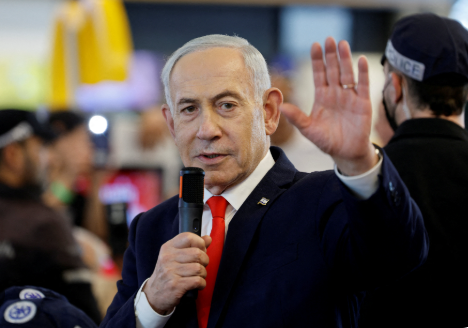
Jerusalem, Oct 27 : As Israel goes to the polls on Tuesday, the first since the tumultuous events of October 7, 2023, it is being seen as a referendum on Prime Minister Benjamin Netanyahu’s leadership.
Issues such as security, judicial overhaul, the secular-religious divide over national burden sharing, ethnicity, and the economy are at the forefront but talks of a two-state solution to the vexed Israel-Palestinian conflict have been pushed out of public discussions.
Opinion polls indicate that Netanyahu’s Likud party and the opposition led by former military chief Gadi Eisenkot are competing in a close race, with neither side assured of the parliamentary majority needed to form a government.
Netanyahu is seeking to retain power after three years of war and mounting demands for accountability over the October 7, 2023, attack.
Eisenkot, a former chief of staff of the Israel Defence Forces, has emerged as a principal challenger, while former prime minister Naftali Bennett is leading a separate opposition alliance with Yair Lapid.
Netanyahu, Israel’s longest-serving prime minister, has resisted calls for an independent state commission of inquiry into the failures surrounding the October 7, 2023, attack.
The assault killed around 1,200 people in Israel and led to the abduction of 251 people to Gaza.
Hundreds of thousands of Israelis have participated in demonstrations over the government’s handling of the war and demands for accountability.
At a rally in Tel Aviv on Saturday, protesters called for a state commission of inquiry into the security failures. Organisers said more than 100,000 people attended.
A young student at Hebrew University, Lev, said the impact of October 7 could be understood by Indians through the experience of the November 26, 2008, Mumbai attacks.
“About 166 people were killed in that dastardly attack and it shook India, a country of 1.4 billion, so much that its anniversary every year still sends tremors among Indians. Just put that in proportion and imagine what it can do to a country of about 10 million people that lost 1,200 lives in a span of 48 hours and 251 of its people were taken hostage,” he said.
Major military failures have historically reshaped Israeli politics.
Following the 1973 Yom Kippur War, the ruling Labour-led Alignment and its allies lost power in 1977 for the first time in 29 years, paving the way for Likud’s rise under Menachem Begin and greater political representation for Mizrahi Jews.
Mizrahi generally refers to Jews of Middle Eastern and North African heritage, while Ashkenazi refers to Jews whose historical origins lie in Central and Eastern Europe.
The distinction has been an important feature of Israeli politics, particularly in the long-standing support for Likud among many Mizrahi voters, who have historically expressed grievances over discrimination and unequal treatment.
In the election following October 7, 2023, some longstanding political loyalties appear open to challenge.
Netanyahu’s carefully cultivated image as “Mr Security” has been damaged by the failures preceding the Hamas assault, while the question of who should be held accountable remains central to the campaign.
Likud has traditionally drawn considerable support from Mizrahi and traditional Jewish voters, even though many of its prominent leaders, including Netanyahu, have Ashkenazi backgrounds.
Eisenkot, whose family has Moroccan Jewish roots, has emerged as a significant challenger to the prime minister. The former military chief’s background has also brought questions of ethnicity to the forefront of the campaign.
A pro-Netanyahu political commentator, Yinon Magal, called Eisenkot a “monkey” during a televised discussion, in remarks widely criticised as a racist slur directed at his Moroccan heritage.
Magal argued that he was referring to Eisenkot being controlled by others, while Netanyahu condemned the remark as inappropriate.
The controversy has revived comparisons with the 1981 election campaign, when entertainer Dudu Topaz used the derogatory term “chah’chahim” to refer to Mizrahi voters associated with Likud.
The episode became part of a wider debate over ethnic discrimination and political representation in Israel.
The current controversy has similarly brought questions of ethnicity and political identity into the campaign, although its electoral impact remains uncertain.
Eisenkot has also drawn sympathy over personal losses during the war. His son and two nephews were killed while serving in the military during the conflict in Gaza.
Another major issue is the divide between secular Israelis and the ultra-Orthodox, or Haredi, community over military service.
Most Jewish Israeli men are subject to compulsory military service, but Haredi men studying in religious seminaries have historically received broad exemptions or deferments.
The prolonged war has intensified resentment among sections of the public over the unequal burden of military service.
The military has faced manpower shortages, while reservists have been repeatedly called up for extended periods. At the same time, ultra-Orthodox parties have sought to preserve exemptions for religious seminary students and funding for their institutions.
The issue has shifted from a debate over social equality to an operational concern for the military.
Israel’s Supreme Court ruled in 2024 that blanket exemptions for Haredi men could not continue without a legal basis, and the dispute has since strained Netanyahu’s coalition.
Haredi leaders argue that full-time religious study should be protected, while critics say the system places an unfair burden on those who serve.
The controversy has become a point of mobilisation for opposition parties, while Netanyahu has sought to maintain the support of ultra-Orthodox coalition partners.
The divide is reflected in voting patterns. An analysis by the Israel Democracy Institute of voting patterns in the 2022 election found a clear correlation between religious self-identification and political preference.
It found that 74 per cent of secular Jewish voters supported opposition parties, while 97 per cent of Haredi voters backed parties in the coalition camp that subsequently formed Netanyahu’s government.
The findings underline the political significance of religious identity, although they do not by themselves establish how these groups will vote in the current election.
Netanyahu’s coalition has also been weakened by disagreements over the military draft and judicial overhaul.
The government’s proposed judicial changes, which sought to increase elected politicians’ influence over judicial appointments and limit aspects of judicial review, prompted mass protests in 2023.
The controversy remains an important source of division, though the campaign has been dominated by questions of leadership, security and military service.
Netanyahu’s calls for a unity government have also faced resistance from centrist and centre-left leaders.
The breakdown of the 2020 power-sharing agreement with Benny Gantz remains a source of mistrust.
Under the agreement, Gantz was due to succeed Netanyahu as prime minister, but the government failed to pass a state budget, triggering early elections before the planned rotation could take place.
The economy is another source of pressure. The prolonged conflict has imposed financial and personal costs on households, businesses and reservists, while public funding for ultra-Orthodox institutions has become part of the wider dispute over the distribution of national responsibilities.
US President Donald Trump’s endorsement of Netanyahu has added an international dimension to the campaign. Trump publicly backed the Israeli prime minister ahead of the election and issued a further endorsement on Sunday, urging Israelis to vote for him.
The impact of the intervention on voting intentions remains uncertain, particularly as Netanyahu faces criticism at home over the October 7 security failures and the handling of the subsequent wars.
The Arab sector could also play a significant role in the post-election arithmetic. Arab citizens make up about 21 per cent of Israel’s population, and their turnout could influence the balance between the competing political blocs.
Pollsters expect Arab turnout to rise to around 63 per cent, compared with about 53 per cent in 2022.
The Arab-led Joint List and Ra’am, headed by Mansour Abbas, are running separately. The Joint List brings together Hadash, Ta’al and Balad, while Ra’am is an independent Islamist party.
Although the parties are not contesting the election as a single list, their leaders have sought to increase Arab voters’ participation and influence over government formation.
The question of whether Arab parties could support an opposition-led government has become an important part of the campaign.
Ra’am previously provided parliamentary support to the Bennett-Lapid government, which took office in 2021, and Abbas has argued for greater political participation to secure improvements for Arab communities.
Netanyahu’s supporters continue to credit him with experience and a strong security posture, while his opponents argue that the October 7 failures and the government’s subsequent decisions demand political change.
The outcome will depend not only on which party wins the most seats but also on whether either political camp can assemble a coalition with the support of at least 61 lawmakers.
Crime and public safety are among the major concerns of Arab voters.
An Israel Democracy Institute survey conducted in late August and early September found that crime in Arab society ranked as the most important consideration for Arab respondents when deciding which party to support.
Arab political leaders have called for greater influence in the post-election process, including through parliamentary cooperation.
But the possibility of their support translating into a government remains uncertain, as several non-Arab opposition leaders have been reluctant to form a coalition with Arab parties. Some have nevertheless left open the possibility of parliamentary support without formal coalition membership.
One issue largely absent from the main Jewish-party campaign is the two-state solution to the Israeli-Palestinian conflict.
Although Arab parties continue to raise Palestinian statehood and the occupation as political concerns, the main contenders have focused on security, governance and Netanyahu’s leadership rather than proposing a pathway towards a Palestinian state.
Public opinion has also become more pessimistic about the prospects of a two-state solution.
A Pew Research Center survey published in September found that 56 per cent of Israelis did not believe Israel and an independent Palestinian state could coexist peacefully, while 17 per cent said they could.
The findings point to the depth of scepticism surrounding the prospect of a political settlement, though they do not mean that the issue has disappeared entirely from Israeli public debate.
