

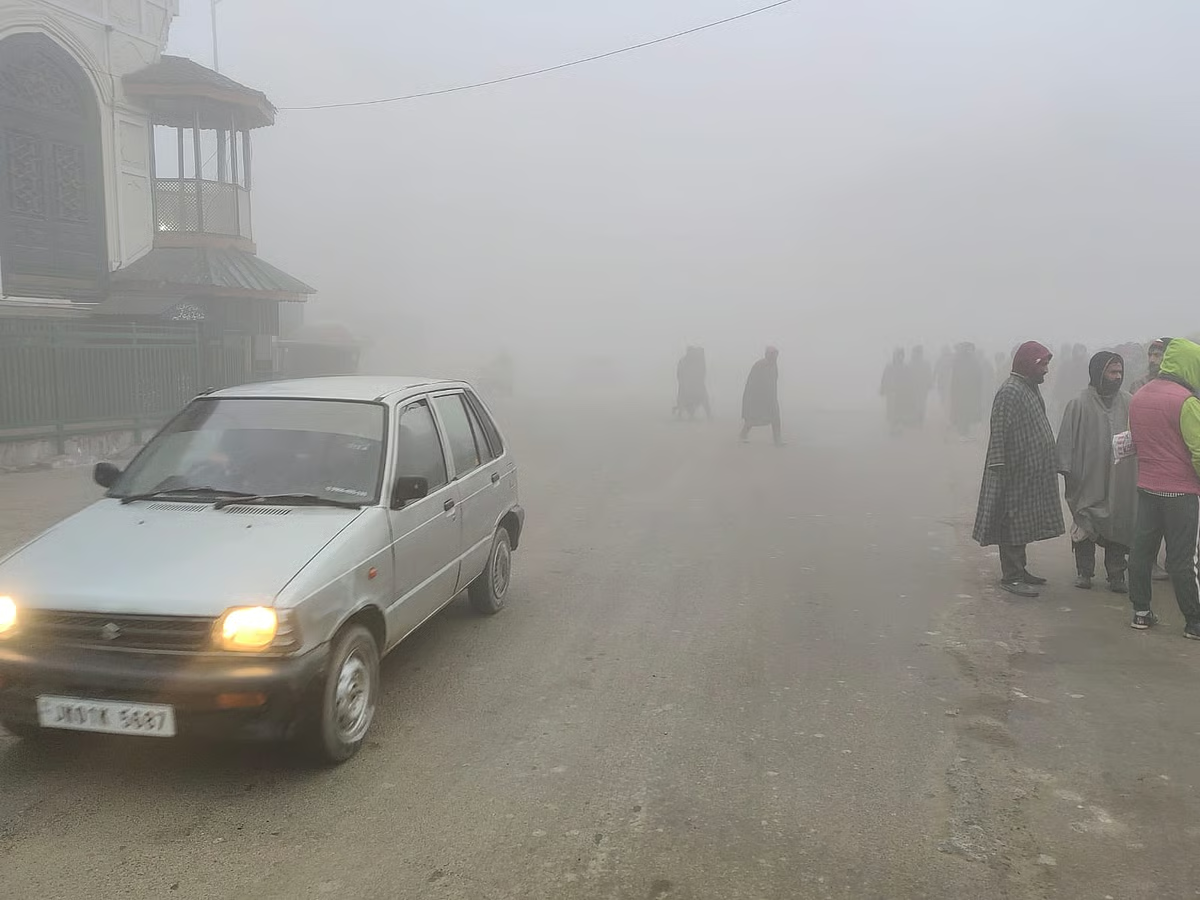
Srinagar, Jan 13: A clear night sky pushed temperatures further down across Jammu and Kashmir on Tuesday, with Srinagar recording a minimum of minus 4.9 degrees Celsius. Dense fog in Jammu city severely disrupted normal life in the morning, bringing both road and air traffic to a halt due to poor visibility.
In Srinagar, only a few people stepped out early in the day as an icy wind swept the Valley from the surrounding mountains. With no significant snowfall expected over the next week, the ongoing spell of intense cold is likely to persist.
Srinagar registered a low of minus 4.9 degrees Celsius, while Gulmarg and Pahalgam recorded minus 3.5 degrees and minus 6.2 degrees, respectively. Jammu city recorded 3.8 degrees, Katra 6.2, Batote 4.1, Banihal 8.9 and Bhaderwah minus 0.2 as the minimum temperatures.
According to the Meteorological Department, partly to generally cloudy conditions are expected till January 18 and 19. On January 20, generally cloudy weather with light rain or snow at isolated locations is likely, followed by partly to generally cloudy skies with light rain or snow at scattered places between January 21 and 23.
For January 24 and 25, the forecast suggests partly cloudy weather across the Union Territory. The MeT office has also indicated a gradual rise in night temperatures at many places. However, it warned that moderate fog over the plains of Jammu division, with dense fog at isolated pockets, is likely to continue for the next five days.
The extended dry spell has triggered serious concern in Jammu and Kashmir, particularly in the Valley, as the MeT Department predicts mostly cold and dry weather conditions till January 25. The lack of snow during ‘Chillai Kalan’ – the 40-day harshest phase of winter that is crucial for replenishing glaciers, streams and water bodies – has raised alarm among farmers, horticulturists and planners.
This critical period is already more than halfway over, yet the plains of the Valley have not received their first snowfall of the season. Chillai Kalan ends on January 30, and any snowfall in February and March tends to melt quickly, offering little benefit to the long-term water storage in the higher reaches.
