

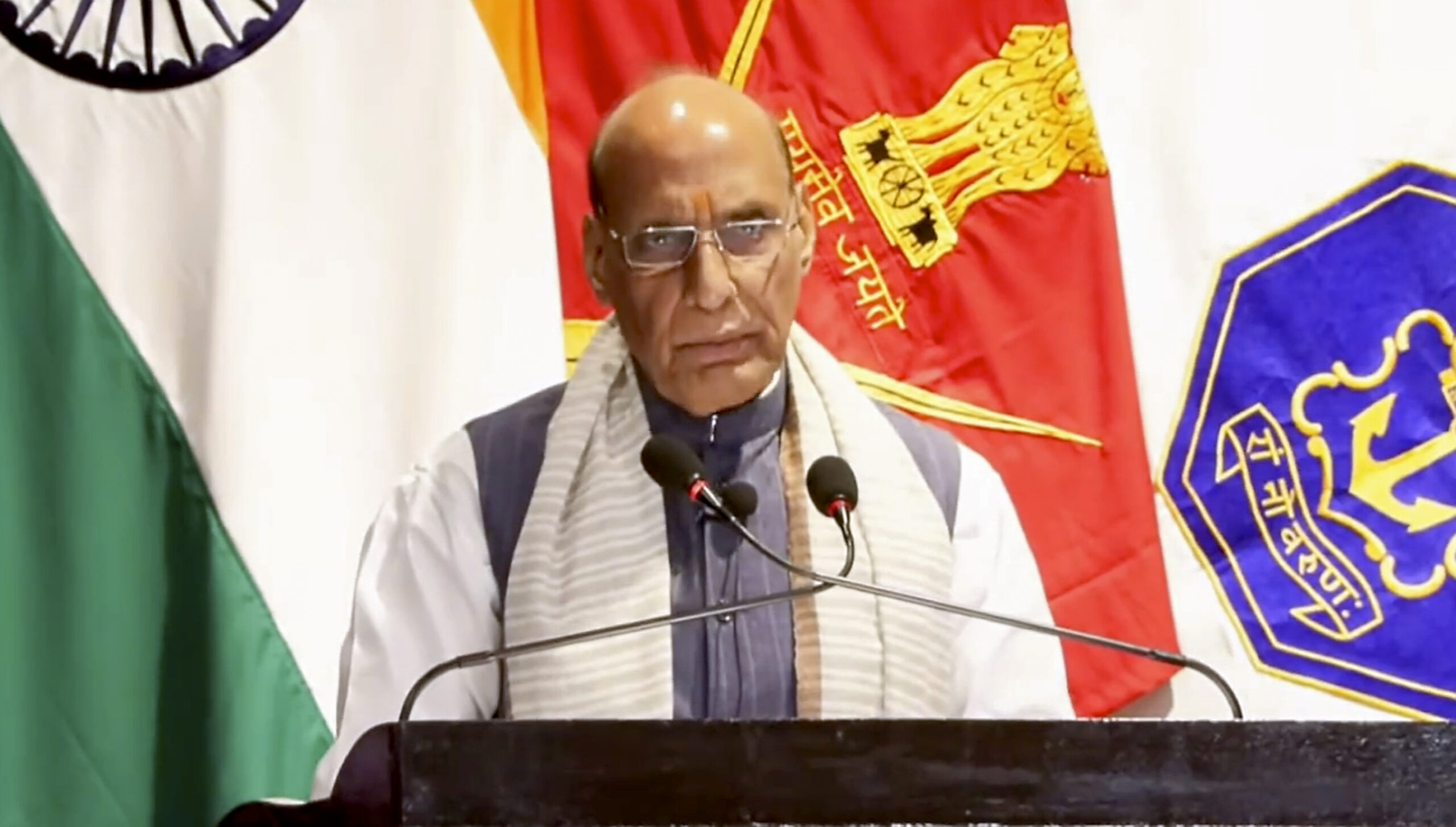
Mhow, Aug 27: Defence Minister Rajnath Singh emphasized that India’s armed forces must be ready for conflicts ranging from brief skirmishes to a five-year war, given the unpredictable global geopolitical landscape.
Speaking at the ‘Ran Samvad’ conclave on Wednesday at the Army War College, he highlighted that modern warfare is evolving beyond troop numbers and weapon stockpiles.
Cyber warfare, AI, drones, and satellite surveillance are now critical, with precision-guided weapons, real-time intelligence, and data-driven strategies defining success.
Singh reiterated India’s commitment to protecting its territorial integrity while stressing it has no interest in claiming others’ land.
“In today’s era, wars have become so sudden and unpredictable that it is very difficult to predict when any war will end and how long it will last,” he said, noting that the Indian military must be prepared for every situation.
“That is, if any war stretches for two months, four months, a year, two years, even five years, then we should be fully prepared for it,” he said in the presence of India’s top military brass including Chief of Defence Staff Gen Anil Chauhan, Air Chief Marshal A P Singh and Navy Chief Admiral Dinesh K Tripathi.
The defence minister said modern battles are no longer confined to land, sea and air, and they now extend into outer space and cyberspace.
“Satellite systems, anti-satellite weapons and space command centres are the new instruments of power. Therefore, what we require today is not just defensive preparedness but also a proactive strategy,” he said.
Elaborating on rapid changes in the military domain, the defence minister said the present era will be defined by non-linear warfare.
“The sheer number of soldiers or the size of weapon stockpiles is no longer enough. Cyber warfare, artificial intelligence, unmanned aerial vehicles and satellite-based surveillance are shaping the wars of the future,” he said.
“In the times ahead, the nation that masters the triangle of technology, strategy and adaptability will emerge as the true global power. To put it simply, this is the moment to learn from history and write a new one; this is the moment to anticipate the future and shape one,” he said.
Singh argued that future wars will not merely be battles of weapons and they will be a combined play of technology, intelligence, economy and diplomacy.
He also noted that national security is no longer a matter of the military, but has become an issue of a “whole-of-nation approach”.
“We do not want anyone’s land, but we are ready to go to any extent to protect our land,” he said.
The defence minister lauded the three services for Operation Sindoor and said it has emerged as a great example demonstrating the success of India’s indigenous platforms, equipment and weapon systems.
“Its achievements have once again underlined that in the times to come, self-reliance is an absolute necessity. We have indeed made significant progress on the path of self-reliance, but there is still a long way ahead,” he said.
Singh said the success of Operation Sindoor is a “perfect example” of bravery and swiftness with which the armed forces acted against the terrorists in Pakistan.
It was something those terrorists could never have even imagined, he said.
“If we speak of Operation Sindoor, it was indeed a striking demonstration of technology-driven warfare,” Singh said.
