

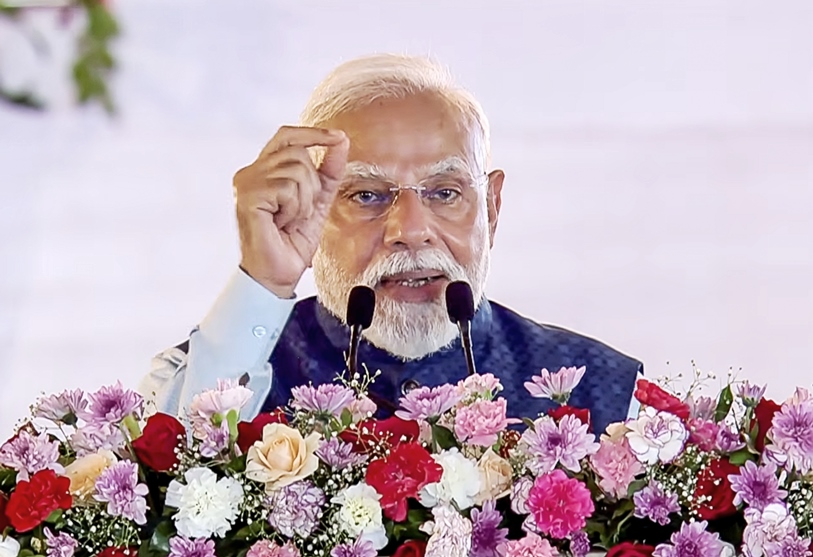
New Delhi, Aug 23: Prime Minister Narendra Modi on Saturday said that guided by the mantra of reform, perform, and transform, India is in a position to help lift the world out of slow growth.
Addressing the Economic Times World Leaders Forum here, the Prime Minister said India will soon become the world’s third-largest major economy, and is on the way to becoming a developed nation by 2047.
Observing that reform is a matter of commitment and conviction for his government, Modi said the next-generation GST reform process, which seeks to make the law simpler, will be completed before Diwali and bring down prices.
The Prime Minister also asked the private sector to increase investment in research and development in sectors like clean energy, quantum technology, battery storage, advanced materials and biotechnology. This will strengthen the resolve of a developed India.
“It is not in my nature to be satisfied with what has already been achieved. The same approach guides our reforms,” he said.
“For us, reforms are neither a compulsion nor crisis-driven, but a matter of commitment and conviction.”
The Prime Minister said the government is going to bring a comprehensive new set of reforms.
“With this arsenal of next-generation reforms, manufacturing in India will increase, market demand will rise, the industry will receive a new boost, new employment opportunities will be created, and both Ease of Living and Ease of Doing Business will improve,” he pointed out.
The government continued to carry out reforms during the just concluded monsoon session of Parliament despite disruptions by Opposition parties, he said.
“Guided by the mantra of Reform, Perform, Transform, India today is in a position to help lift the world out of slow growth,” Modi said.
The Prime Minister said that in the global context, one can realise the strength of India’s economy.
“Today, India is the world’s fastest-growing major economy. We are going to become the world’s third-largest economy very soon. Experts are saying that India’s contribution to world growth is going to be around 20 per cent very soon,” he added.
He said this growth and resilience in the economy are due to the macroeconomic stability that India has achieved in the last decade. Today, the fiscal deficit is expected to come down to 4.4 per cent.
Regarding the fundamentals of the economy, Modi said Indian companies are raising record funds from the capital markets, banks are stronger than ever before, inflation is very low, and interest rates are also low.
The current account deficit is under control, forex reserves are also robust, and every month lakhs of domestic investors are investing thousands of crores of rupees in the market through SIPs.
“You also know that when the fundamentals of the economy are strong, its foundation is strong, then its effect is also seen everywhere,” he said.
The Prime Minister said India is working with full force toward its goal of becoming a developed nation by 2047, and the basis of a developed India is a self-reliant India.
He also pointed out that the country needs to focus on three parameters for a self-reliant India — speed, scale, and scope.
Referring to a commonly used phrase — ‘Missing the Bus’ — to illustrate how opportunities, if not seized, can pass by, Modi said that previous governments in India missed several such buses of opportunity in the fields of technology and industry.
But post-2014, Modi said, India changed its approach and resolved not to miss any more buses, but instead to take the driving seat and move forward.
He said India developed its entire 5G stack domestically.
The country is now rapidly working on Made-in-India 6G technology, he added.
The Prime Minister said that until 2014, India’s automobile exports stood at approximately Rs 50,000 crore annually. Today, India exports automobiles worth Rs 1.2 lakh crore a year.
He also informed that India has now begun exporting metro coaches, rail coaches, and rail locomotives.
Modi also shared that India is set to achieve another milestone by exporting electric vehicles to 100 countries, and a major event related to this achievement will take place on August 26.
Meanwhile, after a gap of more than seven years, Prime Minister Narendra Modi will travel to China on August 31 to attend the annual summit of the Shanghai Cooperation Organisation (SCO) amid signs of a thaw in the bilateral ties following a spell of fractious relationship over the eastern Ladakh border row.
The Ministry of External Affairs (MEA) announced on Friday that Modi will visit the Chinese city of Tianjin from August 31 to September 1, after concluding his two-day trip to Japan.
Modi’s trip to China comes against the backdrop of a downturn in India-US ties after US President Donald Trump doubled tariffs on Indian goods to a whopping 50 per cent, including 25 per cent additional duties for New Delhi’s purchase of Russian crude oil.
The formal announcement of Modi’s visit to China was made three days after New Delhi and Beijing unveiled a series of measures for a “stable, cooperative and forward-looking” relationship that included jointly maintaining peace along the contested frontier, reopening border trade and resuming direct flight services at the earliest.
The measures were announced on Tuesday at the end of Chinese Foreign Minister Wang Yi’s two-day trip to New Delhi.
The MEA said Modi will visit Japan from August 29 to 30 to participate in the 15th India-Japan annual summit. From Japan, the prime minister will travel to China for a visit on August 31 and September 1 to attend the SCO summit.
Modi is set to hold a bilateral meeting with Chinese President Xi Jinping on the sidelines of the SCO summit.
The prime minister’s visit to China comes amid efforts by the two sides to repair the bilateral ties that came under severe strain following the deadly clashes between Indian and Chinese troops in the Galwan valley in June 2020.
Modi last visited China in June 2018 to attend the SCO summit. The Chinese president visited India in October 2019 for the second “informal summit”.
“In the second leg of his visit, at the invitation of the President of China, Xi Jinping, the prime minister will travel to China from August 31 to September 1 to attend the Shanghai Cooperation Organisation (SCO) summit in Tianjin,” the MEA said in a statement.
“On the sidelines of the summit, the prime minister is expected to hold bilateral meetings with several leaders attending the summit,” it said.
The ties between the two neighbours nosedived following the deadly clashes between Indian and Chinese troops in the Galwan valley in eastern Ladakh in June 2020.
The eastern Ladakh face-off effectively ended following the completion of the disengagement process from the last two friction points of Demchok and Depsang under an agreement finalised on October 21 last year.
During their talks on the sidelines of the SCO summit, Modi and Xi are expected to deliberate on new measures to further ease tensions in the bilateral ties that may include de-escalation of the situation along the frontier in eastern Ladakh.
The SCO summit will be held in Tianjin on August 31 and September 1.
In the first leg of his trip, Modi will visit Japan from August 29 to 30 to participate in the 15th India-Japan annual summit.
This will be Modi’s eighth visit to Japan as the prime minister.
Modi and his Japanese counterpart, Shigeru Ishiba, will review the special strategic and global partnership between India and Japan, the MEA said.
It said the discussions between the two sides will cover areas like defence and security, trade and economy, technology and innovation, and people-to-people exchanges.
Modi and Ishiba will also discuss issues of regional and global importance, it said.
“The visit will reaffirm the longstanding special bond of friendship between the two countries,” the MEA said.
Later in the day the Congress questioned the government’s silence over the Chinese envoy using a platform in India to “equate” India with Pakistan as “victims of terrorism” and said it should speak up in national interest.
Party general secretary Randeep Surjewala shared a video of the Chinese Ambassador claiming that Pakistan, along with India and China, has suffered due to terrorism, and alleged that the Modi government foreign policy was “weak-kneed”.
“When a Chinese envoy uses an Adani funded Chintan Research Foundation platform to equate India with Pakistan and claim that Pakistan is a ‘victim of terrorism’, should Modi Government remain a mute spectator wooing the Chinese or ‘speak up’ in National Interest – to question the Chinese as also Adani (sic),” Surjewala said in a post on X.
“This is not strong foreign policy, this is ‘photo op jhula diplomacy’.
“With trade imbalance ballooning, soldiers martyred, land encroached, Pakistan armed with Chinese support and our own platforms given to a Chinese envoy to insult us, the Modi Government and the BJP owes the nation answers,” the Congress leader said.
Asked about India’s challenge of cross-border terrorism emanating from Pakistan, Chinese envoy Xu Feihong on Thursday said Pakistan is also a “victim of terrorism” and that joint efforts are needed to combat the menace.
“A weak-kneed government is not conducive for national interests as is apparent,” Surjewala said.
“Our trade deficit with China touched a record 99.2 billion dollars in FY 2024-25.
“After the Galwan attack, where our 20 brave hearts laid down their lives, TikTok and other apps were banned in rounds, but it remained merely symbolic as dependence on Chinese imports deepened.
“Status quo ante 2020? Despite disengagement headlines, China still holds ground in Depsang, Demchok and Hot Springs, occupying nearly 1,000 square kilometres of Indian territory,” he claimed.
Surjewala claimed that the pre-April 2020 position has not been restored and “it seems to have been deliberately forgotten”.
On terror and Operation Sindoor, Surjewala said, “The April 2025 Pak driven Pahalgam terror attack killed 26 innocent civilians. In its aftermath, Pakistan’s counter actions relied on Chinese jets, missiles and even Chinese satellite intelligence.
“China openly expressed support for Pakistan in the midst of Operation Sindoor. Yet Modi Government remains ‘mute’. This is the so-called ‘iron brother’ partnership.”
On Chinese “aggression” in Arunachal, the Congress general secretary claimed that Beijing renamed 30 places in the state and “built a 100-home village inside our claimed territory. It is also constructing hundreds of dual use border villages”.
“This is an affront to India’s sovereignty. Why are ground realities being altered?” he asked.
He also claimed that China is building the world’s largest dam on the Brahmaputra close to LAC, with huge strategic, hydrological and environmental implications for India.
“There is no consultation by the Chinese nor any attempt to address India’s concerns. Government of India remains ‘mum’ as water of Brahmaputra is being weaponised by the Chinese,” he said.
On terror mastermind Masood Azhar, he said, “Only after a decade of blocking did China finally allow the UN to list him as a global terrorist in 2019. Until then Beijing shielded him, even after Pulwama.”
