

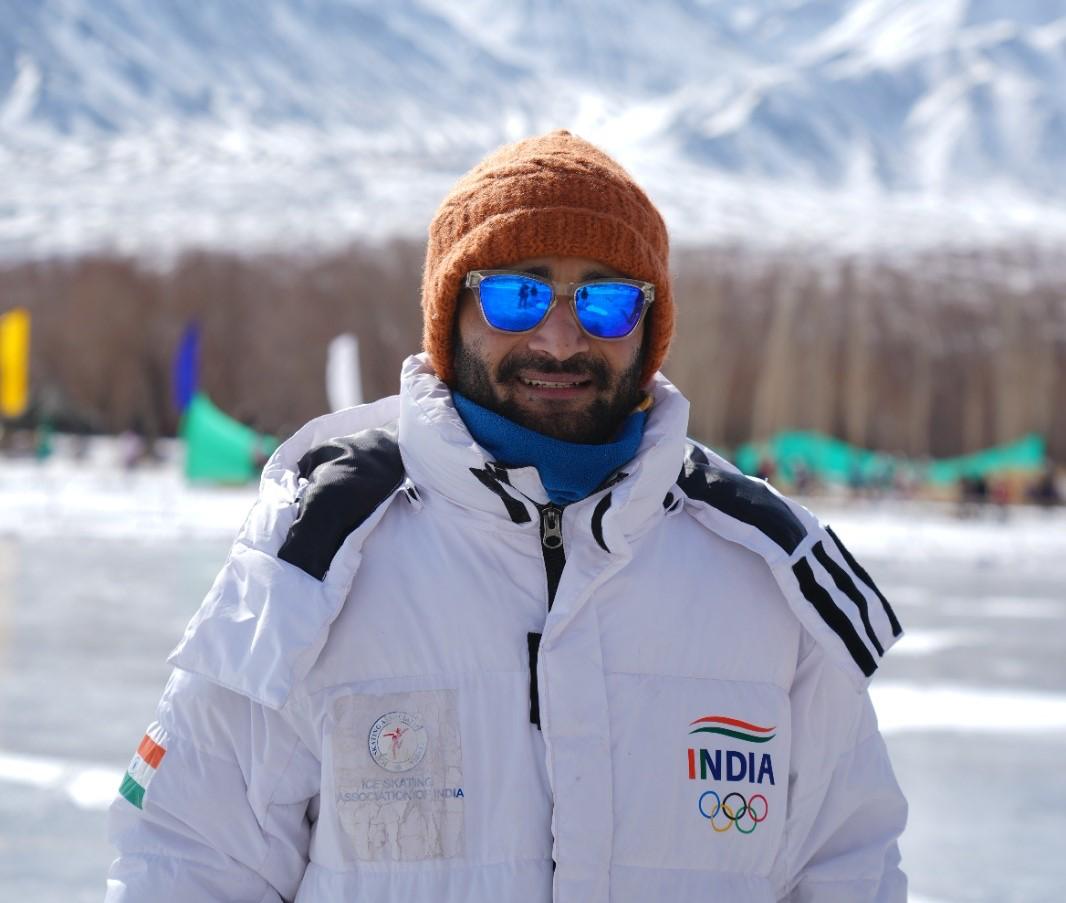
Leh, Jan 28: India is moving closer to hosting the Asian Winter Games, believes veteran ice skater Vishwaraj Rajen Jadeja, who credits the Khelo India initiative for changing the outlook of winter sports in the country.
Speaking on the sidelines of the Khelo India Winter Games 2026 in Leh, Jadeja said that steady improvement in infrastructure and growing awareness could allow India to bid for the Asian Winter Games in the next 10 to 12 years. He stressed that the journey has already begun, with facilities now matching basic international needs.
Jadeja, 40, has spent nearly two decades on ice and remains the most decorated ice skater India has produced. Yet, the ongoing Khelo India Winter Games marked the first time he competed in a domestic event. On Sunday, the final day of the long-track ice skating competition at Gupukh’s Pond, he finished eighth in the men’s 1000m race.
“I never took part earlier because there were no safe tracks,” Jadeja said. “This time the surface was good, so I decided to compete. I was not here to win but to show how far Indian ice skating has come.”
Born into the erstwhile royal Dhrol family of Gujarat, Jadeja grew up without privilege after royalty lost official status in India decades before his birth. Guided by his grandfather’s belief that sport builds lifelong value, he chose ice skating over financial comfort and moved to Europe in the late 2000s to train and compete.
His career includes several national records and rare feats, including a five-kilometre skate at an altitude of 4,500 metres at Tso Moriri Lake in 2019. In 2020, he won three silver medals and a bronze at the Winter World Masters Games in Austria. At the Asian Winter Games in Harbin last year, Jadeja led an Indian team that finished fifth in a team event.
Jadeja believes the shift in India’s winter sports scene began after the launch of Khelo India. “We now have two Olympic-sized artificial ice rinks in Leh and Dehradun for short-track skating and ice hockey. Skiing facilities have also improved,” he said. “We need long-track surfaces, and with that, we can be ready to host major events.”
He also underlined the need for strong backing for athletes and coaches. “Ice skating is an elite sport. Welfare support from the government and corporates is very important. If we get that balance right, producing an Olympian will not take long,” he added.
Leh holds a special place in Jadeja’s life. After a serious accident in 2017, a friend advised him to visit the region to recover mentally and physically. Since then, he has remained closely connected to Ladakh and feels it is best suited for winter sports.
“Leh should be the permanent venue for the Khelo India Winter Games,” he said. “The climate, the setting and the improving infrastructure make it ideal.”
Jadeja also acknowledged the role of Khelo India in drawing attention to winter disciplines. “Media coverage has improved, and awareness is growing. Earlier, ice skating barely received any attention. Now, at least we know where we stand and what we must work on,” he said.
For a sport long pushed to the margins in India, Jadeja’s journey and his belief in the system reflect a slow but steady thaw—one that could see the country host Asia’s top winter event in the years ahead.
