

Shivang Satya Gupta

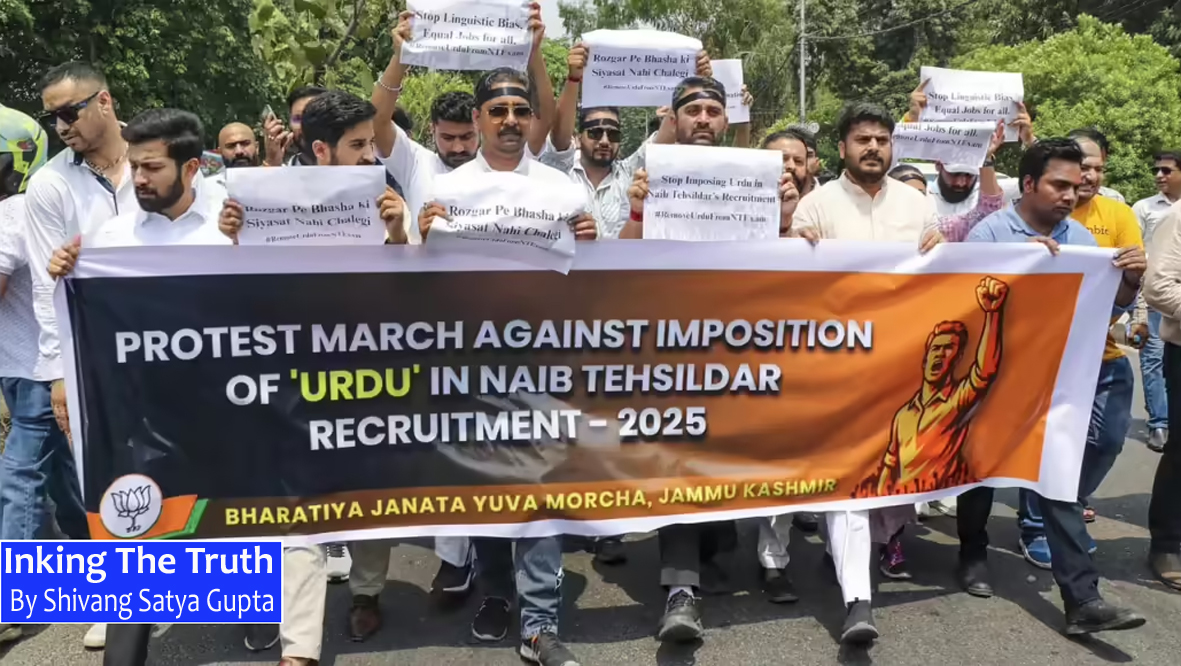
In our last week’s edition of INKING THE TRUTH, we had asserted how the language barrier created by the Jammu and Kashmir Services Selection Board (JKSSB) for 75 posts of Naib Tehsildar–which mandates a qualifying Urdu paper–revives an old wound and sends a dangerous signal: that opportunities in governance can be curtailed based on language preferences.
Over the last week, we dived deep into understanding the reasons as to why Urdu, which was imported into Jammu and Kashmir in the past, and has become outdated and irrelevant in the present, was such a huge factor for deciding the future of not only our youth, but that of the governance.
And our research has revealed shocking, astonishing facts, in terms of numbers and a mindset that has given innumerous wounds to Jammu and Kashmir, and is still hell-bent on continuing its atrocities, hurting the progress of Jammu and Kashmir and its people.
As per the 2011 Census, of the 1.25 crore people of erstwhile, undivided State of Jammu and Kashmir, Kashmiri is the mother tongue of 66.80 lakh people, while the mother tongue of 25.13 lakh people is Dogri.
Among other major languages, Punjabi was the mother tongue of 2.19 lakh people in Jammu and Kashmir, while there were 26.12 lakh people who had Hindi, Gojri, Pahari, Hindi, Gaddi, Padari etc as their mother tongue.
Our readers must be in for a shock, as we at The Earth News were, to learn that Urdu, the current bone of contention, was the mother tongue of less than 20 thousand people in Jammu and Kashmir—19956 to be precise.
Let this number sink in: In a population of 1,25,41,302, only 19956 people have their mother tongue, that is 0.15%.
Clearly, Jammu and Kashmir can survive without Urdu language; then why are those who have remained and still continue to remain in power, so fussy about Urdu?
In a nutshell, this reveals a mindset which for decades kept Jammu and Kashmir’s issues burning, using the region selectively to further their narrative and kept the people’s problems alive, instead of solving them.
Urdu was imported in Jammu and Kashmir, around the 1860s. Before that, Jammu and Kashmir primarily was dependent on Persian, courtesy the rule of Sikh Empire, which relied on Persian as Military and Court language.
Around the 1860s, Maharaja Ranbir Singh brought a major chunk of his court soldiers and Darbaris from the Maharaja of Rampur in Uttar Pradesh, who were Urdu speaking. Soon after, more higher officials were brought from Uttar Pradesh, followed by Punjabi Hindus, who spoke Urdu.
Gradually, the military language in Jammu and Kashmir changed from Persian to Urdu, followed by a change in Court language as well.
It was during the rule of Maharaja Hari Singh, that attempts were made to get rid of Urdu. As history tells us, Maharaja Hari Singh ordered translation of texts—from medical books to historical religious books– into Hindi.
However, that could not fructify, as India got independence and J&K annexed to India, with Pakistan becoming a separate country. The powers who came into being continued with Urdu, with a mindset that Urdu will keep a symbolic connection with Muslim-majority Pakistan, which also adopted Urdu as its national language.
Over the next 75 years, this would be exploited by many, in ways more than one. We are all witness to how Urdu derived from Persian has affected the revenue records in Jammu and Kashmir. Majority of people in Jammu and Kashmir, some of whom claim to be well-versed with Urdu, fail to be well-versed with the land record, leading to corruption by some opportunits in the government departments.
If a land owner cannot read his own land papers, is it of any use? For decades, some selfish actors in Jammu and Kashmir have done politics on language and where there is politics on language with self-centred interests, the disaster will always follow.
Moreover, experts and legal observers have also noted that many disputes in the revenue department stem from linguistic ambiguities in Urdu documents. Translating them from Persian-Urdu to English or Hindi can lead to clearer communication, faster resolution of public grievances, and ultimately better governance, leading to lesser load on our judiciary, which is already grappling with slower justice delivery.
Today, when the entire country is moving forward, people of Jammu and Kashmir are being held back by Urdu. The government must take immediate steps to translate revenue records into English.
And in the past, we have got glimpses of this intention. Not very long ago, the digitization of land records was undertaken, to be followed by their translation. However, a firm hired for the same, left the process in the middle and went away. Some theories say that they indeed faced resistance from those in power.
This brings back to our original question: Why is Urdu, which has become irrelevant in its ancient roots and modern extensions, still a major lingering issue in Jammu and Kashmir?
Over the years, we have been blinded with forced imposition of Urdu, courtesy a separatist mindset which is giving wound after wound to Jammu and Kashmir and its people, for decades.
This ‘Pakistan Se Rishta Kya’ mindset finds its roots in the symbolism that Urdu as a deciding factor, can help Jammu and Kashmir and its people stay aligned with Pak, which has Urdu as its national language.
This mindset is wounding Jammu and Kashmir. After 2019’s historic decisions, when our government and security agencies cracked down on terrorism and its supporters and financers, those sympathetic to Urdu as a symbolic connection to Pakistan, must know that their language war will not succeed, either.
However, they forget one simple fact: We live in Jammu and Kashmir, we are an inalienable and inseparable part of India and our revenue records must be translated in a language which is understood by the people of the country, which is our national language.
Let us be clear: no one is questioning the cultural or historical value of Urdu. We can like Urdu as a language, but will not allow it to be used as a tool of suppression against our youth.
Bottom line is: Urdu, a language which is the mother tongue of less than 20000 people in Jammu and Kashmir cannot be a mandatory criterion for Naib Tehsildar recruitment.
Today, Jammu and Kashmir is moving ahead and our youth cannot be suppressed by a rider or bottleneck. We need to empower everyone, from Kathua to Kupwara, and this use of Urdu as a tool of suppression and separatism will have to be removed.
