

PROFESSOR JIGAR MOHAMMED
The introduction of the historiography by Kalhan gave a concept of regional identity to the Kashmiris. The latter started dialogue between their past and present and assessed themselves in the light of the historical events in the past. Kalhan’s historiography created the time consciousness in Kashmir. It provided information about the stages of social changes in Kashmir period-wise. It is important to mention that Kalhan mentions both the mythological and historical versions of the origin and growth of Kashmir in terms of historical geography, political developments and socio-economic life. For Kalhan, before human settlement in Kashmir it was a lake. It was drained by Kashyap Rishi and became fit for habitation. Similarly, Kalhan traces the emergence of kingship in Kashmir from the Mahabharat period. He mentions Gonada I as the first king of Kashmir, a contemporary of the Mahabharat period. Kalhan’s historiography established a tradition of preservation and propagation of the people making the history of Kashmir in multi-dimensional forms. Kalhan records both the indigenous Historiography in Kash-
mir Professor Jigar Mohammed and outsiders who participated in the hi-
story of Kashmir in a given period.
Historiography was one of the most effective and popular medium of intellectual exercises of the world during medieval period. The Arabs. Persians and Central Asians made the historiography a source of discovering themselves and others in terms of their achievements and failures from the 7th century onwards. But the science of historiography was absent in the Indian sub-continent before the 12th century. It was Kashmir which invented the science of historiography during the 12th century A.D. Kalhan was the first historian of Kashmir who produced first historical work entitled the Rajatarangini. It is important to mention that the historiography’s first and foremost component is the source of information from which a historian derives information pertaining to the theme of his or her work. A writing which does not mention the source of its information is not a history writing. Kalhan was the first writer who established the method of using the sources of information pertaining to various historical event concerning with the past and present.
Kalhan wrote his Rajatarangini in A.D.1148-49 in the Sanskrit. It is edited and translated by Sir M.A. Stein. It is known that Kalhan was the son of Lord Campaka, a very capable minister of King Harsha (1089-1101) of Kashmir. Kalhan presents his work in form of the narrative poem. He covers the historical events of Kashmir from earliest times to the 12th century A.D. Kalhan collected information from the popular traditions, Nilmatapurana, Kshemendra’s Nrpavali, Helaraja’s Parthivavali, the Chavillakara, the Mahatmyas and inscriptions etc. He has used these sources very meticulously.
According to Romila Thapar, one of the most expert modern historians, “Kalhan’s use of inscriptions as source material is a strikingly original element in his historical writing. He refers to inscriptions found in temples, the prashastis (eulogies) on past kings, the inscriptions referring to grants, mainly of land of revenue, made by earlier rulers. The reference to inscriptions in itself is not what is so important as the fact that he uses the information they contain as a legitimate source of history.” (Romila Thapar, ‘Historical Ideas of Kalhan as Expressed in the Rajatarangini’ in Mohibul Hasan (ed.), Historians of Medieval India, Delhi, 1968, pp.1-2).
The introduction of the historiography by Kalhan gave a concept of regional identity to the Kashmiris. The latter started dialogue between their past and present and assessed themselves in the light of the historical events in the past. Kalhan’s historiography created the time consciousness in Kashmir. It provided information about the stages of social changes in Kashmir period-wise. It is important to mention that Kalhan mentions both the mythological and historical versions of the origin and growth of Kashmir in terms of historical geography, political developments and socio-economic life. For Kalhan, before human settlement in Kashmir it was a lake. It was drained by Kashyap Rishi and became fit for habitation. Similarly, Kalhan traces the emergence of kingship in Kashmir from the Mahabharat period. He mentions Gonada I as the first king of Kashmir, a contemporary of the Mahabharat period.
Kalhan’s historiography established a tradition of preservation and propagation of the people making the history of Kashmir in multi-dimensional forms. Kalhan records both the indigenous Historiography in Kashmir Professor Jigar Mohammed and outsiders who participated in the history of Kashmir in a given period. Kalhan makes Kashmir as part of the Mauryan empire under it emperor Ashoka (B.C. 273-232). Ashoka is credited with the foundation of the city of Srinagar and the founder of the Buddhism in Kashmir. Kalhan presents Ashoka as the promoter of the Buddhism in terms of the building Stupas. Kalhan’s depiction of the rule of Ashoka and his son Jaluka also made Kashmiris aware of the rule of others in Kashmir. Moreover, he presents Kashmir to be known to the world, since outsiders worked politically as well as socially.
Kalhan also apprises the Kashmiris of the religious changes in Kashmir during the ancient and early medieval period which created multi-colours society in terms of the followers of the diverse religious trends. The Nagas, a popular cult of Kashmir, the Brahmanism and the Buddhism are presented in forms of religious changes in accordance with the people’s inclinations. Similarly, he also shows the existence of the fatalism in Kashmir society. He ascribes the occurrence of famine to the will of the gods and prayer of the queen as the source of the removal of the miseries of people. His mention of the witch-craft in Kashmir shows people’s superstitious believe.
Through putting these beliefs in historical manner Kalhan contributes to spread a message of social changes as a continuous process of the history of Kashmir. He also establishes that Kashmir incorporated new religious trends either emerged at local level or came from outsides. His historiography conveys people that religious changes were inevitable in a given society from the ancient period onwards. More importantly, it speaks of Kashmir’s tradition of accepting changes as the historical developments and welcoming the new trends.
The introduction of historiography by Kalhan made it possible for the Kashmiris to estimate their political capacity and strength of their region in a given period. They also found the prime movers of the history of their own state. Kalhan ascribes the stability and strength of the state to those rulers who believed in huge territorial aggrandizement. He highlights the significance of the huge conquests of King Lalitaditya -Muktapida (A.D. 725-53), belonging to the Karkota dynasty.
He is not only described as a conqueror of many states of the north, south and east India, but also as a conqueror of Tibet and some parts of the Central Asia. Kalhan gives huge credit to Lalitaditya for appointing some intelligent persons in his court. Lalitaditya is shown to be provider of opportunity to the persons of multiple background, virtually making Kashmir as a region of multi-culturism.
Kalhan mentions that one of the most intelligent courtiers of Lalitaditya belonged to the Central Asia (Tukhara), known as Cankuna. The description of the conquests of Lalitaditya shows the assertion of the armed power of Kashmir and its participation in the world trend of the warfare. More importantly, it also presents the Kashmiris’ vision of world, according to which, though whole world was inhabited by the persons of different ethnic backgrounds, all could be brought together by a statesman and strategist like Lalitaditya. Thus the historiography introduced a concept of the empire building with the inclusion of multi-identities.
Kalhan’s historiography associated a warrior with construction and justice. According to Kalhan, “There was not a town or village, or island, or river, or seas, where he (Lalitaditya) did not raise triumphal monuments. These monuments he named according to the event or the time. When he set out on his expedition, he felt certain of conquest and built a town named Sunishchitpur, or the “City of Certainty”. When in his pride of conquest, he built another named Darpitipura, or the “City of Pride,” in which he set up an image of Keshva. And when his conquest were over, and he was enjoying the fruits of his victories, he raised another city which he named Phalapura (Phala signifies fruit or effect). He completed Parnotsa and built a house for amusement named Krirarama, the name indicating the purpose of the building. In the kingdom of the females he set up an image of Nrisingha-unsupported by anything but placed in the air between two loadstones, one above and one below. When he was out in conquest, is viceroy built a town after the king’s name, but he incurred the king’s anger. In the town of Lalitpura, there was an image of the sun, to which he bestowed the city of Kanyakubja with the adjoining lands and villages. At Hushkapura he built an image of the god Muktasvami and built a large monastery with a stupa for the Buddhists. He set out on his conquest with one koti (ten millions) of cirremt cois. On his return he bestowed eleven kotis to Bhutesha for his purification. He raised the stonehouse of Jeshtarudra and bestowed many villages and lands to it. He also planted a series of machines at Chakradhara to draw water from the Vitsta. Also he raised a strong wall of stone round the temple of the sun. He erected a town adorned with vines, and for the spiritual benefit of the people, and bestowed it with many villages to god Vishnu.” (Kalhan, Rajatarangini,I Eng. Tr. by Jogesh Chunder Dutt in Kings of Kashmira, pp. 70-71).
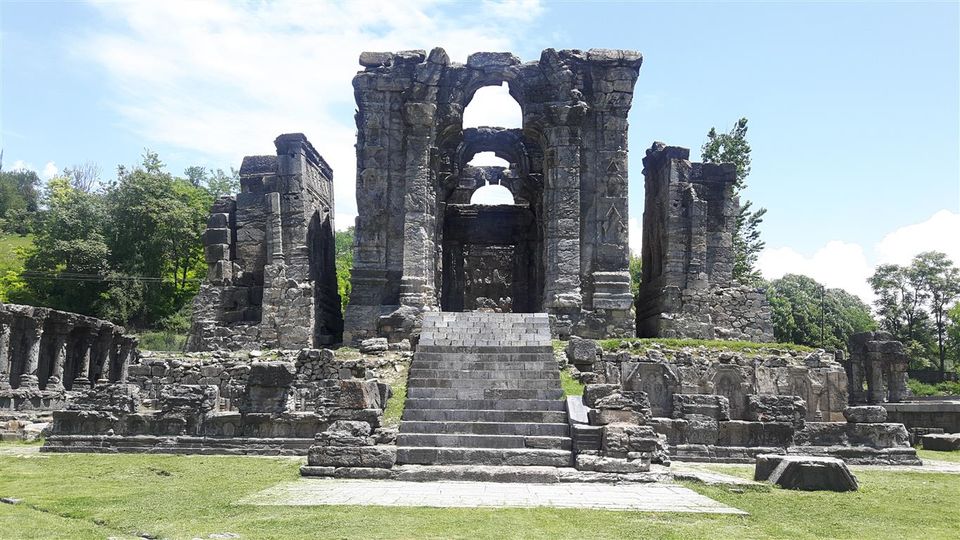
Kalhana conceives a ruler to be visionary. His historiography establishes that though both the liberal and bigot rulers were the parts of history, it was the liberal and visionary ruler who made not only the history of his own, but also made parts of the history of his own kingdom. For him, Lalitaditya was very much respectful to both the Brahmanism and Buddhism. Kalhan narrates the contributions of Lalitaditya to the building of both the Hindu temples and Buddhist monasteries in a very lucid manner. According to Kalhan, “He built a beautiful town named Parihaspura. Here he set up a silver image of Vishnu, named Shiparihasakeshva, and another gold named, Shrimuktakeshva, also an image of Mahavarsha, the mail of this last image being made of gold. He also set up a silver image of Govardhanadhara. He planted a single piece of stone fifty-four cubits high, on which was planted a banner, on the top which he set up an image of Garura. He likewise built a temple of Buddha, which had a square court-yard, also a chaitya, and a monastery. The image of Muktakeshva was built of eighty-four thousand tolas of gold, that Shriparihasakeshava was built of eighty four thousand palas of silver. The image of Buddha which he set up was built of eighty four thousand prasthas of brass. The monastery which had a squire court-yard and the chaitya, were built for eighty-four thousand pieces of the current coin. The rich king built gods of gold and silver by the side of the great gods of the country.”
Kalhana’s historiography set a trend of publicizing the constructive activities of the rulers so that society was to be mobilized in the same direction. Along with the ruler’s constructive activities Kalhan also highlighted the constructive activities of other persons hold some political power. Kamlawati , the queen of Lalitaditya, is also shown as a rich person and the builder of a silver of image of Lord Vishnu. Chakramardika, another queen of Lalitaditya has been shown as a founder of a town named Chakrapura with seven thousand houses. Thus through historiography Kalhan presents women of Kashmir as the participants in socio-economic developments of the region. The political powers of the queens of Kashmir such as Sugandha and Didda are narrated by Kalhan in such a way as they made history for themselves. The Sanskrit historiography of Kashmir not only produced a biography of the region of Kashmir, but also the adjoining states and other contemporary regions of India and foreign countries find some space. Some of the important areas of Jammu hills such as Rajouri, Punch and Kishtwar etc. are presented by Kalhan with their historical events. Kalhan mentions Rajouri as Rajapuri and Kishtwar as Kashtwata.
Through his history writing Kalhan established that a region was not surviving in exclusive term. But it was very much associated with the others. He established that the history moved around the multi-identities of a region. His narratives show that the political, religious changes in Kashmir were usual phenomena. He has shown that the historical changes took place in Kashmir in a very usual manner. The Nagas, Shaivites, Vaishnavites, Buddhist and some others emerged and grew in different phases. All these cults found their own followers in the region. Similarly, Kalhan shows that dynastic changes in terms of political power were also took place in continuous processes. No dynasty was everlasting in terms of retention of its rule in Kashmir.
The Karkota, Utpala, Gupta and Lohara dynasties of Kashmir contributed to the political, social and economic developments in Kashmir. But common people of Kashmir did not identify themselves to any particular ruling dynasty. The dynastic changes did not influence the work culture in Kashmir. For the common people, dynastic changes were just transfer of power from one dynasty to another. They identified themselves more with their socio-economic problems than the ruling dynasties.
However, Kalhan established that historiography created a mingling of diverse thoughts, religious and lingual identities. He has shown that both the centripetal and centrifugal tendencies were parts of history of a region. Similarly, both the constructive and destructive elements were parts of the history of a region. But a region flourished in a popular manner when the constructive elements outnumbered the destructive elements. And these constructive elements belonged to multiple backgrounds. Uniformity was not the popular and dominant historical trends of Kashmir. Kalhan shows that both the king Lalitaditya and Awantivarman (855-83) belonged to two different dynasties of Kashmir, former from the Karkota dynasty and later from the Utpala; but both of them brought huge dividends for Kashmir in terms of economic developments, promotion of the art and architectures and social justice.
The emergence of historiography in Kashmir made people conscious of their regional identities. They not only realized the significance of historical sources in knowing the phases of the social changes at regional level, more importantly, they made history writing one of the most effective means of preservation and promotion of the heritage of the region. It is important to mention that Kashmir is one of the few hill states of India which historical heritage are well documented in historical terms.
The local crafts and craftsmen represent their regional identity in various parts of world with a sense of historical pride. Thus the historiography has been instrumental in making dialogue between past and present in a continuous process.
