

Move to streamline governance, reduced red tape, says CS
Yash Khajuria
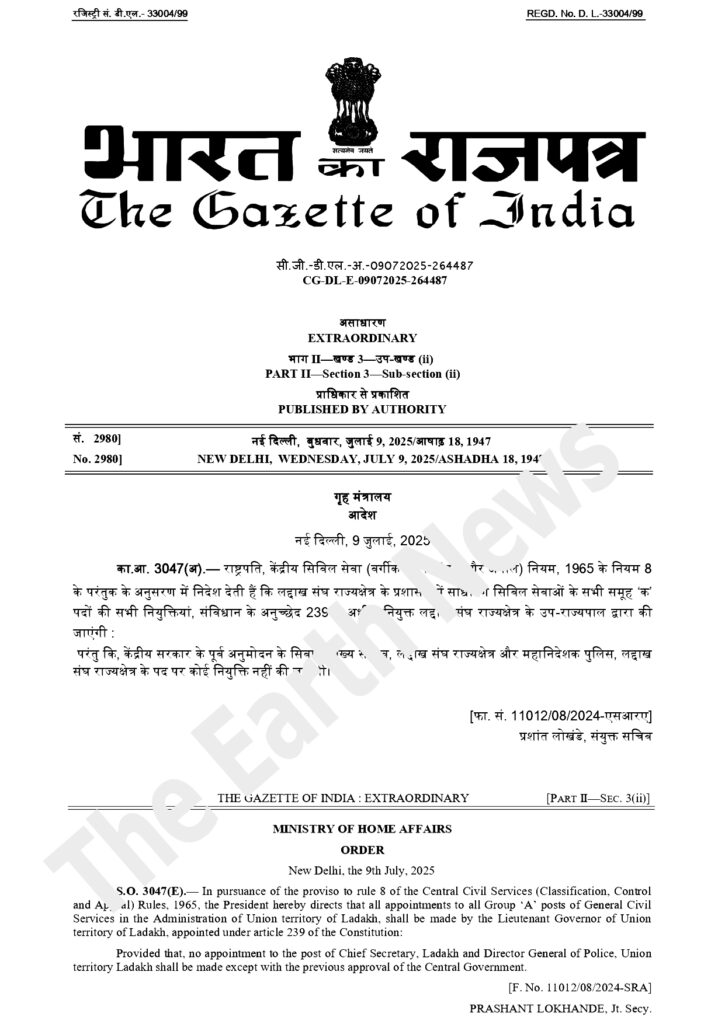
Leh, Jul 09: In a major development reshaping Ladakh’s administrative landscape, the President of India has authorized the Lieutenant Governor of the Union Territory to make appointments to all Group ‘A’ posts of the General Civil Services within Ladakh. The directive was issued through a notification under Article 239 of the Constitution.
Under the new arrangement, the Lieutenant Governor can independently appoint officers to high-ranking administrative roles across the territory. However, two top positions—the Chief Secretary and the Director General of Police—will remain under the purview of the Central Government, requiring its approval before appointments can be finalized.
The notification is intended to enhance governance efficiency in the Union Territory by giving the LG greater operational control. It aligns with the broader framework of Article 239, which governs the administration of Union Territories and enables the President to delegate powers to administrators appointed for such territories.
Ladakh, which became a Union Territory without a legislature in August 2019 after the reorganization of Jammu and Kashmir, has since seen centralized administrative authority vested in the office of the LG. The latest directive further consolidates that role, amid continuing demands from local stakeholders for expanded local governance.
Reliable sources have confirmed that the Union Territory (UT) administration of Ladakh recently submitted a list of employees promoted to gazetted ranks to the Ministry of Home Affairs (MHA) for onward approval by the President of India. Alongside this, a formal request for delegation of powers was also made.
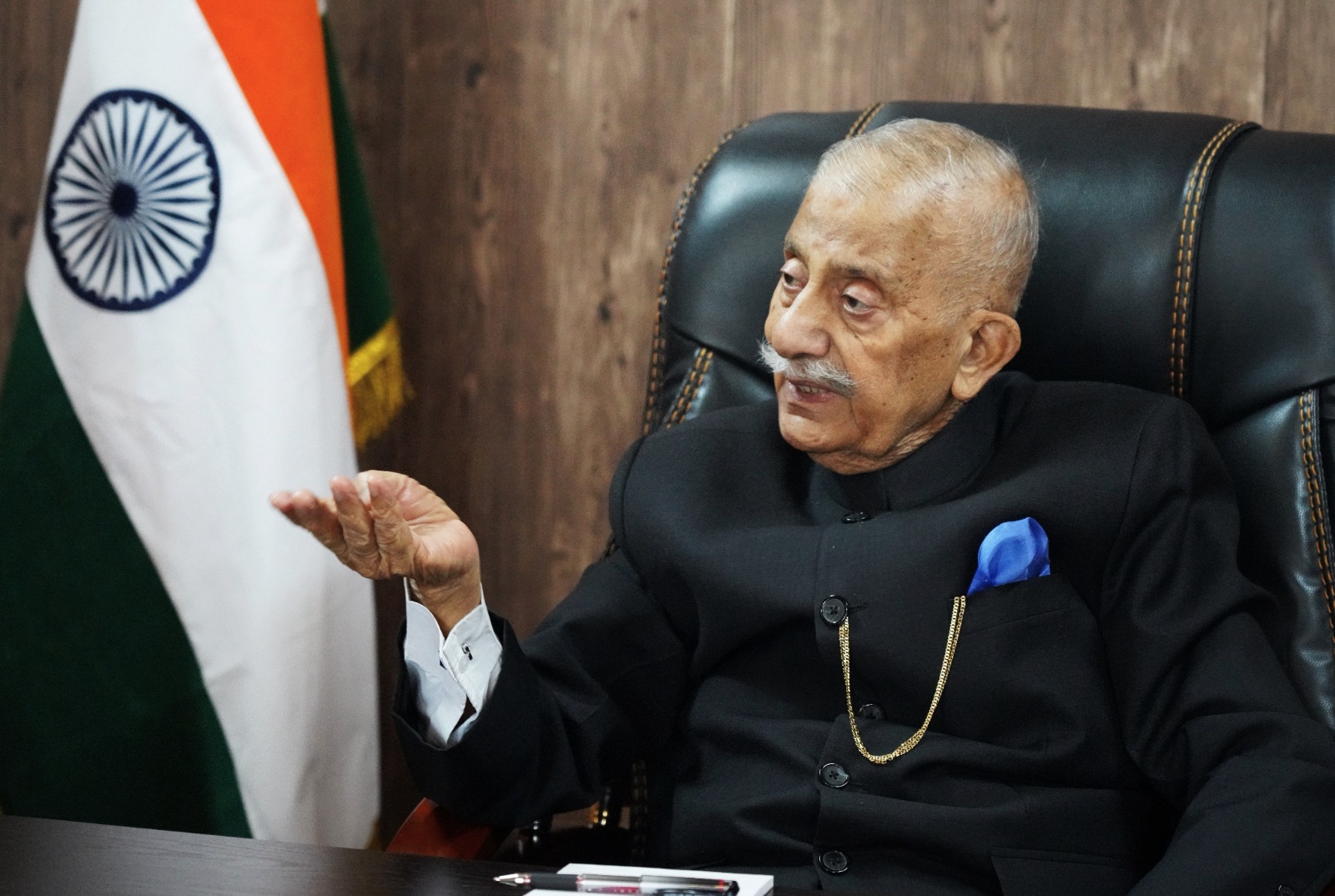
Speaking to The Earth News, Dr. Pawan Kotwal, Chief Secretary of Ladakh, welcomed the move, stating that the delegation of powers to the Hon’ble Lieutenant Governor (LG) of Ladakh for appointing gazetted officers is in line with the government’s vision to ensure seamless governance in the Union Territory.
He explained that earlier, the LG did not have the authority to appoint gazetted officers or issue appointment letters for officials promoted from non-gazetted to gazetted ranks. This lack of empowerment caused significant delays in the official transition of job portfolios, as such cases had to be forwarded to the MHA for approval and issuance of appointment orders.
“With the delegation of powers to the Hon’ble LG, the government has taken a proactive step to eliminate unnecessary procedural delays in such matters,” Dr. Kotwal added.
Michael D’Souza, Hon’ble Administrative Secretary of Ladakh, clarified that under the Central Civil Services (CCS) Rules and Central Civil Instructions (CCI) applicable to Union Territories, the LG of Ladakh is already empowered to appoint officials to Group B and Group C posts. The LG has further delegated the power to appoint Group C employees, including Junior Assistants and Senior Assistants (up to Level 6), to the Administrative Secretaries in Ladakh.
He added that Group B includes both gazetted and non-gazetted posts, and while the UT administration had been issuing promotion and appointment orders for Group B posts with the LG’s approval, challenges arose in the case of Group A posts—such as Consultants, Executive Engineers, and Deputy Directors.
Under existing rules, only the President of India is authorized to approve appointments to Group A posts in Union Territories. However, these powers can be delegated to the respective LG or Administrator only through official notification—which Ladakh did not previously have.
To address this bottleneck, the Ladakh UT Administration formally requested the delegation of powers to the LG. The Ministry of Home Affairs, in consultation with the Ministry of Law and Justice, carefully analyzed the legal and technical aspects and approved the delegation. This is expected to streamline appointments to several crucial roles.
Among the immediate beneficiaries of this decision will be officials such as the Deputy Director of the Archives and Archaeology Department, whose Departmental Promotion Committee (DPC) meeting was held on April 7. Official orders will now be issued without delay. Similarly, regularization orders for Executive Engineers in the PWD Department and for the Chief Executive Officer will be processed in the first phase.
Additionally, promotion orders for all Group A posts cleared by Departmental Promotion Committees (DPCs) are now set to be issued promptly.
Sources further disclosed that around 600–650 promotion cases for Group A and Group B posts are currently pending in the Ladakh UT. Of these, approximately 350 will be filled through direct recruitment, while nearly 300 employees will be promoted based on finalization of technical evaluations and eligibility criteria as per the rules.
The LG’s newly conferred authority covers appointments under the Factories Act for certifying surgeons and inspectors. Officials say the aim is to speed up decision making in a terrain where weather, high altitude and strategic sensitivities demand swift administrative action. Still, voices in Kargil and Leh caution that transferring power from New Delhi to the Lieutenant Governor’s office falls short of the autonomy many demand. Both the Leh Apex Body and the Kargil Democratic Alliance continue to press for inclusion in the Sixth Schedule of the Constitution or full statehood to safeguard identity and economic rights.
Pertinently, two members of the Ladakh Apex Body- a panel which has been engaged with the MHA over critical issues concerning Ladakh, Its Autonomy as a UT, its Climate, and protection of local rights, resigned this week citing dissatisfaction with the pace of reform ahead of scheduled talks with the Union Home Ministry.
Simultaneously, the Ladakh administration has launched its first major recruitment drive since the territory’s formation, opening 359 gazetted posts via the Union Public Service Commission. The initial phase includes 269 posts, covering Medical Officers, Lecturers, Assistant Directors in Economics and Statistics, and Engineers across public departments. This initiative follows the June 2 notification of the Ladakh Civil Services Decentralization and Recruitment (Amendment) Regulation, 2025.
To support local employment and preserve Ladakh’s cultural fabric, the Central Government has also raised the job reservation quota for Ladakhi residents to 85 percent. This measure, notified on June 27 through the Ladakh Reservation (Amendment) Regulation, 2025, responds to growing concerns over demographic changes and local unemployment.
The LG has also been vested with powers under various other statutes, including the Factories Act, 1948, allowing appointments to roles such as Certifying Surgeons and Inspectors of Factories. These administrative changes point to a gradual shift in how Ladakh is governed, with increasing functional control being transferred to the Union Territory’s LG.
Despite these developments, local political groups like the Leh Apex Body and the Kargil Democratic Alliance have raised objections. They argue that these reforms fall short of addressing their core demands—statehood and inclusion under the Sixth Schedule of the Constitution. Both bodies contend that only constitutional safeguards can protect Ladakh’s unique identity, land, and employment rights.
Adding to the unrest, two members of the Ladakh subcommittee resigned ahead of scheduled talks with the Ministry of Home Affairs, signaling dissatisfaction with the current pace and direction of reforms. Youth organizations, including the All Ladakh Unemployed Youth Association, have echoed concerns about the effectiveness and transparency of the ongoing recruitment drive, particularly regarding the inclusion of non-Ladakhi candidates under the domicile rule.
Meanwhile, Ladakh’s strategic location near the Line of Actual Control with China remains a focal point of national security. Governance reforms in the region are viewed by some as a move to reinforce civilian administration amid heightened military presence following the 2020 border standoff.
In contrast, governance models across Union Territories are diverging. Jammu and Kashmir’s LG recently dismissed a proposal for elected representatives to have a say in civil service appointments. Ladakh’s model, by comparison, grants its LG broader administrative authority, underscoring differing approaches in managing territories without legislatures.
As the region balances between central oversight and local aspirations, the evolving administrative framework continues to shape Ladakh’s post-2019 journey.
