

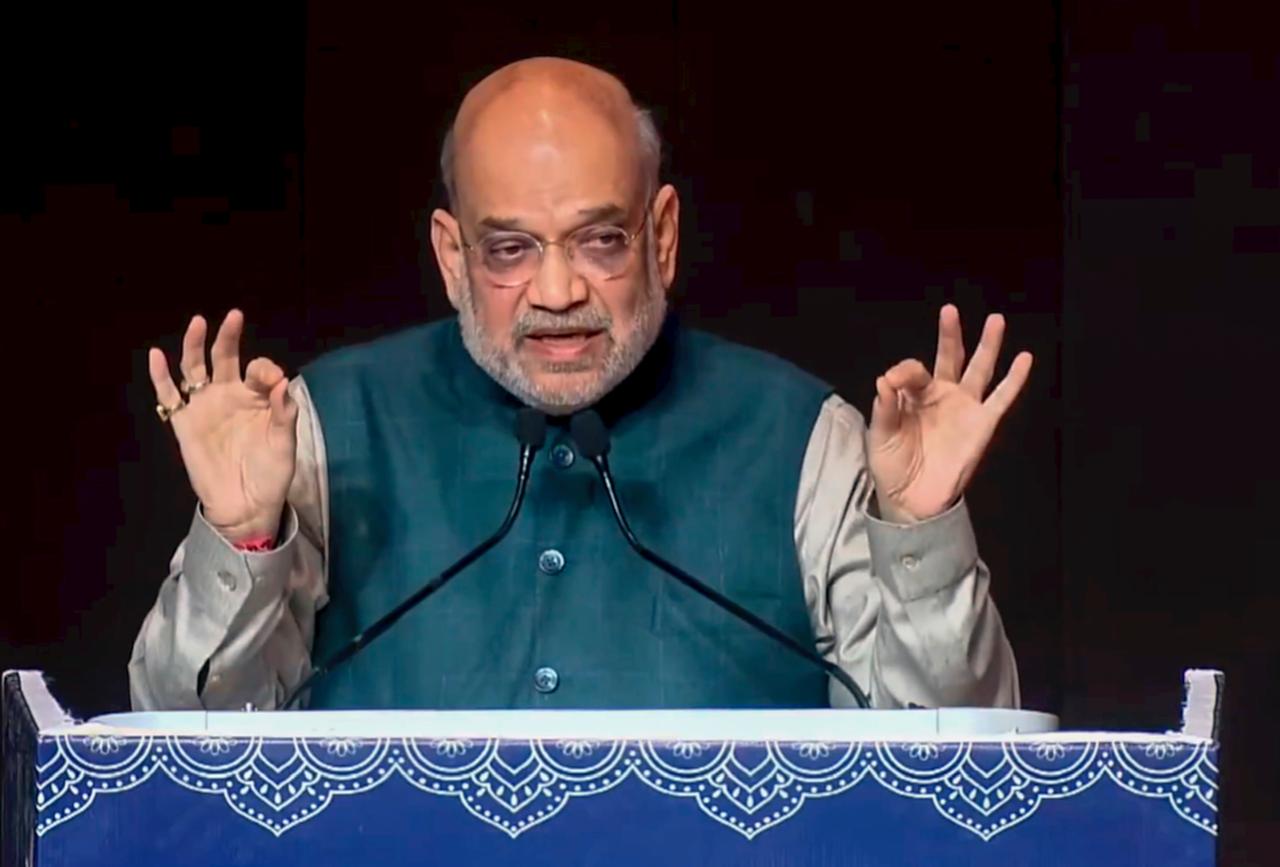
NEW DELHI: Union Home Minister and Minister of Cooperation Amit Shah on Tuesday said the recovery and protection of ₹8,189 crore out of an estimated ₹20,000 crore lost to cyber fraud stands as a major operational outcome of the country’s cybercrime response framework, even as the Ministry of Home Affairs has cancelled over 12 lakh SIM cards, blocked IMEI numbers of more than three lakh mobile phones and arrested 20,853 accused persons till December 2025.
Delivering the opening address at the National Conference on Tackling Cyber-Enabled Frauds and Dismantling the Ecosystem in New Delhi, Shah said returning frozen funds to victims remains central to restoring public trust in the digital economy.
He formally inaugurated the new cybercrime branch of the Central Bureau of Investigation and launched the State Cyber Crime Coordination Centre (S4C) dashboard of the Indian Cyber Crime Coordination Centre.
The Home Minister said cybercrime has shifted from isolated, individual offences to organised and technology-driven operations, requiring institutions to respond with the same scale and coordination as conventional organised crime.
Shah said multiple agencies of the Union government — including State police forces, the CBI, National Investigation Agency, Enforcement Directorate, Department of Telecommunications, the banking sector, the Ministry of Electronics and Information Technology, the Reserve Bank of India and the judiciary — are now working in an integrated framework to contain cyber-enabled fraud.
Referring to financial recovery, he said that through 3.61 lakh cyber fraud complaints, authorities were able to safeguard and return ₹8,189 crore to victims, while the total estimated fraud amount stood at around ₹20,000 crore. He described the recovery effort as the outcome of sustained coordination between investigative agencies, banks and the Indian Cyber Crime Coordination Centre.
The Home Minister said the enforcement push has also focused on closing digital access routes used by offenders. Till December 2025, the Ministry of Home Affairs has cancelled more than 12 lakh SIM cards identified as suspicious, blocked IMEI numbers of over three lakh mobile devices and arrested 20,853 accused persons in cybercrime cases.
He warned that cybercrime has evolved into an organised ecosystem in which digital accounts, SIM cards and payment tools are traded and misused as part of structured criminal operations.
Shah said that India’s rapid digital expansion has created both opportunity and exposure. The country now has over one billion internet users and more than one billion broadband connections. Connectivity from Parliament to village panchayats through BharatNet, he said, has widened access to public services and digital platforms across rural India.
He underlined that in 2024 alone, India recorded over 181 billion digital transactions with a total value exceeding ₹233 trillion. From a global perspective, he said, every second digital transaction now takes place in India, placing a heavy responsibility on authorities to secure payment systems.
The Home Minister said 97 per cent of payment system transactions are currently carried out through digital modes and, by volume, the share has reached 99 per cent. Protecting these transactions, he added, is inseparable from protecting economic stability.
On financial inclusion, Shah said more than 57 crore Jan Dhan accounts are operational as of February 2026, while over ₹48 lakh crore has been transferred directly to beneficiaries through the Direct Benefit Transfer mechanism.
He said cyber security can no longer be treated only as a financial issue and must be viewed as an essential component of national security, covering economic, social and administrative systems.
Referring to the work of the Indian Cyber Crime Coordination Centre since its establishment in 2019, Shah said a nationwide cyber infrastructure has been created and institutional linkages have been strengthened. At the same time, he cautioned that weaknesses in digital evidence handling and the chain of custody continue to affect convictions in cybercrime cases.
The Home Minister said the Ministry of Home Affairs is pursuing a multi-layered strategy focused on real-time cybercrime reporting, expansion of forensic laboratory networks, capacity building, research and development, public awareness and cyber hygiene.
Between January 2020 and November 30, 2025, the national cybercrime reporting portal recorded more than 230 million visits. During the same period, over 82 lakh cybercrime complaints were registered, of which around 1.84 lakh were converted into FIRs.
Shah said the national cyber fraud helpline 1930 has emerged as a critical tool in preventing losses and urged police units across the country to ensure adequate call handlers. Delays in answering distress calls, he said, often lead to irreversible financial damage to victims.
He also directed all public, private and cooperative banks to adopt the Mule Account Hunter software developed jointly by the Government of India and the Reserve Bank of India, warning that incomplete screening of mule accounts will continue to expose customers to fraud.
The Home Minister said 795 institutions, including banks, fintech firms, non-banking financial companies and e-commerce platforms, are now connected with the Indian Cyber Crime Coordination Centre. Sixty-two banks and financial institutions have already been onboarded, and the government aims to bring all remaining institutions, including cooperative banks, onto the system by December 2026.
Highlighting the role of central agencies in tackling cross-border cybercrime, Shah said agencies such as the CBI and the NIA are critical in identifying overseas networks and illegal call-centre operations. He also stressed that faster coordination between banks and the Indian Cyber Crime Coordination Centre is essential for early freezing of fraudulent transactions.
Shah said cybercrime awareness campaigns initiated under the leadership of Prime Minister Narendra Modi have strengthened public outreach, but sustained participation from institutions and citizens is necessary to prevent cyber-enabled fraud from expanding further.
During the event, the Home Minister presented President’s Medals for Distinguished and Meritorious Service and the Kendriya Grihmantri Dakshata Padak to selected officers of the Central Bureau of Investigation.
The two-day conference is being organised by the Central Bureau of Investigation in collaboration with the Indian Cyber Crime Coordination Centre under the Ministry of Home Affairs. Sessions on the first day focused on cyber-enabled fraud trends, mule accounts and financial laundering, misuse of telecom infrastructure and the role of artificial intelligence in cyber investigations.
