

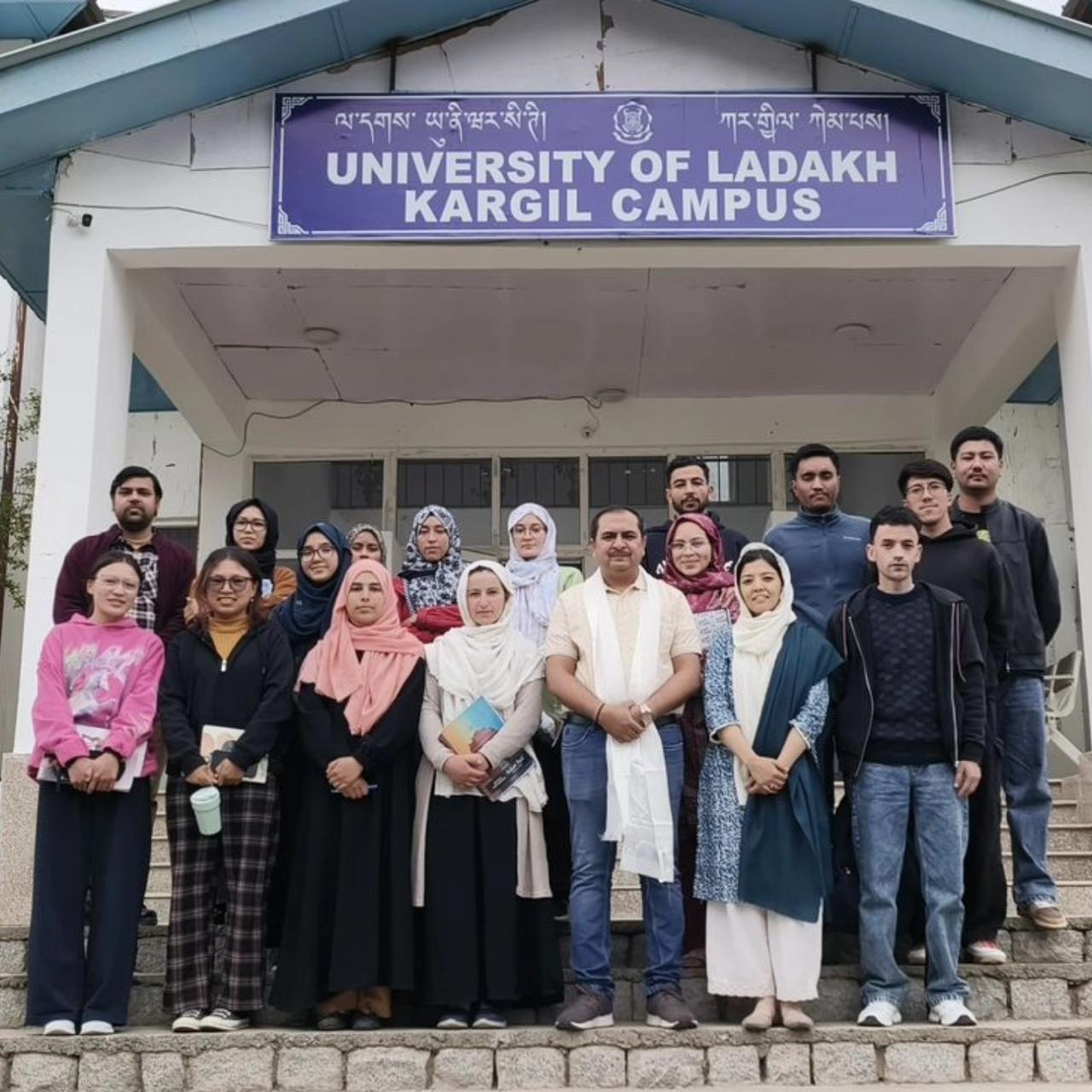
Kargil, May 9 : The Department of Forensic Science, Kargil Campus, University of Ladakh, organised a special academic lecture on “Postmortem Interval (PMI): A Forensic Perspective” at the Conference Hall of the Administrative Block, bringing together students, researchers and faculty members for a detailed discussion on emerging forensic investigation techniques.
The programme was conducted under the guidance of Prof. (Dr.) Saket Kushwaha, Vice-Chancellor, University of Ladakh, and was attended by Dr. Mehboob Ali, In-Charge Administration, Kargil Campus, who served as the patron of the event.
Prof. Rushikesh Joshi from the Department of Biochemistry and Forensic Science, Gujarat University, delivered the keynote lecture, focusing on the scientific and medico-legal importance of determining the postmortem interval in forensic investigations.
At the outset, Dr. Mehboob Ali felicitated the guest speaker with a traditional Ladakhi Khatak as a mark of honour. The programme formally commenced with a welcome address by Dr. Qutsia Tabasum, Coordinator, Department of Forensic Science, who welcomed the guest faculty, academic staff and students participating in the session.
During his lecture, Prof. Joshi elaborated on both conventional and modern molecular approaches used to estimate postmortem interval in medico-legal investigations. He discussed histological examination methods along with advanced molecular techniques, including RNA degradation analysis and its relevance in studying postmortem changes.
He also highlighted the expanding role of the forensic microbiome in enhancing the scientific precision of forensic and medico-legal examinations, while drawing attention to contemporary research trends and evolving technologies in the field of forensic science.
The lecture witnessed active participation from students and faculty members belonging to the Departments of Forensic Science, Anthropology, Disaster Management, Mathematics and other academic disciplines at the Kargil Campus.
Students from the Department of Forensic Science at the Leh Campus also attended the programme through online mode, making the academic interaction inclusive across campuses and enabling broader participation in the specialised lecture session.
