

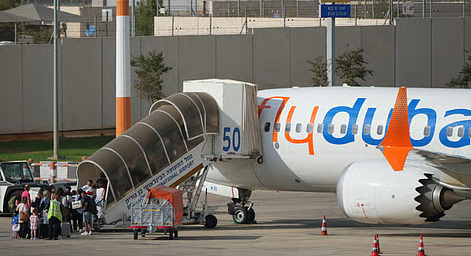
JERUSALEM, OCT 2: The alleged attack on a Flydubai pilot during a flight from Dubai to Tel Aviv has raised fresh questions about aviation security, particularly the screening and monitoring of airline crew members.
Flydubai Flight FZ1073, carrying 174 people, was travelling to Tel Aviv on Wednesday when the co-pilot allegedly stabbed the captain inside the cockpit. Passengers and crew members intervened, and the aircraft was eventually diverted to Tabuk, Saudi Arabia, where it made a safe emergency landing.
The incident is being investigated by authorities in Saudi Arabia, the UAE and Israel, with the United States and Oman also assisting in efforts to determine the circumstances and possible motive.
Security experts said aviation security has traditionally placed greater emphasis on passengers and baggage, while crew members have been subject to different screening procedures depending on the country and airline.
Former Israeli national security adviser Eyal Hulata said the incident could lead to greater scrutiny of flight crews, while other experts cautioned that investigators first need to determine whether existing security procedures were followed.
Questions have also emerged over how the alleged attacker, identified by Israeli authorities as an Omani national, was cleared to operate on a Tel Aviv-bound flight. Israel and Oman do not have formal diplomatic relations.
Israeli Prime Minister Benjamin Netanyahu said there appeared to have been a security loophole and that authorities were taking steps to address it.
International aviation standards establish baseline requirements for pilot licensing and vetting, while individual countries and airlines can impose additional measures. Experts said investigators are likely to examine the co-pilot’s employment history, medical evaluations, previous reports of concerning behaviour and the airline’s response to any warning signs.
The handling of the aircraft’s emergency communications is also expected to come under review. The crew reportedly issued an emergency alert indicating a possible hijacking after the aircraft experienced a sharp descent.
The aircraft was eventually permitted to land at Prince Sultan bin Abdulaziz International Airport in Tabuk. Aviation experts noted that international rules call for assistance to aircraft facing hijacking or other unlawful interference, although the extent of a country’s obligations can depend on circumstances and national regulations.
The incident has also renewed debate over reinforced cockpit doors, which became a central aviation security measure following the September 11, 2001 attacks.
In this case, the injured captain reportedly managed to open the cockpit door, allowing passengers and crew members to enter and restrain the alleged attacker before other crew members took control of the aircraft.
Aviation security specialists said the incident highlights the challenge of protecting aircraft from threats originating not only outside the cockpit but potentially from within the flight crew itself. Investigators are expected to determine whether any existing security or screening procedures failed and whether changes are required.
