

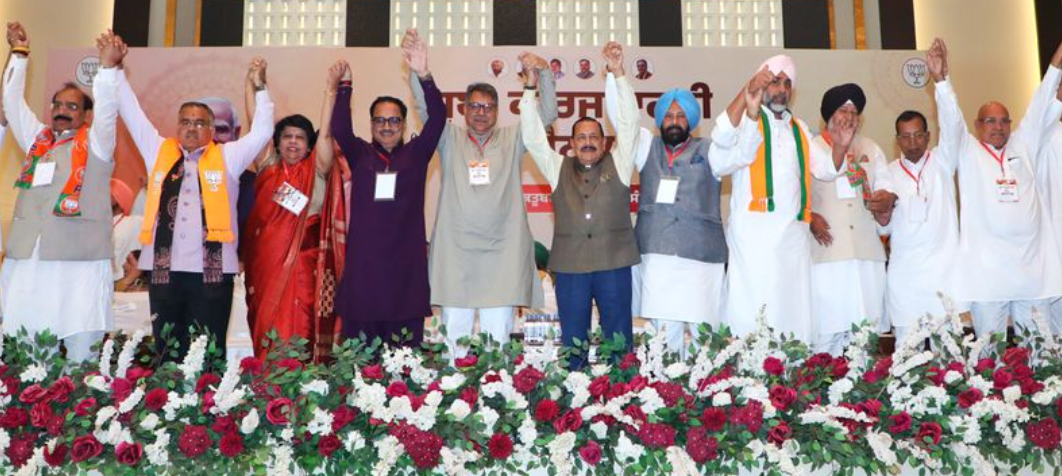
Sangrur, Punjab, October 16: Union Minister Dr Jitendra Singh on Friday said that the vision of a developed India would remain incomplete without a developed Punjab, emphasising that the state must play a key role in Prime Minister Narendra Modi’s vision of Viksit Bharat by 2047.
Addressing the Punjab BJP State Executive Committee meeting in Sangrur, Dr Singh called for development-oriented governance, accountability and effective action against drug abuse, corruption and other challenges facing the state. He also said Punjab needed a “double-engine government” to accelerate its development.
The meeting, held under the leadership of Punjab BJP President Kewal Singh Dhillon, was part of the party’s preparations for the 2027 Punjab Assembly elections. Discussions included plans for all 117 Assembly constituencies.
Senior BJP leaders attending the meeting included Punjab BJP in-charge Dr Satish Poonia, co-in-charges Varinder Sachdeva and Dr Alka Gurjar, and senior party functionary Tarun Chugh.
The discussions covered Punjab’s political, economic and social situation, with particular focus on farmers’ concerns, drug abuse, law and order, women’s safety, pending dearness allowance dues of government employees and the state’s financial condition.
Focus on Infrastructure and Development
Reflecting on Prime Minister Narendra Modi’s 25 years of public leadership, Dr Singh said stable leadership had contributed to changes in India’s global standing, national confidence and development priorities.
Highlighting Punjab’s development potential, he cited ₹43,527 crore in national highway development projects and ₹34,488 crore in railway investments, along with the modernisation of railway stations across the state.
He also referred to the Pradhan Mantri Kisan Samman Nidhi scheme, stating that approximately 11 lakh farmers in Punjab had benefited from the initiative, with ₹6,552 crore distributed under the scheme.
On healthcare, the Minister highlighted AIIMS Bathinda, the Tata Memorial Centre’s cancer facility in Mohali and the establishment of 565 Jan Aushadhi Kendras across Punjab, stressing the importance of accessible healthcare and affordable medicines.
Dr Singh also discussed the Shahpur Kandi project, highlighting the potential of better water-resource management to strengthen irrigation, improve agricultural productivity and support power generation.
Referring to Punjab’s cultural and religious heritage, he mentioned the Kartarpur Sahib Corridor, GST exemption on langar items and initiatives commemorating Sikh history and heritage.
Calls for Action Against Drugs and Corruption
Dr Singh stressed that development must go hand in hand with good governance, transparency and accountability. He raised concerns over drug abuse, corruption, illegal mining, infrastructure quality and the utilisation of public funds.
Referring to reports of bridge damage and concerns over construction standards and illegal mining, he cautioned that negligence and short-term gains could put public safety and infrastructure at risk.
He called for responsible administration and greater accountability to protect public assets and improve the state’s economic prospects.
Youth Employment and Future of Punjab
The Minister also highlighted the changing aspirations of Punjab’s youth, pointing to students from smaller towns pursuing competitive examinations and professional education.
He said a developed Punjab would require stronger educational opportunities, entrepreneurship, employment prospects and an environment that enables young people to build their futures within the state.
Concluding his address, Dr Jitendra Singh said Punjab’s development must remain an integral part of India’s journey towards Viksit Bharat by 2047.
“Viksit Bharat’s vision remains incomplete without Viksit Punjab,” he said, reiterating that development-oriented governance, economic growth, social progress and respect for Punjab’s heritage were essential to the state’s future.
