

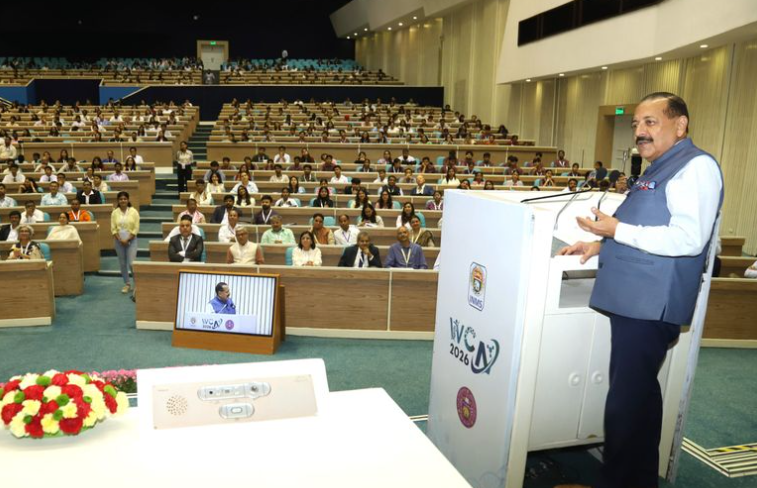
NEW DELHI, Sep 27: Union Minister Dr Jitendra Singh on Sunday inaugurated the World Congress on Nanomedicine 2026 in New Delhi, highlighting the potential of nanotechnology to transform precision medicine and personalised healthcare.
Addressing the inaugural session at Vigyan Bhawan, Singh said nanomedicine could play a major role in the next generation of healthcare by enabling treatments at the cellular level and allowing therapies to be tailored to individual patients.
He said future medical treatment would increasingly take into account factors such as a patient’s genetic profile, lifestyle, dietary habits and environmental conditions.
The congress, hosted by the Institute of Nano Medical Sciences (INMS), Faculty of Medical Sciences, University of Delhi, has brought together more than 2,000 scientists, researchers and young scholars to discuss developments and applications in nanomedicine.
Nobel Laureate Prof Roger D. Kornberg is chairing the congress, while Prof T.M.S. Chang of McGill University is its honorary president.
Explaining the field, Singh said nanomedicine involves applying nanotechnology to medicine, working with structures measured at one-billionth of a metre. He said such technology could help make diagnosis and treatment more targeted and precise.
The minister also highlighted the wider economic potential of nanomedicine, saying developments in the field could contribute to more cost-effective healthcare and create opportunities across the health and technology sectors.
At the same time, Singh cautioned against excessive dependence on technology in medical practice. He said technologies such as artificial intelligence and nanotechnology should complement doctors’ clinical judgment rather than replace essential human and medical expertise.
He also called for medical education to evolve with technological advances while retaining traditional clinical skills such as patient observation and physical examination.
Highlighting government support for nanomedicine research, Singh said the Department of Biotechnology is supporting 210 R&D projects with financial assistance of Rs 174 crore.
The projects cover areas including targeted drug delivery, cancer nanomedicine, infectious-disease treatment, nucleic-acid and vaccine delivery, nano-diagnostics, medical imaging, regenerative medicine, wound healing, nanotoxicology and regulatory science.
Among the emerging areas discussed were oral insulin nanoparticles, nanobots for breast cancer, precision nanoinjection and targeted cancer therapies.
Singh said India’s nanomedicine ecosystem was expanding beyond laboratory research, with government initiatives supporting startups, infrastructure, technology development and regulatory processes.
Through BIRAC, biotechnology enterprises can access programmes such as the Biotechnology Ignition Grant, PACE, SBIRI and BIPP to help translate research into commercial applications and products.
He also said India had developed a regulatory framework for nanopharmaceuticals through guidelines prepared jointly by the DBT, ICMR and CDSCO, covering the safety, quality and efficacy assessment of nanopharmaceutical products.
Singh said India had developed scientific and institutional capabilities in nanomedicine and was increasingly positioned to contribute to future healthcare technologies.
Prof Roger D. Kornberg described nanomedicine as a rapidly developing field with significant potential, particularly in targeted drug delivery, diagnosis, imaging and regenerative medicine.
The World Congress on Nanomedicine 2026 is being organised under the International Society of Nano Medical Sciences and the International Society for Nano Medicine, providing a platform for researchers, students and industry representatives to exchange knowledge and explore collaborations in the field.
