

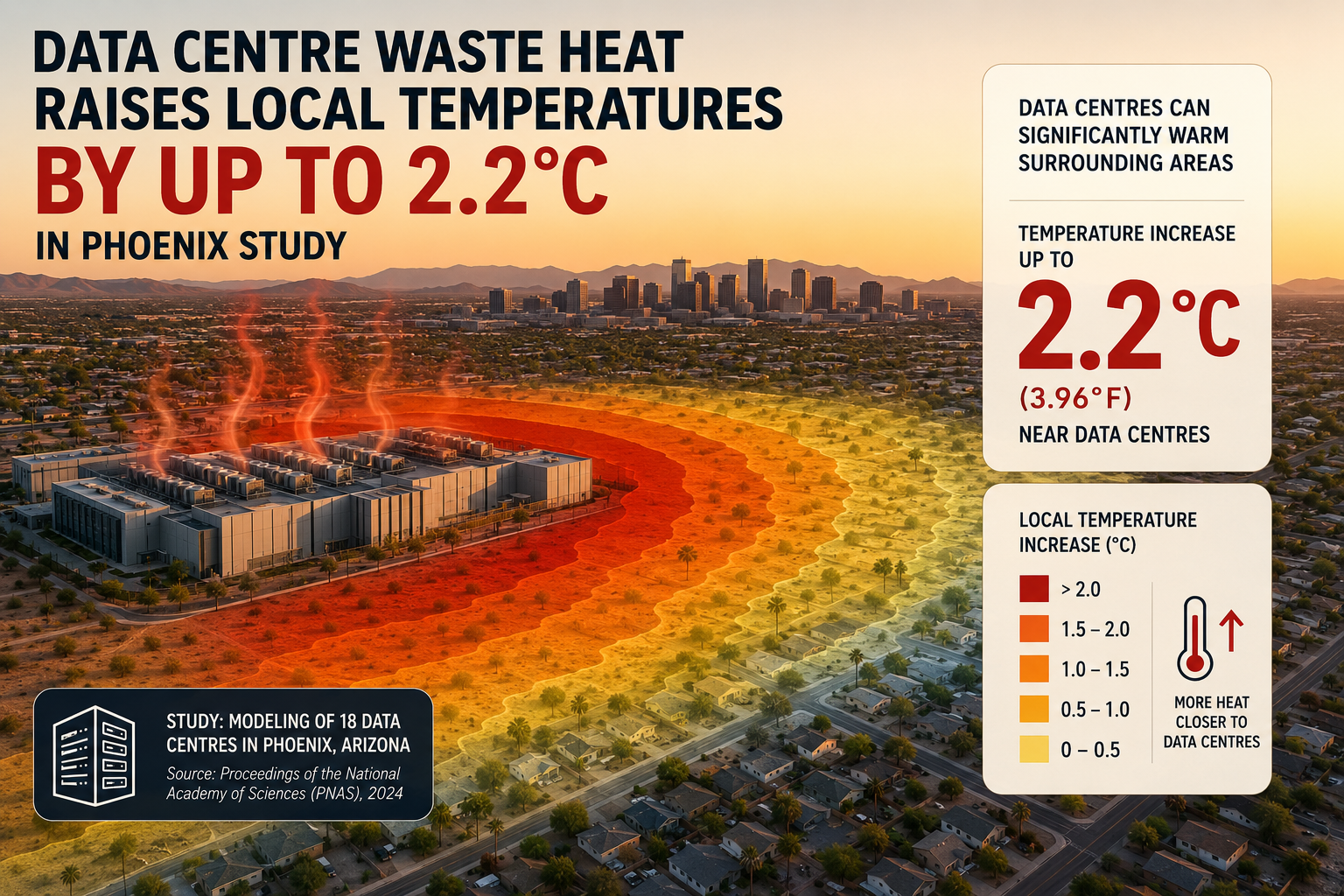
NEW DELHI, May 19: A new US-based study conducted in Phoenix, the hottest city in the United States, has found that waste heat from data centres can significantly raise surrounding air temperatures in nearby neighbourhoods.
Researchers from Arizona State University reported that air temperatures in downwind areas of data centres can increase by as much as 2.2°C (4°F), compared to upwind locations. The study highlights that heat released from a single data centre can exceed the emissions of around 40,000 households.
According to lead author Professor David Sailor, director of ASU’s School of Geographical Sciences and Urban Planning, large-scale data centres release intense concentrated heat due to heavy electricity consumption, which can affect local microclimates.
The study found that air-cooled condenser systems used in many facilities release air that is 8–14°C warmer than surrounding temperatures, creating thermal plumes that drift into nearby residential areas.
Researchers conducted real-time temperature measurements around four data centre sites in the Phoenix metropolitan region between June and October 2025. Using mobile sensor-equipped vehicles, they recorded both upwind and downwind temperatures, observing consistent warming of 0.7–0.9°C on average, with peak increases reaching 2.2°C.
The report, published in the Journal of Engineering for Sustainable Buildings and Cities, is among the first to directly measure localized heat impacts from operational data centres rather than relying on satellite estimates.
Sailor warned that even small increases in temperature can worsen urban heat stress, particularly in already hot regions, as it may drive higher air-conditioning use and further increase local heat emissions.
