

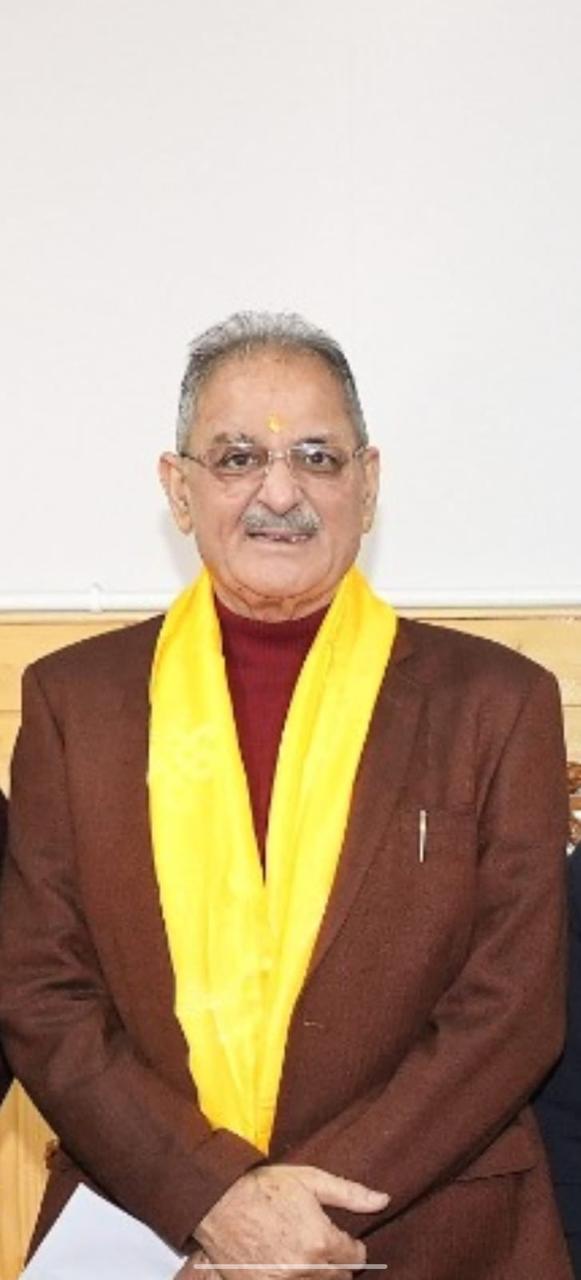
Yash Khajuria
Leh, Mar 06: The Union government on Thursday carried out a wide-ranging reshuffle of gubernatorial and lieutenant gubernatorial positions across several states and Union Territories, resulting in a change of leadership in Ladakh with Vinai Kumar Saxena appointed as the new Lieutenant Governor of the border Union Territory.
Saxena, who currently serves as Lieutenant Governor of Delhi, will replace Kavinder Gupta, who has been reassigned as Governor of Himachal Pradesh. Gupta’s tenure in Ladakh lasted nine months after he assumed office as the third Lieutenant Governor on July 18, 2025 following the resignation of Brigadier (Retired) B.D. Mishra.
The appointments form part of a broader administrative reorganisation announced by the Union government on Thursday.
Under the new arrangements, Taranjit Singh Sandhu has been appointed Lieutenant Governor of Delhi. Shiv Pratap Shukla, who previously served as Governor of Himachal Pradesh, has been appointed Governor of Telangana, while Jishnu Dev Varma, the current Governor of Telangana, will move to Maharashtra as Governor.
The reshuffle also places Nand Kishore Yadav as Governor of Nagaland and Lt. General (Retired) Syed Ata Hasnain as Governor of Bihar. R.N. Ravi, presently Governor of Tamil Nadu, has been assigned to West Bengal, while Rajendra Vishwanath Arlekar, the Governor of Kerala, will discharge the functions of Governor of Tamil Nadu.
The leadership change in Ladakh arrives at a time when the Union Territory has been witnessing sustained public mobilisation over political and administrative issues. Civil society groups including the Leh Apex Body and the Kargil Democratic Alliance have been leading demonstrations demanding full statehood, Sixth Schedule safeguards, stronger protection for local employment and land ownership, and separate parliamentary representation for Leh and Kargil.
The protests have intensified over recent months, reflecting ongoing political tensions in the strategically important high-altitude region.
Ladakh has remained politically unsettled since its reorganisation as a Union Territory without a legislature in 2019. Local leaders have argued that the arrangement curtailed democratic participation and strengthened centralised administrative control. Concerns regarding environmental vulnerability and unemployment among the region’s youth have also been repeatedly raised during the agitation.
The protest movement reached a peak during late 2025 when demonstrations in Leh turned violent, leaving several people dead and many injured. Climate activist Sonam Wangchuk also undertook hunger strikes that drew national attention to the demands raised by Ladakh’s civil society organisations.
During prolonged shutdowns and marches, damage was reported to several structures, including the local Bharatiya Janata Party office and parts of the Ladakh Autonomous Hill Development Council complex.
Protest groups have consistently reiterated a set of demands that includes full statehood with an elected legislature and Chief Minister, Sixth Schedule protection for tribal land and resources, domicile-based reservation in public employment, restrictions on land purchase by non-residents, and separate Lok Sabha constituencies for Leh and Kargil.
The Ministry of Home Affairs has held multiple rounds of discussions with representatives of Ladakh since 2021. Among the draft measures proposed by authorities are an 85 per cent reservation in government jobs for Ladakh residents, a 15-year residency requirement for domicile status, a 33 per cent quota for women in hill development councils, and official recognition of five regional languages.
However, protest leaders have maintained that these proposals fall short of addressing the central political concerns raised by the movement.
In one of his final public engagements in the Union Territory on March 2, Gupta reviewed arrangements for the exposition of sacred Buddha relics in Leh and urged collective efforts to maintain harmony across the region.
Reactions to the latest administrative shift have been varied. Representatives of the Leh Apex Body expressed cautious optimism that the new administration may facilitate renewed dialogue with the Union government. Leaders from Kargil have urged continued vigilance, stating that leadership changes alone may not resolve the underlying political grievances.
With Vinai Kumar Saxena set to assume charge, Ladakh enters another phase of administrative transition even as public demonstrations continue and demands for enhanced political representation remain unresolved.
