

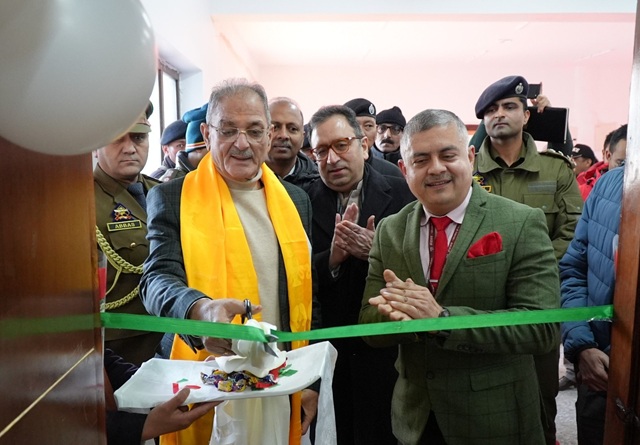
Leh, Jan 07: Lieutenant Governor of Ladakh Kavinder Gupta on Tuesday inaugurated the office of the Directorate of Census Operations in Leh, marking the beginning of preparations for the exercise in the Union Territory in 2027.
The Union Cabinet on December 12 last year approved an outlay of Rs 11,718 crore for conducting the Census of India, 2027, which will include caste enumeration for the first time.
“Lieutenant Governor Kavinder Gupta today inaugurated the office of the Directorate of Census Operations, Jammu Kashmir and Ladakh at Leh,” the Office of the Lieutenant Governor said on X.
Gupta said the milestone marks the beginning of preparations for Census 2027 and will strengthen administrative and statistical readiness in the region.
Speaking at the occasion, Lieutenant Governor Kavinder Gupta said that the upcoming Census 2027 will play a decisive role in shaping Ladakh’s development planning, governance priorities, and allocation of resources, stressing that accuracy and transparency must remain at the core of the exercise.
The Lieutenant Governor made these remarks while inaugurating the Office of the Director of Census Operations and Citizen Registration, Jammu & Kashmir and Ladakh, at the Department of Archives, Archaeology and Museum in Leh.
Addressing officials and stakeholders, LG Gupta said Ladakh’s sparse population spread across difficult terrain makes precise data collection both challenging and essential. He underlined that credible census figures will directly guide future infrastructure planning, public services, and welfare delivery in the Union Territory.
Referring to the long reliance on 2011 Census data, the Lieutenant Governor said the new enumeration will address persistent gaps in planning and policy formulation. He also recalled irregularities reported during census exercises in the erstwhile Jammu and Kashmir state and asserted that the first census in Ladakh as a Union Territory must adhere strictly to constitutional norms.
“This exercise must be carried out with complete transparency, reliability, and efficiency. There can be no dilution in standards,” he said, adding that the UT Administration will extend full cooperation to ensure the smooth conduct of the census.
LG Gupta noted that the Census 2027 has received approval from the Union Cabinet chaired by Prime Minister Narendra Modi, and follows the deferment of the 2021 exercise due to the Covid-19 pandemic. He also linked the census initiative with India’s long-term development goals, highlighting the use of digital tools, geo-tagging, and online self-enumeration through mobile applications and portals.
Chief Secretary Ashish Kundra described the establishment of the census office in Leh as a major administrative step and said advanced digital platforms would ensure timely and accurate data collection. He assured all logistical and administrative support from the UT government.
Director of Census Operations and Citizen Registration, J&K and Ladakh, Amit Sharma, outlined the two-phase census process. The first phase—Houselisting and Housing Census—will be conducted between April and September 2026, while Population Enumeration will begin from September 2026, with special provisions for snow-bound regions. He said the Ladakh house-listing exercise is expected to be held between June 1 and 30.
Sharma said the census will be fully paperless, include self-enumeration options, and collect caste-related data. He also sought additional office space to ensure efficient functioning of the census unit.
Joint Director Arun Kumar presented the vote of thanks.
Administrative Secretaries Sanjit Rodrigues and P.T. Rudra Goud, Additional District Development Commissioner Leh Sonam Nurboo, and senior government officials were present on the occasion.
Earlier, LG Kavinder Gupta had stated that the Union Territory is significantly strengthening its healthcare infrastructure by upgrading hospitals, installing advanced medical equipment, and establishing a new medical college, with a special focus on serving people in high-altitude and remote areas.
Speaking on healthcare developments in Ladakh, Lieutenant Governor Gupta said that three Tesla MRI machines worth approximately Rs 26 crore were installed at the Kargil district hospital. The LG emphasised that building and health infrastructure is being developed at both hospitals, which will further enhance the medical facilities in the region.
Ladakh has a total of 32 primary health centres and 288 Ayushman Arogya Mandirs. To address the challenges posed by the high altitude, oxygen chambers are being installed at various healthcare facilities, which will provide critical care to patients.
“We have two major district hospitals, and both district hospitals are well-equipped. We are striving to ensure that the latest machinery is available there. A week ago, we installed three Tesla MRI machines at our Kargil district hospital, at a cost of approximately Rs 26 crore. Building and health infrastructure is being developed at both our hospitals in Leh and Kargil. We have 32 primary health centres and 288 Ayushman Arogya Mandirs. Overall, considering the high altitude, we are also installing oxygen chambers, which cost crores of rupees… We are bringing in such machinery so that a doctor sitting in the Leh or Kargil hospital can provide consultations to patients in the remote areas at the Community Health Centres (CHCs) and Primary Health Centres (PHCs)… If we look at the average health budget for the entire country, it is 8%, but Ladakh’s budget is 8.76%.”
The Lieutenant Governor also announced that a new medical college will soon be established in Ladakh. “A new medical college is also coming up there… 85% of the seats will be reserved for Scheduled Tribes (STs), with all students from Ladakh. We have acquired the land for this project, and construction will begin soon at a cost of Rs 786 crore,” Ladakh LG added.
