


Outrage over Seating Bias at Ladakh LG’s Swearing-In Ceremony
Yash Khajuria
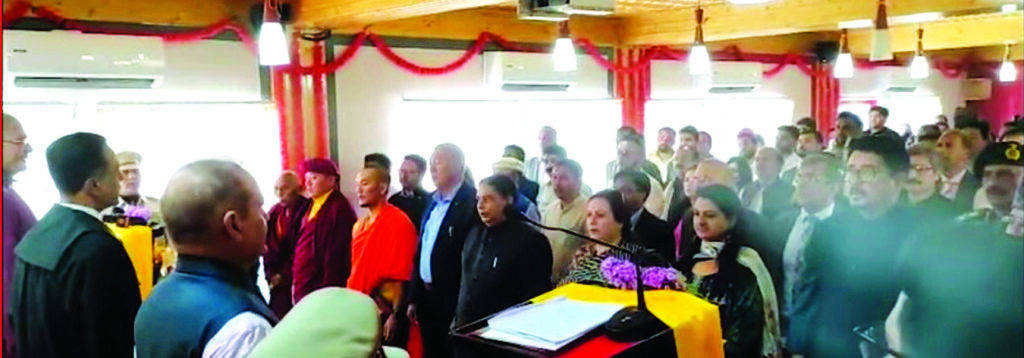
Leh, July 18: What was meant to be a ceremonial beginning for Ladakh’s newly appointed Lieutenant Governor, Kavinder Gupta, has quickly turned into a political flashpoint. Discontent erupted across the Kargil region following allegations of disrespectful seating arrangements during the swearing-in ceremony held in Leh, fueling charges of administrative bias reflecting on deepening regional grievances.
At the heart of the controversy is the placement of religious leaders, LAHDC Kargil members, and other special invitees from Kargil in the back rows of the event venue, while clergy and dignitaries from Leh were visibly seated at the front. The perceived imbalance has not only drawn public outrage but also political condemnation, with many interpreting the arrangement as a symbolic marginalization of Kargil.
Dr. Jaffer Akhoon, Chief Executive Councilor of LAHDC Kargil, expressed his displeasure in no uncertain terms. “The arrangements for the oath ceremony reflect a troubling message. When prominent religious leaders and officially invited members of our district are treated with such disregard, it raises serious questions about the larger administrative mindset toward Kargil,” he told The Earth News.
Dr. Akhoon formally registered his protest with the Secretary to the LG and Chief Secretary of Ladakh, Dr. Pawan Kotwal, emphasizing that such treatment of invited guests cannot be dismissed as a logistical lapse. However, he was careful not to assign blame to the newly appointed LG himself. “The Lieutenant Governor took charge today. Holding him responsible for an oversight by the bureaucracy would be unfair. But going forward, the administration must ensure equal regard for all regions and communities,” he added.
He further urged the LG to adopt an inclusive approach. “Whether from Leh, Kargil, Zanskar, Nubra, Drass, or Nyoma, every citizen deserves equal respect. We look forward to welcoming the LG warmly in Kargil on July 25 and will use that opportunity to appeal for a governance model that treats all Ladakhis with dignity.”
Student leader Mohd. Hassanain Rocky also expressed strong disapproval, characterizing the incident as more than a matter of seating. “This is not just about a few elders being placed in the back. It’s an insult to Kargil—a region that forms the majority of Ladakh’s population. The administration’s actions expose an unsettling disregard for our presence and contribution.”
Rocky called on the Lieutenant Governor’s office to conduct a thorough inquiry and hold those responsible accountable. “Whether this was a deliberate act or negligence, it must be addressed. Moving forward, Ladakh’s governance must reflect balance and fairness. No community should feel alienated or secondary.”
The incident has deepened existing concerns in Kargil about political and administrative marginalization, a sentiment that has grown in the years since Ladakh was carved out as a separate Union Territory. Critics argue that symbolic acts of exclusion reinforce longstanding fears that Kargil’s interests are being sidelined.
In the aftermath of the controversy, Dr. Akhoon reiterated the importance of turning this moment into a course correction. “This cannot be brushed aside as ceremonial oversight. It must be taken as a reminder of the sensitivities in our diverse region. Unity cannot be built on unequal treatment.”
As the newly appointed LG prepares for his first visit to Kargil later this month, the people of the region are watching closely, hoping the administration will move toward a more balanced and respectful governance framework. For many in Kargil, this is not just about protocol—it is about visibility, respect, and an equal place in the evolving narrative of Ladakh.
Rocky summed up the public mood with a pointed appeal: “Let this serve as a moment of introspection. Ladakh’s unity depends on mutual respect and equal representation. We urge the administration to move forward with empathy and fairness.”
