

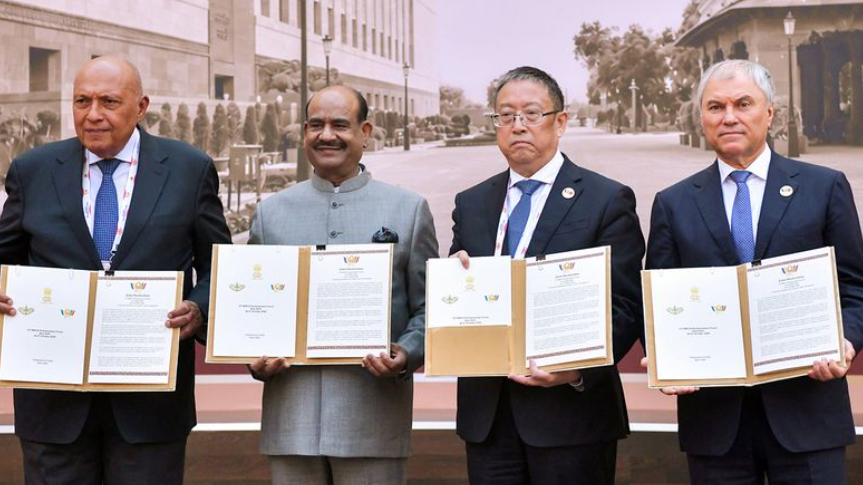
New Delhi, October 27: The two-day BRICS Parliamentary Forum concluded on Tuesday with the adoption of a joint declaration strongly condemning the April 22, 2025, terror attack in Pahalgam, Jammu and Kashmir, and reaffirming the grouping’s commitment to combating terrorism in all its forms.
Announcing the declaration, Lok Sabha Speaker Om Birla said the forum also called for comprehensive reforms of the United Nations, including the UN Security Council (UNSC), to make the institution more representative, democratic, effective and reflective of contemporary global realities.
The declaration condemned the Pahalgam attack, in which 26 people were killed and several others injured, and called for coordinated international action against terrorism, including cross-border movement of terrorists, terror financing and the provision of safe havens.
The forum emphasised that terrorism must not be associated with any religion, nationality, civilisation or ethnic group. It called for those responsible for terrorist activities, as well as their supporters, to be held accountable under applicable national and international laws.
It also urged countries to adopt a zero-tolerance approach towards terrorism, reject double standards in counter-terrorism efforts and ensure that measures to address terrorist threats comply with the United Nations Charter and international law.
The declaration called for the early finalisation and adoption of the Comprehensive Convention on International Terrorism under the UN framework.
Call for United Nations reforms
The BRICS Parliamentary Forum reiterated its support for comprehensive UN reforms, particularly the expansion and restructuring of the Security Council, to ensure fairer representation and improve its ability to respond to current international challenges.
The declaration also opposed unilateral economic and secondary sanctions, stating that such measures could have far-reaching consequences for human rights, development, healthcare and food security.
Reaffirming the principles of sovereign equality, mutual respect, non-interference in internal affairs and peaceful settlement of disputes, the forum described these principles as essential to international peace, stability and development.
West Asia conflict and Palestinian statehood
The declaration expressed concern over escalating tensions in West Asia and called on all parties to exercise maximum restraint and avoid actions that could further worsen the situation.
It reaffirmed support for a peaceful resolution of the Israeli-Palestinian conflict through a two-state solution, with Israel and an independent Palestinian state living side by side in peace and security.
The forum also reiterated the Palestinian people’s right to self-determination, freedom and an independent, sovereign state.
It condemned violations of international humanitarian law, including deliberate attacks on civilians and civilian infrastructure, restrictions on humanitarian assistance and attacks on humanitarian personnel. The declaration stressed the importance of accountability for such violations.
Cooperation on climate change and emerging technologies
The forum also called for stronger international cooperation to address climate change through the implementation of nationally determined contributions and enhanced mitigation and adaptation measures under the UN Framework Convention on Climate Change and the Paris Agreement.
Recognising the growing influence of artificial intelligence and information and communication technologies, the declaration emphasised the need for their safe, secure, peaceful and equitable development and use while respecting national sovereignty and security.
It further highlighted the importance of improving AI energy efficiency, encouraging scientific innovation and using emerging technologies to support economic growth and social development, particularly across the Global South.
BRICS members include Brazil, Russia, India, China, South Africa, Egypt, Ethiopia, Indonesia, Iran and the United Arab Emirates, among others. The forum’s declaration covered counter-terrorism, global governance, regional conflicts, climate change and technological cooperation.
