

Rahul Pandit
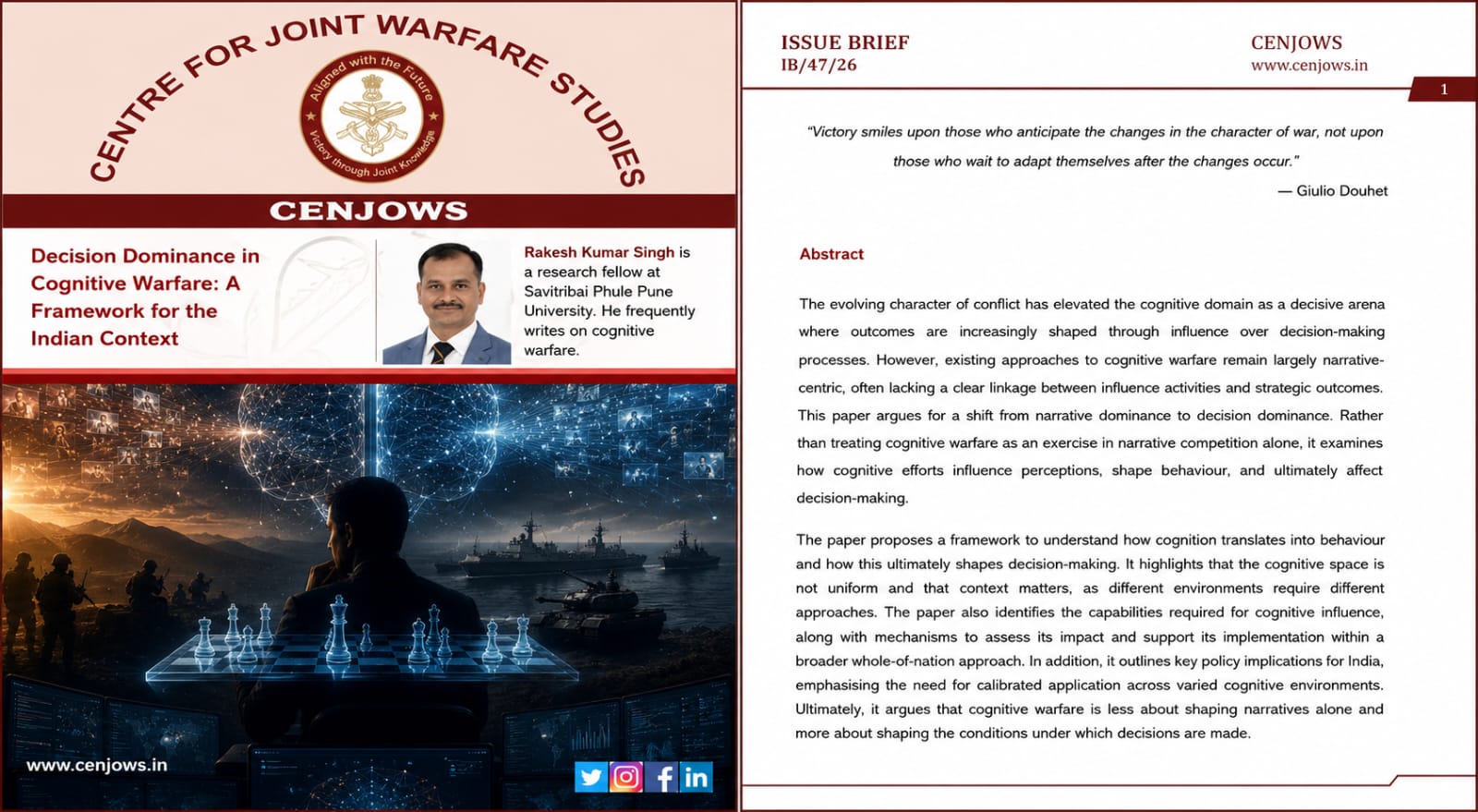
The publication of Decision Dominance in Cognitive Warfare: A Framework for the Indian Context by Col. Rakesh Kumar Singh comes at a time when the character of conflict is undergoing a profound transformation. Wars today are no longer fought solely on land, at sea, in the air, or even in cyberspace. Increasingly, they are fought in the minds of people, where perceptions shape behaviour and behaviour influences decisions. It is in this evolving landscape that this issue brief makes a significant contribution to India’s strategic thinking.
One of the paper’s greatest strengths lies in challenging a widely accepted assumption in information warfare—that success is measured by visibility. In the age of social media, analysts often equate viral posts, trending hashtags, millions of views, or online engagement with strategic success. Col. Singh argues that such metrics can be deceptive. A narrative that dominates public discourse but fails to alter an adversary’s behaviour or decision-making ultimately achieves little in strategic terms.
Instead, he introduces the concept of Decision Dominance, shifting the focus from influencing opinions to influencing decisions. This seemingly simple distinction has far-reaching implications. The paper argues that the true objective of cognitive warfare is not merely to win the information battle but to shape the environment in which governments, militaries, institutions, and societies make critical choices.
The framework presented is both systematic and practical. Rather than treating cognitive warfare as an abstract concept, the author develops a structured model beginning with cognitive terrain mapping, progressing through narrative framing, behavioural activation, and decision environment distortion, before culminating in decision dominance supported by continuous feedback. The framework transforms cognitive warfare from an academic discussion into a practical guide that can assist planners and policymakers.
Particularly noteworthy is the paper’s recognition that cognitive environments differ across regions and political systems. By categorising them into high-permeability, semi-permeable, and controlled environments, the author acknowledges that a one-size-fits-all approach to influence operations is unrealistic. Democracies such as India operate in a vastly different information ecosystem compared to tightly controlled states like China, requiring customised strategies rather than imported doctrines.
The issue brief also deserves appreciation for placing India at the centre of the discussion rather than borrowing Western strategic templates wholesale. India’s linguistic diversity, democratic openness, federal structure, vibrant media landscape, and expansive digital ecosystem present both strengths and vulnerabilities in the cognitive domain. The paper recognises these realities and advocates a whole-of-nation approach involving government institutions, the Armed Forces, intelligence agencies, academia, industry, media, and civil society.
Equally important is the emphasis on measurable outcomes. Instead of celebrating reach and engagement, the author proposes evaluating cognitive operations through indicators such as delayed decision-making, institutional confusion, policy reversals, behavioural shifts, and strategic hesitation. Such an outcome-oriented approach has the potential to reshape how future information campaigns are planned and assessed.
The paper also highlights the growing role of artificial intelligence, data analytics, behavioural sciences, and social media monitoring in understanding and influencing cognitive environments. As AI-generated content, deepfakes, algorithm-driven influence campaigns, and synthetic media become increasingly sophisticated, this framework provides a timely foundation for developing indigenous Indian responses.
For military professionals, strategic planners, policymakers, scholars, and students of national security, the issue brief offers far more than theoretical insights. It presents a conceptual roadmap that can stimulate debate, inspire further research, and contribute to the development of India’s cognitive warfare doctrine.
No single paper can comprehensively address every dimension of such a vast and evolving field. Nevertheless, Col. Rakesh Kumar Singh has succeeded in opening an important conversation. By moving beyond narratives towards decision-centric thinking, he has introduced an idea that deserves serious attention within India’s strategic community.
As conflicts increasingly shift from the battlefield to the cognitive domain, frameworks such as this may well become essential reading for those responsible for safeguarding India’s national security. The paper is not merely an academic exercise; it is a timely reminder that in modern warfare, victory often belongs not to the side that speaks the loudest, but to the one that most effectively shapes the decisions of others.
