

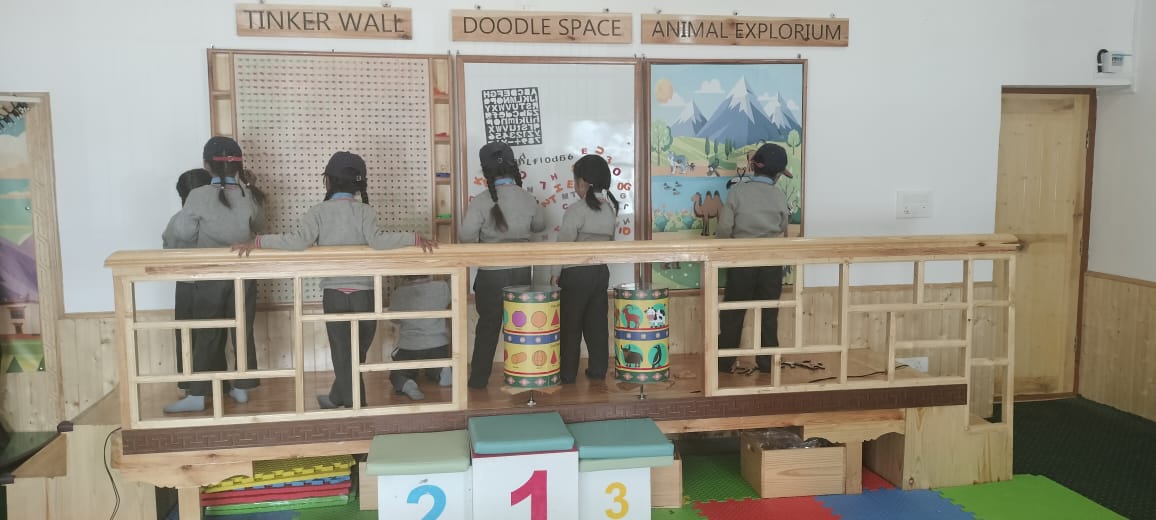
Leh, May 16 : The District Institute of Education and Training (DIET) Leh on Friday hosted students and teachers of Government Middle School Sanker for an educational exposure visit aimed at familiarising young learners with experiential and activity-based teaching methods, as part of efforts to strengthen child-centred learning practices in schools.
The students were taken through various academic and demonstration sections of DIET Leh, including the Balvatika Model Room, where faculty members introduced them to interactive teaching tools, creative classroom activities and contemporary pedagogical approaches designed to make learning more engaging and practical.
During the visit, students actively participated in demonstrations and explored educational models and learning resources displayed in different laboratories. The contextualised Jadui Pitara Box, locally known as “Mig Thrul Gi Gum”, emerged as one of the major attractions during the programme, with students showing keen interest in hands-on learning exercises and interactive educational materials.
Faculty members of DIET Leh explained the role of experiential education in enhancing conceptual understanding among children and emphasised the need for classroom environments that promote curiosity, observation and creativity. The visiting students engaged enthusiastically with the activity-based modules and learning aids showcased during the sessions.
Teachers accompanying the students appreciated the initiative undertaken by DIET Leh and observed that such exposure visits help bridge the gap between textbook learning and practical understanding. They said interactions with innovative educational models encourage students to think critically and develop greater interest in classroom learning.
The programme was conducted in an interactive and cheerful atmosphere, with faculty members expressing gratitude to Government Middle School Sanker for organising the visit and encouraging students to engage with innovative educational practices beyond the conventional classroom setting.
The exposure visit forms part of broader efforts to promote learner-friendly educational environments and strengthen foundational learning through participatory and experience-driven teaching methods in schools across the region.
