Shivang Satya Gupta
The preliminary investigation report released by India’s Aircraft Accident Investigation Bureau (AAIB) into the horrific June 12 crash of Air India flight AI171 in Ahmedabad, which claimed 260 lives, raises more questions than it answers.
More troubling, however, is the report’s glaring gaps and its apparent bias that deflects scrutiny from powerful international stakeholders—particularly Boeing and engine manufacturer GE—while implicitly casting suspicion on two pilots who are no longer alive to defend themselves.
The subsequent portrayal of these findings by sections of the foreign media has been not just disappointing but dangerous, as it risks distorting the truth while absolving corporate giants of accountability.
Let us be unequivocal: a tragedy of this magnitude demands a full, fearless, and transparent investigation. Instead, what we are being served is a 15-page preliminary report steeped in ambiguity, marred by omissions, and disturbingly deferential to the global aerospace behemoths involved.
We are not pointing any fingers, but let’s be honest: We are living in a world where corporations often use financial muscle and legal maneuvering to suppress uncomfortable truths, and thus, it becomes imperative that our institutions resist external influence and fulfill their duty to the public. We are hoping that this report has been without any influence, but there are still gaps that need to be filled.
To be clear, the AAIB deserves credit for working swiftly under intense public scrutiny. The release of a preliminary report within weeks is a commendable step, aimed at transparency and urgency. However, the document itself—just 15 pages long—is undeniably hasty, inconclusive, and lacking in essential detail. It outlines the “what” of the tragedy, but not the “why”—and in its ambiguity, it has unwittingly opened the door for speculation, much of it dangerously misplaced.
Worse, some sections of the international media have seized on this preliminary information to construct a narrative that rests heavily—if not entirely—on blaming the pilots. With no conclusive evidence in hand, and despite key questions left unaddressed by the AAIB, these foreign outlets have presented half-truths as headlines. This is not just irresponsible journalism—it is a disservice to the grieving families, to India’s aviation community, and to the pursuit of truth.
At stake are not only the lives already lost, but the safety of millions of passengers who place their trust in civil aviation every day.
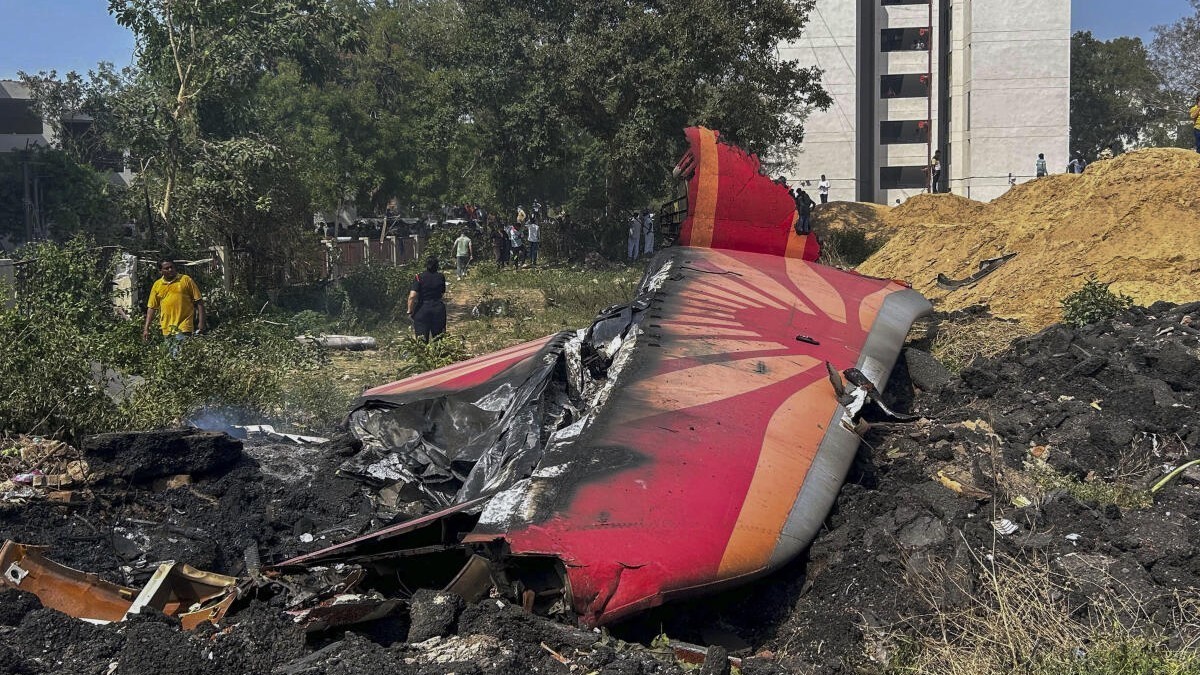
Let’s begin with what we do know. According to the AAIB’s report, the Boeing 787-8 Dreamliner experienced an abrupt loss of thrust from both engines within seconds of takeoff. The aircraft, just airborne from Ahmedabad, plummeted into a nearby building, killing nearly everyone onboard and 19 more on the ground.
The AAIB found that the fuel control switches—which regulate the flow of fuel to the engines—were both moved from “RUN” to “CUTOFF” within the span of one second. This led to a total loss of engine power and rendered the aircraft uncontrollable. The cockpit voice recorder (CVR) captures one pilot asking the other: “Why did you cut off the fuel?”—to which the response is a denial.
This brief exchange, without context, has become the centrepiece of most media coverage. And yet, critical details remain missing: Who said what? What was the lead-up to that question? Was there a mechanical or electrical failure? Were the switches triggered manually—or could an equipment or software glitch have caused it? Or were there any external sabotages?
Most glaringly, the full CVR transcript has not been released. Without it, we are left to interpret a fragmented soundbite, which is hardly a sound basis for attributing blame in a tragedy of this scale.
Here lies the first troubling issue: while the report offers a minute-by-minute account of events leading up to the crash, it completely stops short of offering any insight into why the switches moved. It neither conclusively blames the pilots nor rules out mechanical, electrical, or software-related failures. Yet, despite this studied ambiguity, the report does not recommend any action for Boeing 787-8 operators or GE engine users. There is no alert, no inspection mandate, no technical advisory—nothing that suggests the AAIB is seriously entertaining the possibility of aircraft malfunction.
Instead, the report appears to nudge readers toward a singular, convenient conclusion: pilot error. This, despite the fact that one pilot is heard asking the other, “Why did you cut off the fuel?” and the other denying it. Without releasing the full cockpit voice recording transcript, the context of this exchange remains unclear. Was it a miscommunication? A distraction? A sign of something going wrong outside their control? We are left to guess.
That is unacceptable. As veteran aviators have pointed out, fuel switches are equipped with protective locking mechanisms. Accidental movement requires lifting the switch over a mechanical gate—a deliberate action not easily performed under normal operating conditions. Moreover, the aircraft was in the initial climb phase, a period of intense workload and strict procedural adherence. For both switches to be moved, one after the other, in the span of a second, implies either an extraordinary breakdown in procedure—or something else entirely.
The AAIB report chooses to selectively quote from the cockpit voice recorder (CVR), providing one cryptic line while withholding the full transcript. Why? Surely a public investigation into a mass-casualty disaster should prioritize maximum transparency, particularly when that very quote is being used as the cornerstone for speculation around pilot error.
This lack of openness has rightly drawn criticism from the Airlines Pilots Association of India (ALPA), which has slammed the investigation for being “shrouded in secrecy” and accused it of “bias against the pilots.” ALPA’s concern is not unfounded. The investigation seems to be steering toward a preordained conclusion, ignoring critical factors such as the FAA airworthiness directive in 2018 that flagged potential issues with similar fuel control switches on other Boeing models. The locking feature, it warned, could be disengaged. The AAIB report acknowledges this—but fails to investigate whether such a malfunction occurred here, or whether Air India conducted any corrective action in line with the FAA advisory.
One must ask: Why was this not explored in depth? Why were Boeing and GE given a clean chit so early in the investigation? And more importantly, why has no recommendation been issued to reevaluate the design or functionality of the switches involved?
As troubling as the report’s evasions are, the way it has been interpreted—and amplified—by sections of the global media is equally reprehensible. In a rush to explain the crash, major foreign outlets have leaned heavily on the suggestion of pilot error, peddling headlines like “Pilots Cut Off Fuel to Engines,” with little regard for nuance or factual balance.
This is not journalism—it is speculation dressed up as reporting. The absence of verified evidence, the lack of a complete CVR transcript, and the unresolved questions surrounding switch mechanics should have prompted caution. Instead, what we witnessed was a feeding frenzy, where sensationalism trumped sobriety.
Opposition leaders in India have rightly called out this behaviour. Shiv Sena (UBT) MP Priyanka Chaturvedi castigated a British news outlet for parroting Boeing’s innocence while scapegoating Indian pilots, referring to it as “Boeing Bacchao Corporation.” The term may be acerbic, but the sentiment is shared by many: there is a palpable sense that global corporations are being shielded, while dead Indian pilots are being vilified.
One cannot ignore the elephant in the room, which is Boeing. The AAIB report makes a passing reference to a 2018 airworthiness bulletin issued by the US Federal Aviation Administration (FAA), which warned of fuel switch vulnerabilities in Boeing 737s—design features that are reportedly similar in the 787-8 Dreamliner. The FAA had flagged the possibility of locking mechanisms being disengaged, raising the risk of unintentional fuel cutoff. Did Air India ever inspect the switches in question? Was the issue addressed by Boeing in later aircraft? Were similar advisories issued to 787 operators?
We don’t know—and the report doesn’t say.
This omission is concerning. Boeing is not a peripheral player here—it is central to the investigation. The aircraft involved in the crash was nearly 12 years old. If there is any possibility of a design, software, or maintenance-related lapse, that angle must be pursued with full rigour. Any suggestion that the switches moved only due to human action must be substantiated, not assumed.
And yet, no recommendations have been issued to Boeing 787-8 operators. No inspections advised. No advisories published. That silence is deafening.
The uncomfortable truth is that Boeing has form when it comes to deflecting blame. The infamous 737 MAX crashes in 2018 and 2019, which killed 346 people, were initially pinned on pilot error and poor training. It was only after relentless investigative journalism and whistleblower accounts that systemic design flaws—particularly with the MCAS software—were revealed. Boeing eventually admitted fault and agreed to a $2.5 billion settlement with the US Justice Department. Are we witnessing the early stages of a similar whitewash here?
If the past is any indication, the answer could well be yes. The tendency to throw pilots under the bus—especially when they are no longer alive to defend themselves—offers a convenient shield for regulatory and manufacturer failures. The fact that no fault was found in the aircraft or engines so early in the investigation reeks of premature absolution.
Credit must be given to India’s Civil Aviation Minister K. Ram Mohan Naidu, who has publicly cautioned against jumping to conclusions. Emphasizing the need for a complete, concrete, and credible investigation, Naidu said it would be “immature” to read too much into the preliminary report. He has also promised that justice will be done for the families of those who lost their lives.
These are welcome statements. But words alone are not enough. The Government of India must ensure that the final report—whenever it is released—is not only exhaustive but also fearless in assigning responsibility. The AAIB must be insulated from any corporate or diplomatic pressure. India is no longer a pushover in the global order. If foreign manufacturers have erred, they must be held accountable—just as an Indian operator or pilot would be.
Moreover, the Ministry of Civil Aviation must push for greater transparency. The full CVR transcript must be released to the public. The aircraft’s maintenance and service history, especially concerning the fuel control switches, must be scrutinized. Air India’s compliance with FAA directives must be verified.
And if it turns out that Boeing or GE failed in their responsibilities—whether in design, manufacture, or advisory communications—they must face regulatory action and financial penalties. The days of shielding global corporations at the cost of Indian lives must end.
Also, the media—especially foreign outlets—must exercise greater caution and responsibility. Journalism is not about pushing convenient narratives; it is about upholding the truth, even when it is messy or incomplete. The dead Pilots cannot speak, and it is cowardly to tarnish their legacy without evidence.
Finally, the Indian public deserves regular updates. The final AAIB report, when it comes, must be exhaustive, conclusive, and devoid of any trace of ambiguity. Justice cannot be served in half-measures.
This tragedy has devastated hundreds of families. Their grief is compounded by the knowledge that the search for truth is being derailed by premature insinuations and half-formed conclusions. For them, justice lies not just in compensation, but in knowing exactly what went wrong—and in seeing those responsible held to account.
Indian aviation professionals—pilots, engineers, and cabin crews—have long operated under challenging circumstances. They deserve respect, not suspicion. To sully the reputation of two deceased aviators, both with extensive experience, based on a cryptic voice recording and no corroborative evidence, is an injustice not only to their memory but to the entire aviation community.
The AAIB’s final report must not be another exercise in obfuscation. It must probe deeper into the aircraft’s mechanical and software systems, evaluate Air India’s maintenance protocols, and include inputs from all relevant stakeholders, including ALPA and international watchdogs.
The lives of 260 people demand nothing less than full accountability. The truth must not become another casualty. This tragedy must be a turning point—not only for how we investigate aviation disasters but for how we value Indian lives.
We must reject any investigation that is cursory. We must challenge any narrative that is prejudiced. And we must insist that truth—not corporate convenience—prevails.
If Boeing is at fault, let the record reflect it. If Air India missed a crucial maintenance check, it must be held accountable. And if human error truly caused the crash, let that too be shown with clarity and evidence—not conjecture.
What we must not allow is for foreign media headlines to write the first draft of history—especially when that draft scapegoats the voiceless, shields the powerful, and distorts the public discourse.
Let’s not rush to blame. Let’s not play into sensational headlines. Let us, instead, wait for the full truth—and demand that it be pursued without fear, without favour, and without failure.
AAIB Report: Every Indian Life Matters. Don’t rush to blame. Instead, demand for full truth without fear, favour or failure.