

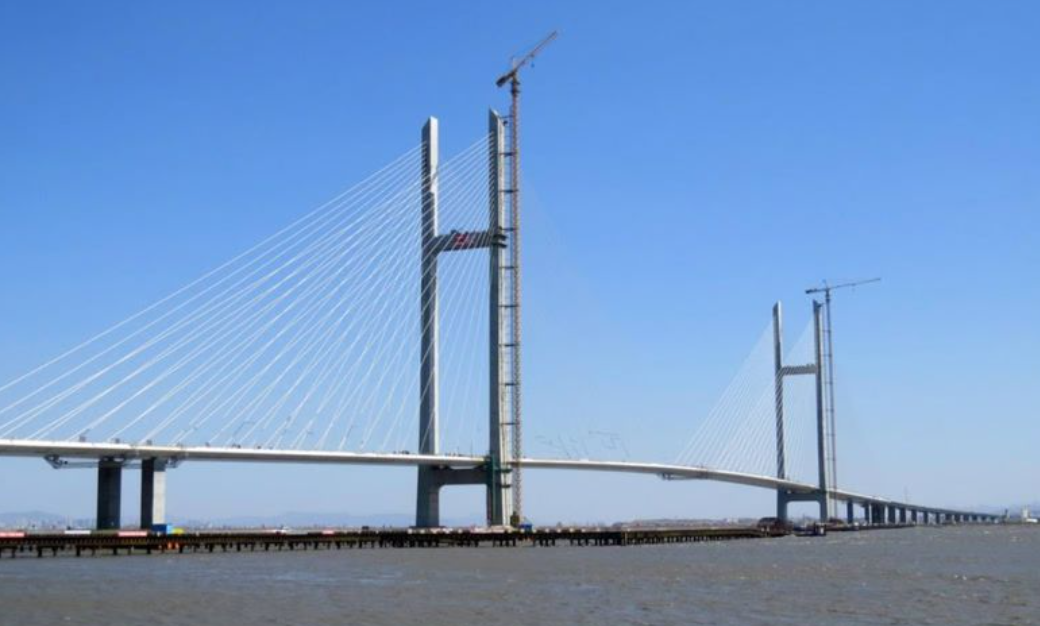
BEIJING, October 14: A new bridge connecting China and North Korea is set to open on Thursday, more than a decade behind schedule, marking another step towards strengthening economic and strategic ties between the two neighbouring countries.
China’s official Xinhua news agency reported on Wednesday that a ceremony would be held to inaugurate the New Yalu River Bridge. The four-lane structure, stretching approximately three kilometres, will link the northeastern Chinese city of Dandong with North Korea’s Sinuiju.
The bridge was originally expected to become operational in 2014, after China completed construction of access roads, customs facilities and other supporting infrastructure on its side. However, the opening was postponed as North Korea had not completed the corresponding work on its territory.
The prolonged delay sparked frustration among residents of Dandong, who had anticipated that the bridge would bring significant economic benefits to the border city. At the time, China’s state-affiliated Global Times published a report highlighting local concerns over the stalled project.
The delay also fuelled speculation that Pyongyang was reluctant to deepen its economic dependence on Beijing or was unhappy with China’s support for United Nations sanctions imposed over North Korea’s nuclear programme. Differences over the bridge’s location were also cited as a possible reason.
Once operational, the new bridge is expected to ease pressure on the existing Dandong-Sinuiju crossing, which handles more than 70 per cent of official trade between the two countries. Built in 1937, the ageing bridge carries both railway and road traffic, with vehicles able to move in only one direction at a time.
South Korean authorities reported last year that at least 17 road and rail connections were operating along the more than 1,400-kilometre China-North Korea border.
The new infrastructure is expected to improve transportation and gradually increase bilateral trade. However, a sharp immediate rise in Chinese exports is considered unlikely, as Beijing is expected to take Pyongyang’s interests into account, according to a recent report by Gyubeom Kim of South Korea’s Institute for National Security Strategy.
Kim suggested that North Korean exports to China, including processed goods, food products, cosmetics and alcoholic beverages, could also expand.
The inauguration comes around a month after North Korea and Russia opened a one-kilometre road bridge across the Tumen River, reflecting their efforts to strengthen bilateral relations. Moscow said the new crossing could facilitate the daily movement of up to 300 vehicles.
South Korean analyst Jeong Eun-i of the Institute for National Unification said the China-North Korea bridge was significantly larger and could accommodate two-way traffic around the clock, including containers and heavy cargo trucks.
China has traditionally been North Korea’s largest trading partner and a crucial source of economic support. However, North Korean leader Kim Jong Un has increasingly prioritised relations with Russia, sending thousands of troops and conventional weapons to support Russian President Vladimir Putin’s war in Ukraine, reportedly in exchange for military and economic assistance.
More recently, Kim has moved to strengthen ties with Beijing, apparently seeking economic gains and closer strategic coordination against the United States.
China, meanwhile, is looking to reassert its influence over Pyongyang. Around 98 per cent of North Korea’s external trade was conducted with China last year, underscoring Beijing’s central role in the North Korean economy.
The bridge’s opening has been anticipated since Chinese President Xi Jinping visited Pyongyang in June for talks with Kim. During the meeting, Xi expressed China’s willingness to expand cooperation in trade, agriculture, construction and technology, while Kim described relations with Beijing as a top strategic priority.
