Close Menu
  • Home
  • Latest Stories
  • Inking The Truth
  • Jammu & Kashmir
  • Ladakh
  • Entertainment
  • National
  • International
What's Hot

India’s Himalayan Shield Is Being Built on Roads, Runways and Information

BJP fields fresh candidates for UP Rajya Sabha polls; drops Hardeep Puri, seven others

Govt Working to Make Pension Services More Accessible, Technology-Driven and Citizen-Centric: Dr Jitendra Singh

Facebook X (Twitter) Instagram
Monday, October 5
  • About
  • Contact us
  • Advertise With Us
  • Privacy Policy
Facebook X (Twitter) Instagram YouTube
The Earth News
E-Paper Edition
  • Home
  • Latest Stories

    BJP fields fresh candidates for UP Rajya Sabha polls; drops Hardeep Puri, seven others

    October 5, 2026

    Govt Working to Make Pension Services More Accessible, Technology-Driven and Citizen-Centric: Dr Jitendra Singh

    October 5, 2026

    Himanta unveils bust of first Indian tea planter, charity auction raises Rs 2.26 cr for flood relief

    October 5, 2026

    Bengal approves 14,454 govt posts, Rs 50,000 scheme for unmarried women pursuing higher education: CM Suvendu

    October 5, 2026

    Nobel Prize Week Beginning In Stockholm With Medicine Award

    October 5, 2026
  • Inking The Truth

    Protect Ladakh Region, Honour India’s ‘Himalayan Inheritance’

    September 30, 2026

    The Autonomy Report’s Missing Half: How a Political Narrative Became J&K’s “History”?

    September 26, 2026

    Citizens’ Cooperative Bank Crisis: Save The Institution, Fix The Accountability

    September 2, 2026

    Why an Operation Sindoor Documentary Has Rattled Pakistans

    August 25, 2026

    When the Law Fell Short: The Case for Protection of Hindu Deities Act

    July 31, 2026
  • Jammu & Kashmir

    BJP Conspiring Against NC Government to Disturb Peaceful Atmosphere in J&K: Rattan Lal Gupta  

    October 5, 2026

    LG Manoj Sinha Prorogues J&K Legislative Assembly

    October 5, 2026

    Congress’s Pakistan love exposes traitors within: Bali Bhagat

    October 5, 2026

    Seva Sankalp Abhiyan connects welfare, women empowerment and youth creativity: MP Sat Sharma

    October 5, 2026

    Law making bodies cannot be used as platform for pedalling worn out rhetoric and extra constitutional debates: RS Pathania

    October 5, 2026
  • Ladakh

    Demand for restoration of Buddhist temple in Zanskar to be looked into: Ladakh Chief Secy Kundra

    October 5, 2026

    LG Saxena Meets Ladakh Nambardars, Assures Action On Public Grievances

    October 3, 2026

    Gandhi Jayanti; 12th Anniversary of Swachh Bharat Mission celebrated at High Court

    October 2, 2026

    Ladakh Launches Large-Scale Saffron Cultivation Experiment

    October 2, 2026

    Saffron Cultivation Begins In Ladakh In First Major Crop Diversification Experiment

    October 2, 2026
  • Entertainment

    Ramesh Sippy Attends IFFJK, Hopes to Shoot Films in J&K

    September 9, 2026

    Court Dismisses Cheating Case Against Actor Sunny Leone, Husband

    August 26, 2026

    Rani Mukerji Receives Honorary Doctorate from La Trobe University, Honoured at IFFM

    August 15, 2026

    Veteran Actor Pradeep Singh Rawat Passes Away at 74 After Battle with Blood Cancer

    August 5, 2026

    ‘Batwara 1947’ Highlights Humanity and a Mother’s Strength Amid Partition: Sunny Deol

    August 3, 2026
  • Features Stories

    India’s Himalayan Shield Is Being Built on Roads, Runways and Information

    October 5, 2026

    Refugee’ on What Basis? Readers Deserve a Clarification , “Rohingyas are illegal foreigners “ doing crimes

    October 2, 2026

    Pakistan’s Militancy Strategy Faces Regional and Domestic Blowback, Assessment Says

    September 30, 2026

    How the West Softens Its Air War Losses

    September 29, 2026

    Pakistan’s ‘Turkey Card’ Tests the Limits of Islamabad’s Strategic Partnerships

    September 29, 2026
  • More
    • National
    • International
The Earth News
  • Home
  • Latest Stories
  • Inking The Truth
  • Jammu & Kashmir
  • Ladakh
  • Entertainment
  • National
  • International
Features Stories

India’s Himalayan Shield Is Being Built on Roads, Runways and Information

Earth News NetworkBy Earth News NetworkOctober 5, 2026No Comments5 Mins Read
Share Facebook Twitter Pinterest Copy Link Telegram LinkedIn Tumblr Email
Share
Facebook Twitter LinkedIn Pinterest Email

By Ravish Handoo

In the Himalayas, distance is a strategic fact. A post may be only a few kilometres from a sensitive point, yet separated from timely support by snow, broken roads, thin air and unforgiving terrain. The confrontations at Doklam in 2017 and Galwan in 2020 made one lesson difficult to ignore: holding the frontier depends not only on the soldier at the post, but on how quickly India can move, supply, observe and reinforce.

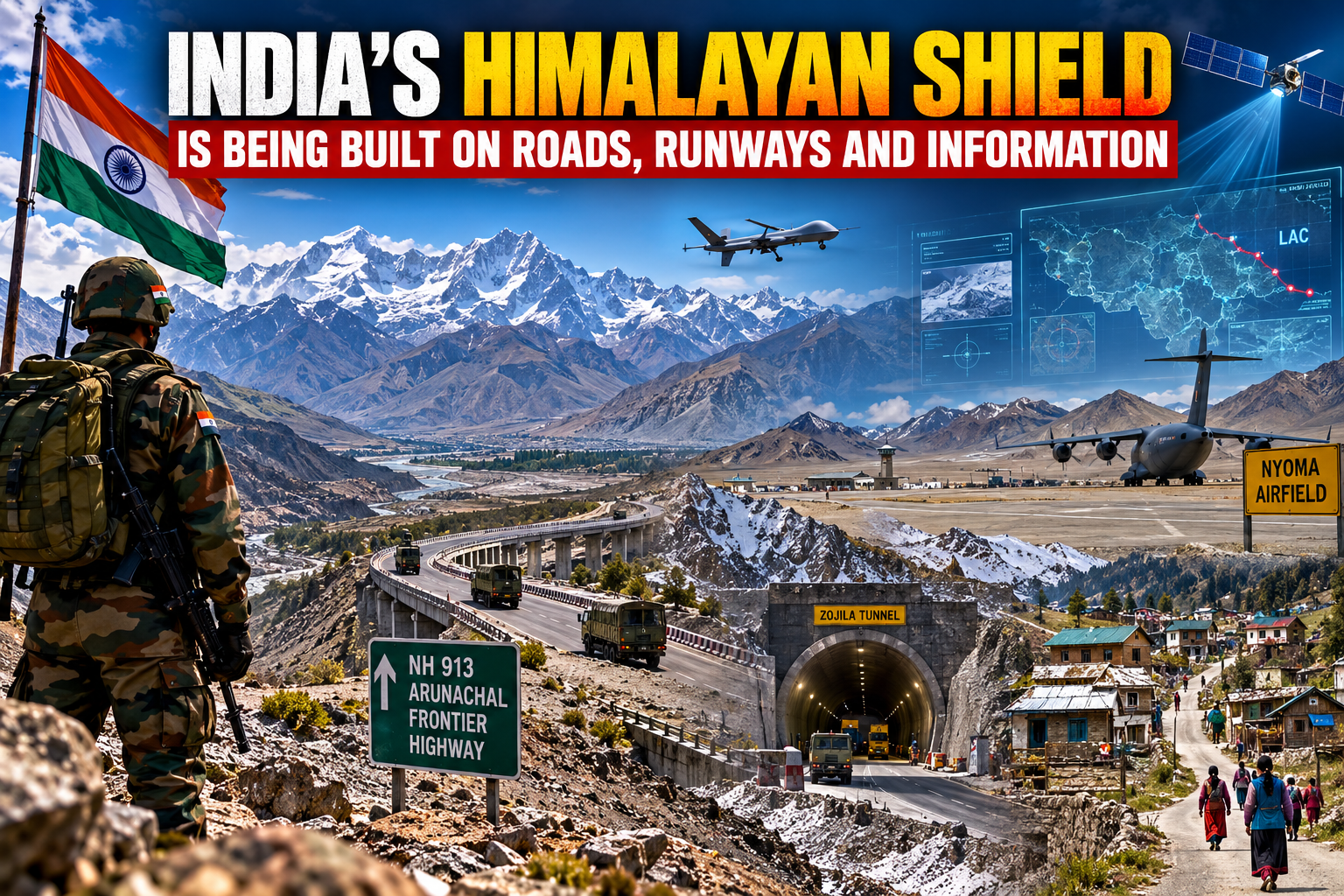
India’s answer is taking shape across several fronts. Roads and tunnels are pushing deeper into difficult terrain. Airfields and advanced landing grounds are shortening the distance between bases and frontier positions. Drones, satellites and sensors are helping commanders see more of a landscape that can conceal movement and disrupt communication. Border villages are being brought into development programmes that can improve daily life while strengthening India’s presence.

The approach is sensible. Its success, however, will depend on execution: whether projects are completed on time, remain usable in extreme weather and connect into a dependable network rather than stand as isolated achievements.

The Arunachal Frontier Highway, designated NH 913, is central to this effort. Planned to run for nearly 1,824 kilometres across Arunachal Pradesh, the corridor is intended to connect remote areas from the western part of the state towards Vijaynagar in the southeast. In 2024, the government sanctioned more than ₹6,700 crore for eight stretches covering over 300 kilometres. Work has been taken up on sections including Tato–Monigong, Hunli–Hayuliang and Pango–Jorging.

For communities, the highway could mean more reliable access to schools, healthcare, markets and emergency services. For the military, it offers the prospect of faster movement across areas where geography has long shaped the pace of operations. Those purposes reinforce one another. A road that serves local residents can also strengthen logistics; a corridor built for strategic access can connect villages that have remained isolated.

But a highway on a map is not yet a strategic advantage. The real test is whether it can be built and maintained across landslide-prone slopes, river valleys and severe weather. A frontier road network needs bridges, alternate routes, reliable communications and maintenance plans that account for the conditions in which it must operate. Resilience comes from the system around the road as much as from the road itself.

That is why tunnels and all-weather links matter. The Atal Tunnel has improved access through the Pir Panjal range, while the Zojila tunnel project is intended to make the Srinagar–Leh route less vulnerable to seasonal closure. In Ladakh, dependable access has direct consequences for both civilian life and military logistics. Yet each project must be judged by the practical change it delivers: how many days access is maintained, how quickly supplies move and how effectively disruptions can be managed.

Air access is the other part of the equation. In a region where ground movement can be slow or blocked, high-altitude airfields and advanced landing grounds provide options for moving personnel and essential supplies. The development of Nyoma airfield in Ladakh, alongside the use of Daulat Beg Oldi, strengthens India’s ability to operate in remote sectors. In Arunachal Pradesh, upgraded landing grounds can support logistics and emergency response.

Air infrastructure does not replace roads. Aircraft depend on weather, availability and specialised support; roads provide the sustained movement needed to supply and maintain forces. The advantage comes from combining the two, so that a disruption in one route does not leave a frontier position cut off.

Technology adds another layer. Satellites, unmanned aerial vehicles, radars, electro-optical equipment and ground sensors can help build a clearer picture of activity across a vast and difficult landscape. Secure communications allow that information to reach the people who need to act on it. In mountains, where terrain can block line of sight and weather can change rapidly, early warning and reliable communication can matter as much as physical access.

Yet equipment alone does not produce information superiority. Sensors must be integrated, data assessed and communications protected. Technology must give commanders usable, timely information—not simply more feeds to monitor. It can help reduce uncertainty, but it cannot remove the need for trained personnel, sound judgment and strong logistics.

The civilian dimension is equally important. The Vibrant Villages Programme aims to improve infrastructure and livelihoods in selected border communities. Better electricity, roads, healthcare, digital access and economic opportunities can make life more viable in places where remoteness has often pushed people towards leaving. A thriving village also sustains India’s administrative and social presence along the frontier.

That presence must be built around residents’ needs. Development cannot be treated as a security instrument alone. Villages are homes and communities, not markers on a map. If programmes deliver lasting services and livelihoods, the benefits will extend beyond their strategic value. If they do not, official announcements will not reverse the pressures that drive migration.

India’s Himalayan frontier is therefore being shaped by more than construction. It is an effort to connect mobility, air access, surveillance, communications and community development into a working network. NH 913 could become a major part of that network, but its significance will depend on the links it creates and the reliability it delivers.

The strongest frontier is not necessarily the one with the most projects. It is the one where roads remain open, airfields are usable, information reaches decision-makers, supplies arrive when needed and border communities can build a future. India has begun assembling those elements. The measure of its strategy will be whether they work together—on the ground, in every season.

Arunachal Frontier Highway Arunachal Frontier Highway 1824 Km Arunachal Pradesh Border connectivity Border Infrastructure border roads Border Roads Organisation BRO Doklam 2017 Eastern Ladakh Galwan 2020 Galwan clash Himalayan Border India China border India China Border News India Himalayan Frontier Ladakh NH 913 NH913
Follow on Google News Follow on Flipboard
Share. Facebook Twitter Pinterest LinkedIn Tumblr Email Copy Link
Previous ArticleBJP fields fresh candidates for UP Rajya Sabha polls; drops Hardeep Puri, seven others
Earth News Network
  • Website

Related Posts

Demand for restoration of Buddhist temple in Zanskar to be looked into: Ladakh Chief Secy Kundra

October 5, 2026

Uri National Highway To Remain Closed On October 4 And 11 For Hill-Cutting Work

October 4, 2026

LG Saxena Meets Ladakh Nambardars, Assures Action On Public Grievances

October 3, 2026

Comments are closed.

Latest Posts

India’s Himalayan Shield Is Being Built on Roads, Runways and Information

BJP fields fresh candidates for UP Rajya Sabha polls; drops Hardeep Puri, seven others

Govt Working to Make Pension Services More Accessible, Technology-Driven and Citizen-Centric: Dr Jitendra Singh

Himanta unveils bust of first Indian tea planter, charity auction raises Rs 2.26 cr for flood relief

Bengal approves 14,454 govt posts, Rs 50,000 scheme for unmarried women pursuing higher education: CM Suvendu

Nobel Prize Week Beginning In Stockholm With Medicine Award

The Earth News
Facebook X (Twitter) Instagram YouTube
  • About
  • Contact us
  • Advertise With Us
  • Privacy Policy
© 2026 Earth news. All Rights Reserved. | Powered by Ideogram Technology Solutions [P] Ltd..

Type above and press Enter to search. Press Esc to cancel.