

By Pooja Bhatia
There are many ways in which the contribution of the Indian Army in Jammu and Kashmir is measured. We speak about the men guarding the Line of Control, counter-terrorism operations, difficult deployments in snowbound mountains and the sacrifices made by soldiers in protecting the country. Yet, away from the bunkers and patrol routes, another contribution has been unfolding quietly for years. It does not involve weapons or military manoeuvres. It involves classrooms, teachers, books, laboratories, playgrounds and thousands of young children.
The Army Goodwill Schools are perhaps among the finest examples of what the Indian Army’s relationship with the awam of Jammu and Kashmir can achieve when security and human development move together.
The schools emerged from the Army’s Operation Sadbhavana, a wider outreach programme under which education was identified as an important area of engagement with communities in Jammu and Kashmir and Ladakh. The official Army Goodwill Schools network describes access to education as one of the key focus areas of this initiative. Today, the network includes dozens of schools established in areas where geography, economic circumstances and years of instability have often made access to quality education difficult.
To understand their significance, one has to look beyond the number of schools or students.
For a family living in a remote village of Kupwara, Baramulla, Bandipora, Rajouri or another difficult part of Jammu and Kashmir, education is not an abstract policy objective. It is deeply personal. It is the hope that a son or daughter will have choices that an earlier generation perhaps never had. It is the possibility that a child growing up amid mountains and limited opportunities can someday become a doctor, engineer, teacher, entrepreneur, sportsperson, civil servant or professional of his or her choosing.
A good school brings that possibility closer.
That is why the real importance of the Army Goodwill Schools cannot simply be measured by buildings constructed or examinations passed. Their greatest contribution may be the confidence they create among families.
Every morning when a child walks through the gate of an Army Goodwill School carrying a school bag, a small but important message is being delivered: the future of Jammu and Kashmir will ultimately be determined not by those who preach violence, but by young people equipped with knowledge, confidence and ambition.
This is particularly meaningful in regions that have lived through prolonged periods of disturbance.
Children should never have to inherit the anxieties of the generation before them. They deserve classrooms where the biggest concern is an unfinished mathematics assignment, a science experiment that refuses to work, selection for the school football team or preparation for an examination. Ordinary childhood itself becomes precious in a place that has experienced extraordinary circumstances.
Army Goodwill Schools help create precisely that space.
Their contribution also challenges an often simplistic understanding of the relationship between the Army and local communities. A soldier posted in Jammu and Kashmir performs a security responsibility, but Operation Sadbhavana reflects the recognition that lasting stability also depends upon relationships with people.
A classroom creates those relationships in ways that no security deployment ever could.
Consider the interaction surrounding such a school. Local teachers find employment. Parents interact with the institution. Children participate in sports, cultural programmes and educational activities. Communities see infrastructure being developed for their children. Students encounter opportunities beyond their immediate surroundings.
Over time, familiarity replaces distance.
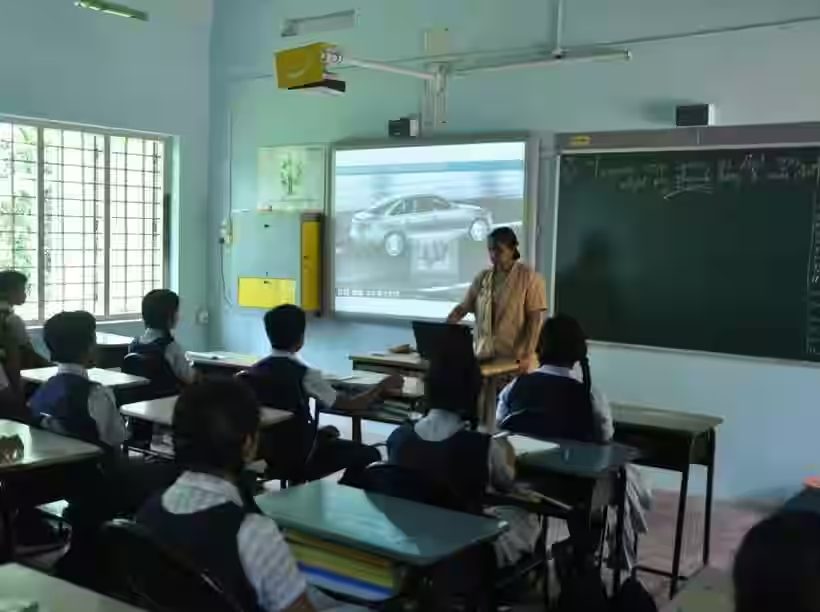
The Army Goodwill School programme has also benefited from the involvement of local teachers and staff. This is important because the schools should not be viewed as institutions operating apart from society. They are embedded within the communities they serve. The teacher standing before the blackboard may belong to the same district, speak the same language and understand the social circumstances of the children sitting in front of her.
That makes the model particularly valuable.
Education cannot succeed merely through buildings and equipment. It requires trust between parents, teachers and students.
The scale of the effort is substantial. Earlier official and media accounts have reported tens of thousands of students studying through the Army Goodwill School network and significant support being extended to government schools through renovation, infrastructure and equipment under Operation Sadbhavana. The numbers have varied over time as the programme has evolved, but the larger story remains consistent: education has become one of the most enduring components of the Army’s civic outreach in the region.
There is another dimension that deserves greater recognition.
A school in a remote area does more than educate the children enrolled in it. It can transform the aspirations of an entire village.
When one student succeeds, younger children acquire a role model. When a girl from a remote community performs exceptionally in academics or sport, other parents begin imagining similar possibilities for their daughters. When former students enter universities and professional institutions, education gradually becomes part of the community’s expectations rather than an exception available only to a fortunate few.
This is how social transformation actually occurs. Not always through grand announcements, but through accumulated individual successes.
One child at a time.
One family at a time.
One village at a time.
The Army deserves credit for understanding something very fundamental about Jammu and Kashmir: peace cannot merely mean the absence of violence. Peace must eventually translate into the presence of opportunity.
A young person who sees a pathway towards education, employment and dignity possesses something enormously valuable: a stake in the future.
This is also why initiatives such as Army Goodwill Schools should not be viewed only through the narrow prism of counter-insurgency or “winning hearts and minds”. Those phrases may have relevance in security literature, but they do not adequately describe what happens inside a classroom.
A teacher explaining algebra to a fourteen-year-old is not conducting a military operation.
She is teaching algebra.
A child learning how to use a computer is not participating in a strategic outreach programme.
He is learning a skill.
A girl preparing for her board examination is not a statistic in a security narrative.
She is preparing for her future.
Perhaps that is the greatest success of the Army Goodwill Schools. Over time, the schools acquire an identity larger than the programme that created them. They become simply schools: places where parents want their children to study because they believe those institutions can provide them with a better education.
For the Indian Army, this is an unusual legacy.
Armies are normally remembered through battles, victories, regiments and military history. But somewhere in the mountains of Jammu and Kashmir, there are young men and women whose lives may have taken a different direction because a school was established near their village, a teacher was appointed, a laboratory was created or somebody made it possible for them to dream beyond the limitations of geography.
There is something profoundly Indian about that story.
The soldier guarding a difficult frontier and the teacher educating a child living near that frontier are contributing, in very different ways, to the same national future.
Jammu and Kashmir has undergone enormous change over the decades, and its younger generation increasingly carries aspirations similar to young Indians everywhere: better education, good careers, entrepreneurship, technology, travel, sport and a better standard of living.
Institutions that nurture those ambitions deserve support and recognition.
The Army Goodwill Schools have quietly been doing exactly that.
Perhaps years from now, when the story of this period in Jammu and Kashmir is written, some of its most important chapters will not be about operations conducted or militants eliminated. They will be about children who went to school, families that discovered new opportunities and communities where the next generation grew up believing that its future could be larger than its past.
That would be a remarkable legacy for any institution.
For the Indian Army, it may ultimately be one of its most meaningful contributions to the awam of Jammu and Kashmir.
Pooja Bhatia is a media analyst and law graduate with an interest in history and geopolitics.
