

NEW DELHI: Prime Minister Narendra Modi has called on farmers across India to consider transitioning to natural farming, a method that tackles key agricultural challenges such as over-reliance on chemical fertilizers and pesticides, soil degradation, and long-term sustainability.
In a LinkedIn post, Modi encouraged farmers to start small with the ‘one acre, one season’ approach, highlighting that even small-scale success can spark wider adoption.
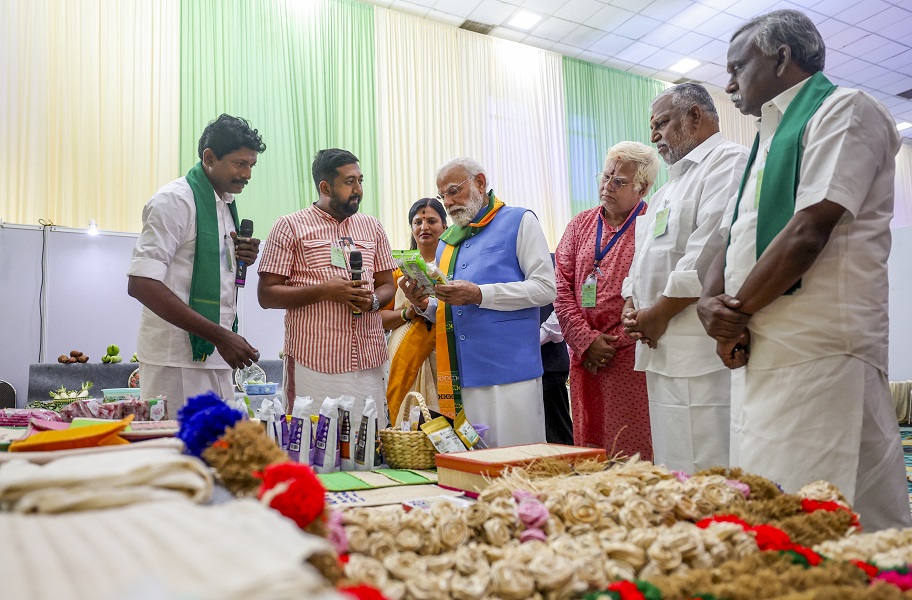
Speaking at the South India Natural Farming Summit in Coimbatore, Modi shared his experience meeting a diverse group of farmers, scientists, and even former corporate professionals who had returned to traditional farming practices.
He emphasized that natural farming, rooted in India’s ancient agricultural knowledge and modern ecological principles, promotes biodiversity by integrating crops, trees, and livestock.
This approach prioritizes soil health through recycling farm residues, mulching, and aeration, rather than relying on chemical inputs.
“Natural farming, as we all know, draws from India’s traditional knowledge systems and modern ecological principles to cultivate crops without synthetic chemicals. It promotes diversified fields where plants, trees and livestock coexist to support natural biodiversity. The approach relies on recycling farm residues and enhancing soil health through mulching and aeration, rather than external inputs,” he stated.
“This Summit in Coimbatore will forever remain a part of my memory! It indicated a shift in mindset, imagination and confidence with which India’s farmers and agri-entrepreneurs are shaping the future of agriculture,” he added.
Modi mentioned that the programme included an interaction with farmers from Tamil Nadu in which they showcased their efforts in natural farming and “I was amazed!”
“I met people whose life journeys and commitment to doing something new were noteworthy,” he added.
Citing instances of individual entrepreneurs, he said that there was a farmer who managed nearly 10 acres of multi-layered agriculture with bananas, coconuts, papaya, pepper and turmeric.
“He maintains 60 desi cows, 400 goats and local poultry,” Modi wrote.
“Another farmer has dedicated himself to preserving native rice varieties like Mapillai Samba and Karuppu Kavuni. He focuses on value-added products, creating health mixes, puffed rice, chocolates and protein bars,” he added.
The prime minister praised a first-generation graduate, who runs a 15-acre natural farm and has trained over 3,000 farmers, supplying nearly 30 tonnes of vegetables every month.
“Some people who were running their own FPOs supported tapioca farmers and promoted tapioca-based products as a sustainable raw material for bioethanol and Compressed Biogas,” he said.
Referring to a case study of entrepreneurs, who showed how science and sustainability can blend seamlessly, Modi wrote, “One of the agri-innovators was a biotechnology professional who built a seaweed-based biofertilizer enterprise employing 600 fishermen across coastal districts; another developed nutrient-enriched bioactive biochar that boosts soil health.
“The people I met there belonged to different backgrounds, but there was one thing in common: a complete commitment to soil health, sustainability, community upliftment and a deep sense of enterprise.”
Emphasising India’s commendable progress in the field of natural farming, Modi reminded the Centre’s National Mission on Natural Farming, saying that it has already connected lakhs of farmers with sustainable practices.
“Across the nation, thousands of hectares are under natural farming. Efforts by the Government such as encouraging exports, institutional credit being expanded significantly through the Kisan Credit Card (including for livestock and fisheries) and PM-Kisan, have also helped farmers pursuing natural farming,” he said.
He added, “Natural farming is also closely linked to our efforts to promote Shree Anna or millets. What is also gladdening is the fact that women farmers are taking to natural farming in a big way.”
Modi highlighted the challenges caused by modern farming and said that over the past few decades, the rising dependence on chemical fertilisers and pesticides has affected soil fertility, moisture and long-term sustainability.
“At the same time, farming costs have steadily increased,” Modi stated.
According to him, natural farming directly addresses these challenges.
“The use of Panchagavya, Jeevamrit, Beejamrit, and mulching protects soil health, reduces chemical exposure, and lowers input costs while building strength against climate change and erratic weather patterns,” he added.
The prime minister encouraged farmers to begin with ‘one acre, one season’ and said that the outcomes from even a small plot can build confidence and inspire larger adoption.
“When traditional wisdom, scientific validation and institutional support come together, natural farming can become feasible and transformative,” he said.
“I call upon all of you to think of pursuing natural farming. You can do this by being associated with FPOs, which are becoming strong platforms for collective empowerment. You can explore a StartUp relating to this area,” he added.
He called the convergence among farmers, science, entrepreneurship and collective action in Coimbatore truly inspiring.
“I am sure we will together continue making our agriculture and allied sectors productive and sustainable. If you know of teams working on natural farming, do let me know too,” Modi said.
