

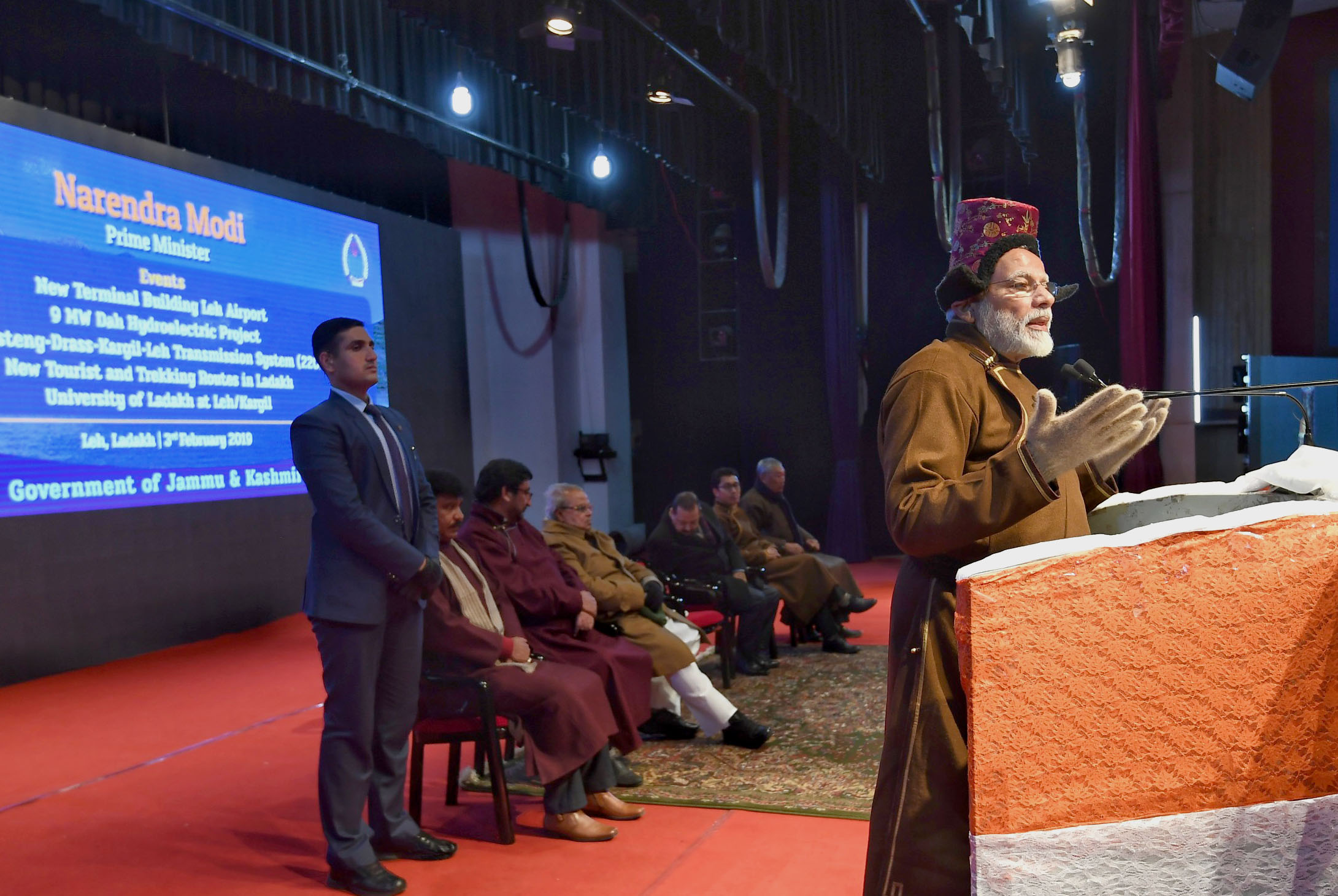
For over seven decades, Ladakh remained politically sidelined, economically neglected, and administratively bound to a system that rarely acknowledged its unique needs. Despite its strategic importance, rich cultural identity, and an unwavering sense of patriotism, Ladakhis continued to live under the shadow of Kashmir-centric governance, without a platform to voice their aspirations.
This special feature traces the historic journey of Ladakh—from its first demand for Union Territory status in 1949 to the realisation of that dream in 2019, under the Modi government. It documents how Ladakh’s transformation from a neglected frontier to a well-connected and empowered Union Territory marks one of the most significant regional shifts in post-Independent India.
From a forgotten kingdom to a neglected appendage of J&K, Ladakh’s 7-decade wait for administrative justice ends with a UT
Much before it was incorporated into the erstwhile state of Jammu and Kashmir in 1834 under the command of Zorawar Singh, General of the Dogra ruler Gulab Singh, Ladakh used to be an independent kingdom. Post-Partition, when Maharaja Hari Singh signed the accession of Jammu and Kashmir, Ladakh also became part of the Indian state of Jammu and Kashmir.
However, it faced discrimination and neglect both from the successive governments in Jammu and Kashmir, and the dispensations one after another in Delhi, for decades altogether. Culturally, geographically and socially very different from Jammu and Kashmir, and for that matter from the entire of the country, Ladakhis needed an identity of their own, but within the framework of Indian Constitution. Patriotic to the core, the people of Ladakh, sacrificed their lives for the country, but their voice for a separate region was never considered by those in power.
History records that for the first time a Ladakh delegation had met the then Prime Minister Jawaharlal Nehru way back in 1949 seeking separate UT status for the remote region, but to no avail. The aspirations continued for decades altogether, however, and the dream fructified only after Prime Minister Narendra Modi took over.
For Ladakh, it all started changing in late 2018. Jammu and Kashmir, then under President’s Rule, was divided into three administrative units, with Ladakh joining Kashmir Valley and Jammu region. While not many could read much into the developments, the long-cherished dream of Ladakh and its people was to be realized later in the 2019, courtesy the historic decisions by Modi government.
Following the revocation of Article 370, the Jammu and Kashmir Reorganisation Bill 2019 provided for two separate UTs in the form of Jammu and Kashmir on the one hand, and Ladakh on the other.
This realization of the quintessential dream freed Ladakh from historic overshadowing by Kashmir when it comes to development and allocation of resources and led to a wave of joy and celebrations across Leh and Kargil districts of the cold desert.
The decision reflected that under the leadership of Prime Minister Narendra Modi, the present dispensation at Centre always accorded very high priority to the development of Ladakh and welfare of the local population.
The local sentiments in Ladakh also echoed the view that the Centre government fulfilled its responsibility to safeguard the future of Ladakh which is a very sensitive and fragile region having distinct culture, traditional practices, customs and languages.
DISCRIMINATION HISTORY, BUDGET RISES 6-FOLDS
Up until the 2019 reorganisation, Ladakh—then a part of erstwhile Jammu and Kashmir, faced repeated neglect and discrimination was meted out to it over the years. This reflect in its budgetary allocation which was at its highest in year 2018-19 at Rs 1172 crore.
However, all of that changed when Ladakh was granted the Union Territory status in October 2019. In the period from October 2019 to March 2020, Ladakh’s budget was raised up to Rs 5754 crore. In Modi government’s first full budget in its second term, the budget was further raised to Rs 5958 Crore, a six time increase over what it used to get before Modi government’s historic 2019 decision.
Over the next years, the Budget for Ladakh has not been decreased and has remained at Rs 5958 crore, providing much needed assistance to the growth and development of the region.
The government’s increased budgetary allocations have significantly focused on infrastructure development in Ladakh over the years. Key areas of development include green energy, telecommunications, road networks, sports, grid transmission lines, and infrastructure for health and education, even as several centrally sponsored initiatives, such as the Pradhan Mantri Gram Sadak Yojana (PMGSY), Central Road and Infrastructure Fund (CRIF), Jal Jeevan Mission (JJM), and Pradhan Mantri Awas Yojana (PMAY) have also witnessed major success.
ENABLING GOVERNANCE, PROTECTING IDENTITY
Of the several momentous decisions taken by Central government, two historic reforms stand out for the people of Ladakh. These are the creation of new districts to bring governance closer to the people, along with 95% reservation in local government jobs for permanent residents of Ladakh.
These bold measures will not only transform the administrative landscape of this strategically important region, but also safeguard its unique cultural identity and ensure that the youth of Ladakh are the true architects of their future.
While no previous government could fathom the distinct governance and development challenges faced by Ladakh, it was the current dispensation which created new administrative mechanisms to ensure that no citizen of Ladakh feels disconnected from the mainstream of development.
The Centre recently approved the creation of five new districts– Zanskar, Nubra, Sham, Changthang and Drass, thus bringing the total number of districts in Ladakh to seven, along with Leh and Kargil districts, bringing the government services closer to citizens.
In another path-breaking move, the Centre has implemented 95% reservation for Ladakh residents in Group C and D government jobs. This reservation prevents influx of outsiders that could dilute local employment opportunities.
This move protects Ladakhi languages, culture, and tribal identity; creates economic security for local families and slows youth migration — currently 4,000–5,000 Ladakhi youth migrate annually in search of jobs and ensures that Ladakhi sons and daughters will lead the governance and development of their own land.
FROM A NEGLECTED FRONTIER TO WELL-CONNECTED, STRATEGIC, EMPOWERED REGION
Ever since taking over the power at Centre in 2014, Narendra Modi government has done better for Ladakh compared to earlier governments, in several measurable ways. Modi government gave Ladakh UT status, which no other party did; it quadrupled infrastructure spending in the region; prioritized national security in Ladakh for the first time; and promoted tourism and local empowerment.
Ladakh, the crown of India, is not just a land of stunning landscapes but also of strategic significance. However, for decades, the region remained largely isolated during winters due to extreme weather, making life difficult for locals and posing a challenge to national security logistics.
The current dispensation at Centre, ever since it took over in 2014, has seen Ladakh with a renewed focus, empowering it at every step in this 11-year-long journey. Today, under his visionary leadership, Ladakh is witnessing an unprecedented transformation in connectivity, among other things. Major infrastructure projects, once considered impossible, are now turning into reality.
The upcoming Zojila Tunnel being built at the cost of Rs 4900 crore will realise the impossible dream of all-weather connectivity for Ladakh. India’s longest road tunnel will ensure year-round connectivity between Srinagar and Leh via Drass and Kargil. The Zojila Tunnel will reduce the current dangerous and weather-prone travel over Zojila Pass from over 3 hours to just 15 minutes, enabling all-weather, strategic movement of civilian and defence traffic.
The Zojila Tunnel is being joined by Z-Morh Tunnel, which will provide all-weather access to Sonamarg, a key tourist and military post en route to Ladakh, and the Nimu–Padum–Darcha Road (NPD Road).
This 298 km-long road, being constructed by the Border Roads Organisation (BRO) will creates an alternative all-weather route connecting Ladakh with Himachal Pradesh, bypassing J&K valleys. The upcoming Shinku La Tunnel will make the NPD route a true winter-proof link, ensuring even deep interiors of Zanskar remain connected.
This transformation of Ladakh will ensure year-round supply of essential goods, lower costs of transportation, and reliable medical access in emergencies, even as Tourism can become a 12-month sector, benefiting local entrepreneurs.
This will also add on to reliable military logistics amid increasing geopolitical sensitivities along the LAC (Line of Actual Control), even as several isolated hamlets will no longer remain cut off during winter.
Since 2014, the central government has invested over Rs 12,000 crore in connectivity projects in Ladakh. BRO’s annual budget for Ladakh has increased more than 5-fold since 2014. In 2023-24, BRO completed 125 projects worth Rs 3,611 crore, many of them in Ladakh. Double-lane road coverage in Ladakh has expanded from 40% to 80% in the past decade.
This is not all though.
After the completion of the 272-km-long Udhampur-Srinagar-Baramulla Rail Link (USBRL) project, Indian Railways has now planned for a new rail line connectivity to Ladakh. PM Narendra Modi-led government has identified the Bilaspur–Manali–Leh new railway line project as a strategic line and Indian Railway is set to begin work on the construction of a new rail connectivity to Ladakh.
The Railway Board has completed the survey of a new rail line between Bilaspur and Leh via Manali. As of March 2025, the anticipated cost of the Bilaspur-Manali-Leh rail line project is Rs 1,31,000 crore (as per DPR). On completion, the railway line project to Ladakh will not only boost the economic growth of the region but also give an impetus to the travel and tourism industry.
The current government’s resolve and political commitment to Ladakh’s development are truly commendable. What was once a neglected frontier is now emerging as a well-connected, strategic, and empowered region of the nation. The people of Ladakh today look forward to a future where the harshness of winter will no longer isolate them — a dream being fulfilled thanks to the tireless efforts of our central leadership, and the Ladakh administration.
