


Chhewang condemns Bloodshed, Demands Immediate Talks | Wancghuk Calls off Hunger Strike | BJP, Congress trade blame |


Yash Khajuria
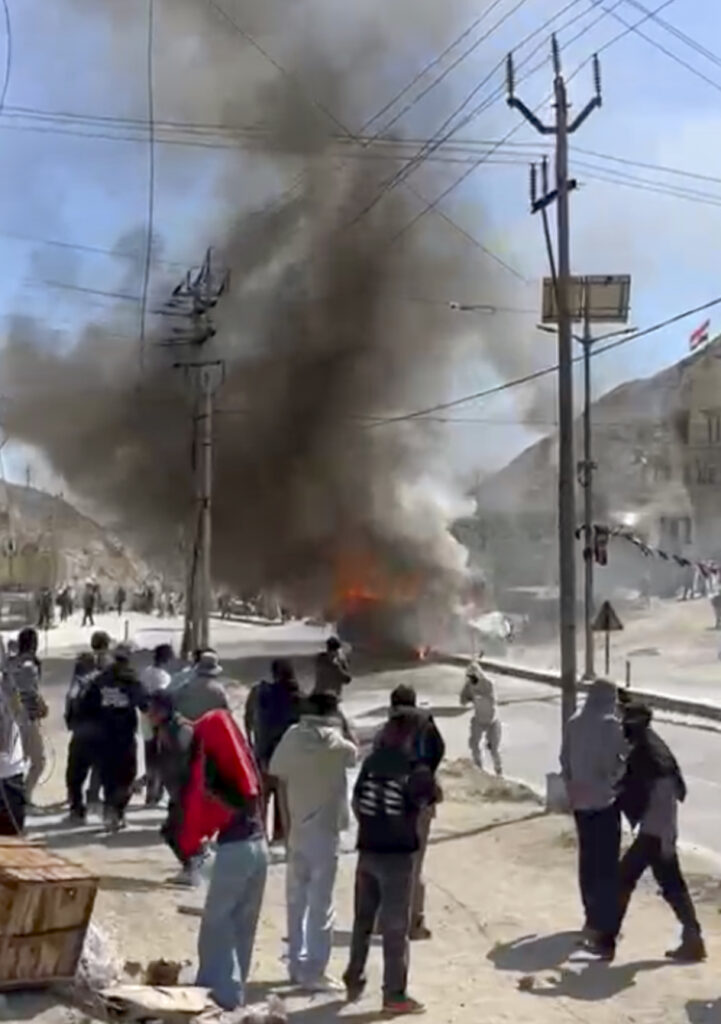
Leh, Sept 11: At least five people were killed and nearly 70 others injured on Wednesday as violent unrest engulfed Leh town in the Union Territory of Ladakh. The violence broke out after a mob of youths protesting the delay in talks on Ladakh’s four-point agenda turned unruly. The protesters, demanding early discussions with the Ministry of Home Affairs (MHA) on constitutional safeguards and full statehood for Ladakh, clashed with security forces, plunging the tourist hub into turmoil.
According to official sources, the casualties occurred during fierce confrontations when police attempted to disperse protesters who turned unruly. The situation escalated after demonstrators attacked and set ablaze the Bharatiya Janata Party’s (BJP) district headquarters in Saboo, intensifying the region-wide shutdown that crippled normal life.
Security personnel resorted to tear gas, baton charges, and rubber bullets as mobs pelted stones and torched at least one security vehicle, triggering chaos in this strategically sensitive border region.
The agitation was spearheaded by the Leh Apex Body (LAB) and allied groups, which had called for a complete shutdown of commercial and transport activities. The protest drew wide support from political, religious, and trade organizations, focusing on the long-standing demand for Ladakh’s inclusion under the Sixth Schedule of the Constitution to safeguard tribal autonomy, land rights, and employment opportunities for locals.
Expressing anguish over the violence, LAB Chairman Thupstan Chhewang said the protest, though intended to be peaceful, spiraled into unrest due to “unfortunate incidents.” He accused the Union Government of ignoring Ladakh’s demands, which, he claimed, had forced the region’s traditionally peaceful movement onto a path of confrontation.
“Today’s protest was organized by the youth wings of several political, religious, and spiritual organizations with support from allied groups. Unfortunately, the demonstration turned violent and resulted in clashes between protesters and police. Ladakh has a history of being a torchbearer of national unity and democratic dissent. But today’s violence is the result of the Government of India’s prolonged ignorance of Ladakh’s demands and its delay in holding dialogue with Ladakhi leadership.”
He termed the deceased youth “martyrs,” paying solemn tribute to them and expressing solidarity with their families. He held the Union Government responsible for “pushing Ladakh’s peaceful movement towards unrest” and urged the immediate resumption of dialogue for a just resolution.
Chhewang added that the tragedy could have been avoided if the government had acted in time. “Ladakh is a sensitive region, surrounded by hostile neighbors, and unrest here could be exploited by external forces. I urge the Government of India, especially the Ministry of Home Affairs (MHA), to take immediate cognizance of the situation and resume negotiations without delay,” he said, while also appealing to the youth to shun violence.
Climate activist Sonam Wangchuk, called off his hunger strike and called the youth to restore peace. Wangchuk released a video message urging protesters to shun violence. He cautioned that violent methods could undermine the legitimacy of their struggle for constitutional safeguards.
The protest, initially staged outside the Ladakh Hill Council office, escalated into chaos after restrictions on public gatherings were enforced. Eyewitnesses reported scenes of panic as protesters—many of them students and young professionals—chanted slogans demanding legislative autonomy and protection against external economic encroachments, which they fear threaten Ladakh’s fragile ecology and cultural heritage.
In the aftermath, the Leh administration imposed prohibitory orders under Section 144, restricting gatherings of more than four persons. Reinforcements from central paramilitary units were deployed to restore calm amid apprehensions of further escalation.
The annual Ladakh Festival, a major cultural attraction, was abruptly canceled on its concluding day, underscoring the deepening gulf between local aspirations and central government policy.
Meanwhile, opposition leaders in New Delhi criticized the Centre’s handling of the crisis, alleging delays in initiating meaningful dialogue on Ladakh’s four-point agenda, which includes Sixth Schedule status, enhanced administrative powers, and dedicated parliamentary representation. Analysts warned that unresolved tensions in Ladakh could resonate across other frontier regions seeking greater autonomy.
The ruling BJP, however, sought to shift blame to the Congress party. Ladakh BJP spokesperson Mohd. Hassan Pasha, in a press conference, accused Congress of playing a “shameful role” in instigating unrest and sabotaging ongoing negotiations.
“Congress has repeatedly betrayed Ladakh’s aspirations. Its involvement in yesterday’s incidents exposes its double standards and anti-people agenda,” Pasha alleged.
He demanded that Congress be expelled from the Kargil Democratic Alliance (KDA) and removed from the MHA’s High-Powered Committee on Ladakh. “Including Congress in this process is an insult to genuine stakeholders who have fought sincerely for Ladakh’s safeguards,” Pasha said, urging the Centre to act decisively to protect the credibility of the movement.
Contradicting the BJP’s claim, climate activist Sonam Wangchuk described the violence as “unfortunate,” but asserted that it was an “organic response” to what he called the Union Government’s “dilly-delaying tactics.” Wangchuk alleged that the Centre had been “humiliating” the protesting Ladakhis by denying their rightful demands and indefinitely postponing formal talks.
“We have undertaken multiple climate fasts and even marched to Delhi to knock on the doors of the Union Government, seeking dialogue in a peaceful manner. Yet, despite our non-violent initiatives, the Government chose to humiliate the Ladakhis by neither engaging with us for months nor granting Sixth Schedule status, even though the BJP had twice promised it in its election manifesto,” Wangchuk stated.
He further alleged that the Government deliberately scheduled the dialogue for October 6—after the launch of their 35-day hunger strike—thereby compelling protesters to continue their agitation without resolution. “This provoked deep resentment among the youth, who felt humiliated by the Centre’s dismissive attitude. The resulting violence and demonstrations were, therefore, a natural outburst of their frustration,” he added.
When asked about the possibility of political elements orchestrating the unrest to sabotage the proposed talks, Wangchuk categorically denied such involvement. “No political party in Ladakh possesses the organizational strength to mobilize such a large-scale demonstration, especially one driven predominantly by the youth,” he remarked.
In the aftermath of the protests, which left government and private property gutted in Leh city, District Magistrate Romil Singh Donk, IAS, imposed prohibitory orders under Section 163 of the Bharatiya Nagarik Suraksha Sanhita (BNSS), 2023. The directive, issued ex parte, cited grave concerns over public peace and order.
As per the order, the assembly of five or more persons, rallies, processions, or marches without prior permission from the competent authority stands prohibited. The use of loudspeakers on vehicles has also been restricted, while individuals have been barred from issuing public statements deemed capable of inciting unrest or disturbing public tranquility. Any violation of these directions, the order warned, will attract punitive action under Section 223 of the BNSS.
As tensions remain high, the spotlight now shifts to the Union Government’s response in addressing the simmering unrest and navigating the fragile balance between national security and Ladakh’s constitutional aspirations.
