

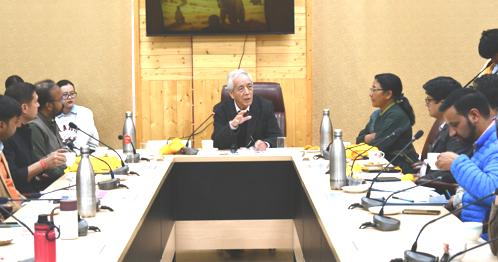
Leh: The G.B. Pant National Institute of Himalayan Environment (GBPNIHE), Ladakh Regional Centre (LRC), Leh, in collaboration with Eliezer Joldan Memorial College (EJMC), celebrated the International Day for Biological Diversity (IDB) 2026 on Friday with a strong call for community-led conservation and climate resilience in the fragile Himalayan region.
Held under the global theme “Acting Locally for Global Impact,” the event brought together scientists, academicians, researchers, environmentalists and students to deliberate on biodiversity conservation challenges facing Ladakh and the wider Himalayan ecosystem.
The programme was chaired by former Vice Chancellor of the University of Ladakh, C. Phunchok, who highlighted the growing environmental vulnerabilities in Ladakh due to climate change. Speaking as the Chief Guest, he warned about accelerating glacier retreat and the increasing threat of Glacial Lake Outburst Floods (GLOFs), stressing the urgent need for sustainable environmental management and climate resilience planning in the Himalayan region.
The event commenced with ceremonial lamp lighting followed by a welcome address from EJMC Principal Prof. Stanzin Yangdol, who emphasized the ecological importance of the Trans-Himalayan landscape and called for collective efforts to preserve Ladakh’s unique biodiversity.
Dr. Sandipan Mukherjee, Scientist and Head of GBPNIHE-LRC, outlined the objectives of the programme and underlined the urgency of protecting fragile Himalayan ecosystems from mounting pressures such as climate change, habitat degradation and unsustainable human activities. He said local conservation initiatives are critical to achieving the targets outlined in the Kunming-Montreal Global Biodiversity Framework.
A series of expert lectures formed the core of the programme. Dr. Naveen Chandra, Scientist at LRC-NIHE, spoke on the rich biodiversity of the Himalayas and discussed major threats including habitat loss, climate stress and increasing anthropogenic pressure. He also highlighted conservation planning, ecosystem restoration and community participation as key strategies for sustainable biodiversity management.
Adding to the discussions, WWF India’s Western Himalayan Programme Coordinator Rohit Rattan delivered a lecture on the Himalayan Brown Bear in the Trans-Himalayan region. Describing the species as a “keystone species,” he highlighted the growing challenges posed by habitat fragmentation, climate change and human-wildlife conflict, while stressing the importance of habitat protection and local community involvement in conservation efforts.
The celebration also witnessed enthusiastic student participation through painting, photography, poster-making and speech competitions focused on biodiversity conservation and environmental awareness. The entries were evaluated by scientists and faculty members from both institutions.
During the valedictory session, winners of various competitions were felicitated with prizes and certificates by the dignitaries. The event concluded with a formal vote of thanks delivered by Dr. P.K. Garg, Scientist at LRC-NIHE.
Around 100 participants, including faculty members, researchers, administrative staff and students from both institutions, attended the programme, reflecting growing awareness and engagement on biodiversity conservation issues in the ecologically sensitive Himalayan region.
