

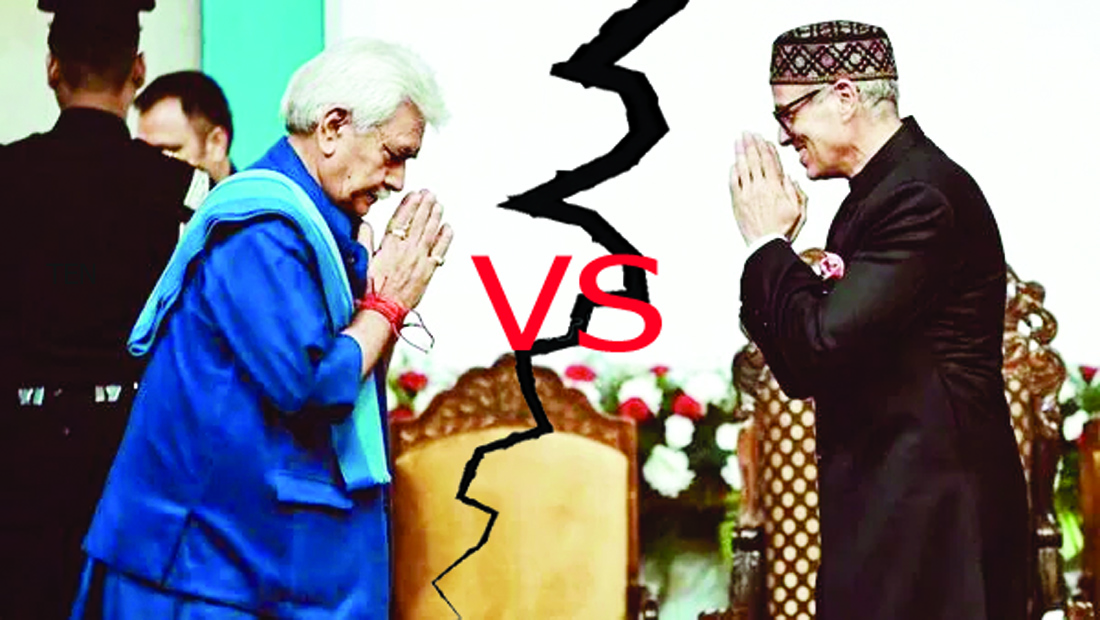
Srinagar, Oct 31: A sharp political undercurrent rippled through Jammu and Kashmir’s power corridors on Friday as Lieutenant Governor Manoj Sinha launched a fresh political salvo, asserting that the Union Territory’s lack of statehood “cannot be an alibi for underperformance.” He maintained that the elected government led by Chief Minister Omar Abdullah possesses “all necessary powers” to govern effectively.
Speaking at the J&K Union Territory Foundation Day celebrations at the SKICC, Sinha’s remarks reignited the long-standing debate over the restoration of statehood — a pledge that has lingered in uncertainty since the abrogation of Article 370 in August 2019. His reiteration that “delimitation first, elections next, and statehood later” remains the Centre’s definitive roadmap was interpreted in political circles as a firm indication that New Delhi’s stance is unlikely to change under political pressure.
Sinha’s statement, delivered with characteristic precision, was viewed as a calculated message to political parties accusing the Centre of withholding constitutional status to deflect responsibility for governance lapses. His tone — assertive and dismissive of excuses — underscored the Centre’s conviction that administrative performance must stand independent of political status.
Caught off guard by the remarks, Chief Minister Omar Abdullah adopted a cautious stance. Refusing to be drawn into confrontation, he said he would “verify the exact statement” before offering a detailed response, hinting that his reply would come “at the right time.”
The exchange has injected renewed vigour into the political discourse, with opposition voices questioning whether the Centre’s sequential approach — delimitation, elections, and then statehood — has effectively become a permanent deferral of constitutional restoration. Analysts view Sinha’s intervention as a clear signal that the Raj Bhavan remains aligned with New Delhi’s calibrated strategy and is unwilling to concede ground amid growing regional unease.
Addressing the Foundation Day gathering, Sinha recalled that Union Home Minister Amit Shah had stated in Parliament that the process would follow a clear sequence: delimitation first, assembly elections second, and the restoration of statehood at an appropriate time.
“But some people have issues,” Sinha said. “When the assembly elections were held, it was clear that they were being conducted for the UT assembly. The elected government cannot use the absence of statehood as an excuse for inaction.”
He further emphasized that the elected government “has all the powers” and urged political leaders not to mislead people under the pretext of the UT’s status. “The government should use its powers for the betterment of the people of Jammu and Kashmir,” he added.
Meanwhile, Chief Minister Omar Abdullah declined to engage in a public exchange with the Lieutenant Governor over his remarks. When asked by reporters about Sinha’s statement, Abdullah said he had not yet read the LG’s comments.
“First, I would like to see the exact words he has used,” Abdullah noted. “If there’s a difference between what he said and what is being reported, it would not be right for me to comment based on incorrect information. But if he has indeed said what you’re saying, I will respond at the appropriate time,” he said.
Earlier in the day, Abdullah attended the inaugural ceremony of the Kashmir Marathon Expo, where he emphasized the importance of promoting sports and tourism.
“With every major event, efforts are made to give athletes the best possible experience,” he said. “When I participated in the half marathon in Delhi, I saw similar events being organized there, and participants appreciated them greatly. It’s good that, apart from the run, an expo is also being organized here.”
He added that the expo would showcase Jammu and Kashmir’s handicrafts and tourism potential to visitors from across the country, expressing hope that it would contribute to tourism promotion in the region.
As Jammu and Kashmir marked another Foundation Day under Union Territory status, the divergence between the Lieutenant Governor’s office and the elected leadership resurfaced with renewed urgency, setting the stage for an intensifying contest over the region’s democratic trajectory — one that could shape its political narrative in the months ahead.
