

Shivang Satya Gupta
For over three decades, the rivers of Jammu & Kashmir have been harnessed to light up not just our homes, not just Jammu and Kashmir, but many other states beyond the borders of our Union Territory. The massive hydropower projects built on our soil, from Kishanganga, Uri, Dul Hasti, to Nimoo-Bazgo, Chutak, Baglihar, and more, are a source of immense pride of each and every resident of Jammu and Kashmir and Ladakh.
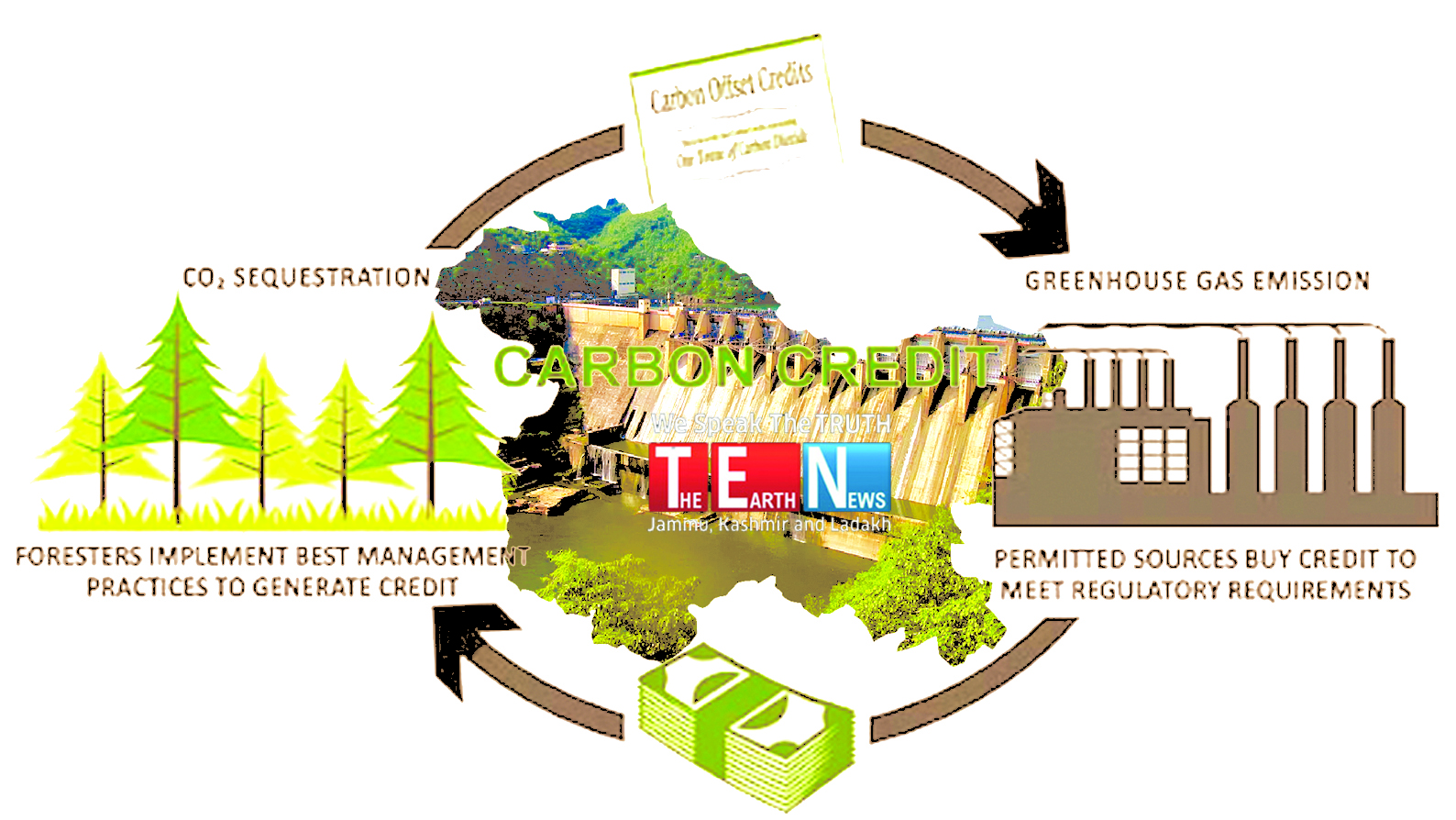
But there is a side to this story that the public has barely been told. These projects don’t just generate electricity, they also generate carbon credits. Carbon Credits are a parallel stream of wealth created under international climate agreements like the Kyoto Protocol’s Clean Development Mechanism (CDM).
These credits are meant to reward clean energy generation by putting a price on every tonne of carbon dioxide avoided. On global markets, they trade at anywhere between $8 and $30 per credit, often yielding millions of dollars annually for a single project.
And yet, ordinary citizens of J&K have seen no visible benefit. The question writes itself: Who pocketed the credits of our rivers?
In theory, the answer seems simple, NHPC Ltd., the central PSU running projects like Kishanganga and Dul Hasti, registers them under CDM and claims the credits. JKSPDC, our own state corporation, was supposed to earn carbon revenues from the prestigious Baglihar project and channel them into the state treasury. Joint Ventures like CVPPPL, developing the Chenab Valley mega-projects (Kiru, Kwar, Pakal Dul), have policy approval to keep the credits.
On paper, all is well.
However, in reality, there is a wall of silence. NHPC’s reports never disclose project-wise carbon credit earnings from J&K, while JKSPDC’s balance sheets don’t clearly list Baglihar’s carbon income. No CAG audit has traced these revenues, and the RTI applicants have been stonewalled with vague, non-committal replies.
This opacity is not just troubling; it is unacceptable. It leaves citizens wondering whether these credits were undersold, under-reported, or quietly siphoned off.
Experts, The Earth News reached out to, point to three main routes by which this public wealth could have been manipulated: Consultancy capture, opaque sales and finally, no budgetary line item.
Registration under CDM and Voluntary Carbon Markets was outsourced to private consultants who often took disproportionate cuts or diverted proceeds. Credits can be sold in voluntary markets at a “declared” low price while fetching higher amounts in actual transactions — creating scope for illicit enrichment. And, without a dedicated entry in J&K’s budget books, there is no way for the public to know whether Baglihar’s credits ever reached the state coffers.
This is not just an accounting issue. If honestly accounted, this revenue could have been a game-changer for J&K. How, you may ask.
Let me explain. It could have resulted into lower electricity bills for consumers already paying some of the highest tariffs in the country, along with better flood management, drainage, and rehabilitation measures after disasters like the 2014 floods. It could have been realized in investment in solar, wind, and small hydel projects to make J&K power surplus; and at the risk of sounding very practical, employment for our youth in green energy projects.
Instead, we see nothing but a black hole. Insiders allege that billions have been skimmed off through backroom deals, with middlemen, consultants, and a handful of officials benefitting, while the public remained blissfully unaware that such wealth even existed.
This is not without precedent. Himachal Pradesh faced a scandal where hydropower carbon credits were allegedly sold at throwaway prices, leaving the public with crumbs. J&K appears to have followed the same path — letting what could have been a steady, long-term income stream slip through the cracks of governance.
This is where governance must step in. J&K cannot afford another chapter of hidden loot. The solution is neither radical nor complicated. This involves transparency, audit, accountability and legislation.
The government may do well to publish project-wise data on carbon credit generation, sales, and revenue earned. It should commission a CAG-style forensic audit of all major projects, including Baglihar and Kishanganga, as well as fix personal responsibility on officials and consultants if funds were misused or diverted. Finally, the government should mandate that at least half of future carbon credit revenue be deposited in a J&K Public Welfare Fund to support power subsidies, renewable energy, and disaster relief.
For decades, our rivers have not just lit homes but also quietly generated a stream of global income — income that rightfully belongs to the people of Jammu & Kashmir. Yet, we are left with no answers, no figures, and no clarity.
This is not just a matter of finance; it is a matter of justice. Who betrayed the trust of the people? Who converted our collective wealth into a private windfall? And why are successive governments silent?
The people of J&K deserve to know. The nation deserves to know.
We, at The Earth News, will stay on this trail. If you have documents or testimony on carbon credit deals in J&K, write to us. Together, let us ensure that the wealth of our rivers finally flows back to its rightful owners, the people of Jammu and Kashmir.
