

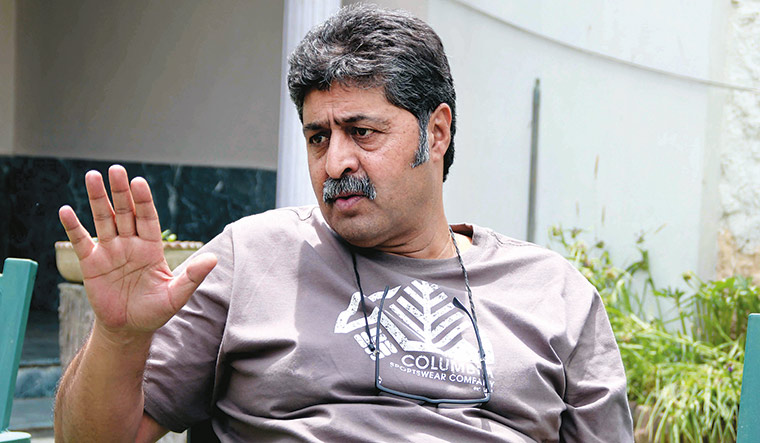
Bilal takes dig at brother Sajjad, joins mainstream to reclaim father’s legacy
Srinagar, July 19: Former separatist leader Bilal Gani Lone has openly criticized the Hurriyat Conference, holding the separatist alliance responsible for its current irrelevance and labeling it “non-functional.” He also accused Pakistan of creating a political and social mess in Jammu and Kashmir by promoting division instead of peace. In a candid reflection, Lone acknowledged that both the Hurriyat leadership and Pakistan missed crucial opportunities to bring positive change to the region.
Bilal Lone’s decision to transition into mainstream politics marks a significant ideological shift. He stated that his motivation comes from a deep concern for the younger generation, emphasizing that India is “too big a power” to confront. He urged youth to view India without political bias and to find their place within the broader national framework. According to him, the younger generation must be told the truth about the past 35 years, as “the politics of exploitation has to stop.”
In an exclusive interview, Lone underlined the Hurriyat’s fading presence, asserting that the alliance formed in 1993 has lost all relevance in the Valley. While he acknowledged that people once trusted the Hurriyat, he emphasized that today’s political realities have changed. He admitted that the concept behind the Hurriyat might have been meaningful in the past, but its inability to act has led to its failure.
Lone did not spare Pakistan from criticism either. He dismissed Islamabad’s claims and promises as hollow, stating that “nothing has come out” of their interventions. He said it is foolish to think Pakistan can take Kashmir by force, citing a recent 48-hour standoff at the border where no ground was lost or gained. For him, it is clear that the people of Kashmir must move forward—regardless of Pakistan’s role.
Expressing regret over missed opportunities, Lone admitted that the separatist movement could have achieved more for the people but failed due to poor decisions. His shift to mainstream politics, he said, is not about political ambition but a sincere desire to be part of a “genuine political process.” He explained that his decision is rooted in a need to give back to his community, adding that “it is payback time.”
Lone’s new political focus goes beyond just roads, water, and electricity. He aims to prioritize the education, healthcare, and entrepreneurship opportunities for the youth, who he described as the “biggest casualty of the conflict.” He believes violence has brought nothing but destruction and has “finished generations,” leaving Kashmiris at a disadvantage.
He called on Kashmiris to stop viewing India through the lens of parties like the BJP or Congress, and instead see the country for what it truly is. According to Lone, those who have tried to challenge India have failed, and it’s time to accept that truth. On the topic of Article 370, he said the abrogation may have been a “psychological blow” for Kashmiris, even though the provision had become politically hollow.
Although he expressed humility in saying he’s “too small a man” to advise Prime Minister Narendra Modi, he urged the central government to stop viewing Kashmir through the lens of vote-bank politics and instead work toward healing and inclusion. He emphasized that trust has been the biggest casualty in Kashmir and that reconciliation must begin—not just between nations but among people themselves.
Bilal Lone also stated that the political chapter ahead must be built on sincerity, especially with the younger generation that has little knowledge of past events. He clarified that his decision to join mainstream politics is driven by a desire to honor the “true legacy” of his father, Abdul Gani Lone, which he claims has been misrepresented, even within his own family. Without directly naming anyone, his remarks appeared to be a subtle critique of his brother, Sajjad Lone, a long-time mainstream politician. Bilal said they have taken different political paths since 2002 and urged his brother to build his politics on his own merit without exploiting their father’s ideology.
He recalled that the People’s Conference, the party founded by his father, ended with his father’s assassination on May 21, 2002. Bilal Lone emphasized that his own political path will be organic and free from opportunistic behavior. He vowed to pursue a politics of truth, stating he is not in the race for any political office such as MLA or Chief Minister, but rather committed to a slow, steady journey toward regaining public trust.
Even as he distanced himself from his former separatist colleagues, Lone maintained a respectful tone toward Mirwaiz Umar Farooq, calling him a leader of “great stature” and saying he would support him if he pursued a constructive political path. Lone reaffirmed that his political shift is meant to protect the youth, who have been the most affected by decades of conflict.
He concluded by stating that reconciliation between Kashmiri Muslims and Pandits is vital. Trust between the two communities must be restored, and a fresh start is essential. He said that if Kashmiri Pandits return to live in the Valley, their protection should come not from the state, but from the Muslim community itself. He called for sincere dialogue, truth, and accountability for past wrongs, and encouraged apologies where needed.
