

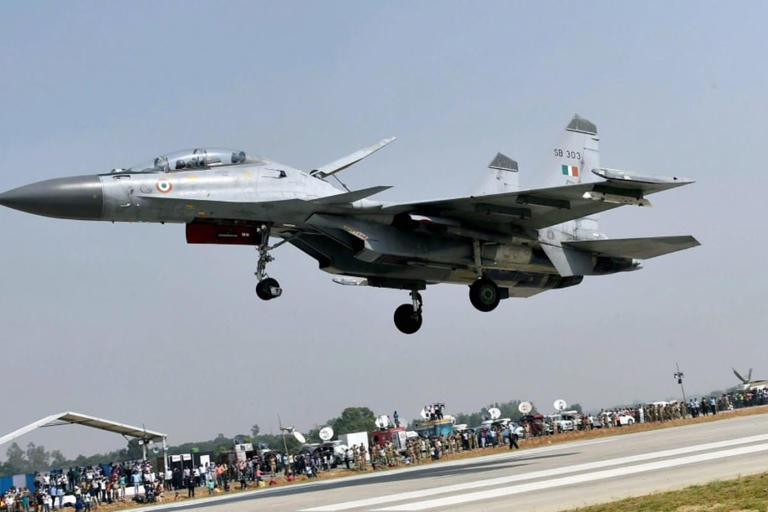
New Delhi, Jul 03: India’s air combat fleet is poised for a transformation as the government moves ahead with a comprehensive upgrade of the Su-30MKI fighter jets. Under the Super-30 program, 84 aircraft are slated for modernization over the next few years at a cost of Rs 66,829 crore, aiming to boost the Indian Air Force’s operational edge amid rising regional tensions.
Modern aerial warfare has evolved rapidly, shifting from troop-heavy battles to sophisticated, tech-driven campaigns. Precision strikes, drones, and networked radar systems are now central to warfare—a reality demonstrated not only in global conflicts but also during India’s Operation Sindoor.
Confronted with growing threats from both Pakistan and China, India is accelerating efforts to revamp its military capabilities. While expanding its fleet of indigenous Tejas jets and advancing plans for a fifth-generation fighter under the AMCA project, the upgrade of the Su-30MKI fleet stands as a pivotal move in strengthening the country’s aerial strike capabilities.
The Su-30MKI, a 4.5-generation aircraft originally developed with Russian collaboration, will receive a sweeping suite of enhancements. These include the integration of the domestically developed Virupaksha radar, a gallium nitride-based AESA radar capable of detecting targets up to 400 kilometres away. In addition, the aircraft’s cockpit will be entirely digitised, and it will be armed with new-generation missiles such as the Astra MK-2 and Astra MK-3 Gandiva—both capable of beyond-visual-range strikes.
These upgrades are aimed at resolving earlier vulnerabilities. During the 2019 Balakot air operation, Su-30MKIs were reportedly outmatched by Pakistan’s F-16s due to radar and missile range disadvantages. The Super-30 overhaul is designed to eliminate such gaps, allowing the Indian Air Force to better counter adversaries in any future confrontation.
With the upgraded fleet expected to remain in service until 2055, this move represents a critical pivot in India’s broader defense modernization roadmap. It not only extends the life and relevance of an already potent platform but also enhances the IAF’s ability to project power across contested skies.
As India presses forward with both imported upgrades and indigenous development, the Super-30 project emerges as a decisive chapter in the country’s evolving airpower narrative—where legacy platforms meet next-generation technology to prepare for tomorrow’s battles.
